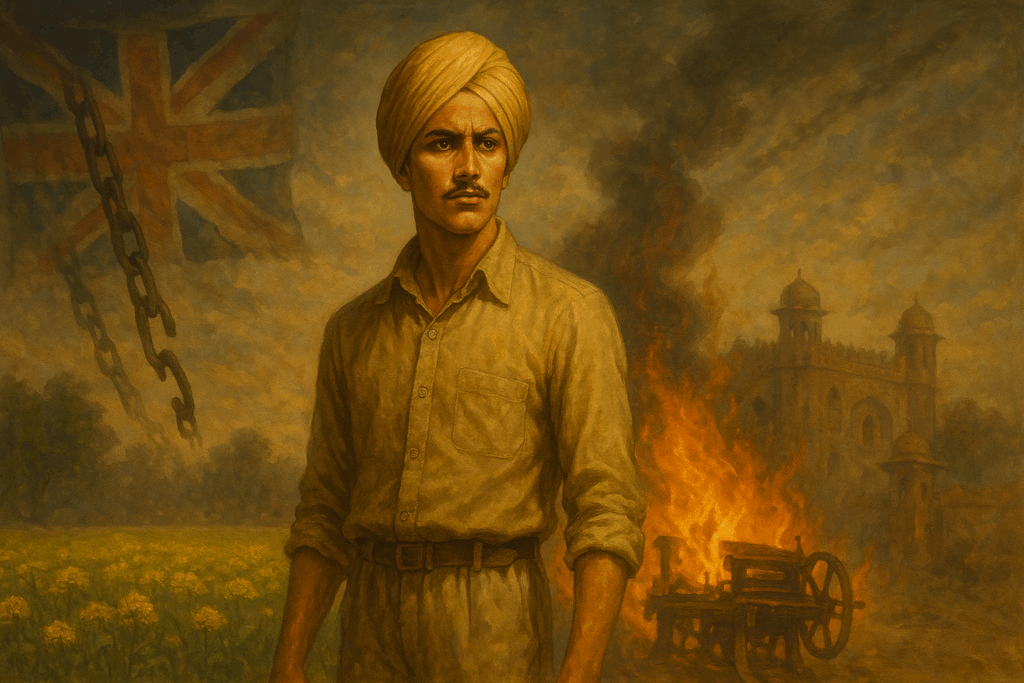
On a sun-drenched day of May 24, 1896, in the quaint village of Sarabha in Ludhiana district, Punjab, a boy was born who would go on to set the soul of India’s freedom movement ablaze. His name was Kartar Singh Sarabha. Though he died at the mere age of 19, his indomitable spirit, visionary zeal, and unshakable courage made him one of the most iconic revolutionaries of pre-independent India. Through the dust and shadows of our colonial past, Kartar Singh’s story emerges like a forgotten flame – a light too bright to be dimmed by time.
As the British Empire stood tall, unchallenged by most, it was boys like Kartar who dared to shake its very foundations. This is the story of a young revolutionary whose life was not just a timeline of events, but a compelling narrative of inspiration, grit, and ultimate sacrifice.
Roots in Punjab – The Making of Kartar Singh Sarabha
Born into a well-to-do Jat Sikh family, Kartar Singh was raised under the care of his grandfather after his father’s untimely death. Sarabha village, though small, had the air of resilience and pride that often pervades the rural heartland of Punjab. His early years were marked not by tales of kings and conquerors, but by the quiet heroism of farmers, community leaders, and the Sikh tradition of standing against injustice.
Even as a child, Kartar exhibited a spark that separated him from others. He was quick-witted, deeply curious, and fiercely independent. His schooling began at a local village pathshala, and soon he moved to Malwa Khalsa High School in Ludhiana. The school, though modest, exposed him to nationalistic ideas fermenting in the backdrop of British India’s tyranny.
An interesting anecdote from his school days reveals his early rebellious streak. Once, during a school inspection led by a British officer, Kartar Singh refused to greet the official with the customary bow. When scolded, he retorted, “I bow only before my Guru and my nation”. Though punished for his insolence, the incident etched his name in the minds of many peers who would later remember him not as a student, but as a revolutionary in the making.
His academic journey took a significant turn when he enrolled at Ravenshaw College in Cuttack, Odisha. It was here that Kartar’s perspective broadened beyond Punjab. The socio-political atmosphere in Odisha, where nationalist leaders like Gopabandhu Das were making waves, sowed deeper seeds of resistance in his heart. Kartar wasn’t merely a student of books; he was becoming a student of Bharat Mata’s silent cries for freedom.
The American Sojourn – Awakening in the Land of Liberty
In 1912, like many young Indians from affluent backgrounds, Kartar Singh sailed across the oceans to the United States of America. He landed in California with the dream of becoming a chemist and enrolled at the University of California, Berkeley. But destiny had other plans.
Berkeley, known for its liberal ideologies and student activism, became the crucible of Kartar’s revolutionary transformation. He encountered a racially hostile environment in the U.S., where Indian immigrants were treated with contempt and suspicion. The discrimination he faced ignited a realisation: colonialism didn’t just affect the Indian homeland – it haunted Indians everywhere.
It was during this period that Kartar Singh came into contact with the Ghadar Party – a revolutionary group formed by Indian expatriates determined to overthrow British rule in India. Inspired by their fiery speeches, radical writings, and commitment to direct action, Kartar quickly became one of the most active and youngest members of the movement.
Not content with simply being a foot soldier, Kartar took up the editorial responsibilities of the Ghadar newspaper, contributing articles in Urdu, Punjabi, and English. He even translated revolutionary content into Gurmukhi to spread the message among Indian soldiers and peasants. His writings were bold and unfiltered, calling upon Indians to rise against the British with arms if necessary.
One of his popular poems ended with the chilling yet stirring lines:
“Shaheedan di yaad vich Hamesha rahe Kartar Singh, Sarabha jive” (Kartar Singh Sarabha always lives by the code of honour and the memory of the martyrs!)
He became an expert in propaganda, networking, and the underground operations of the movement. Most remarkably, despite being a student and far from his homeland, Kartar Singh carried Bharat within his heart. He would often tell his peers, “It is not enough to dream of freedom. One must fight for it.”
Return of the Warrior – The Ghadar Mutiny Plan
The year was 1913. A wave of dissatisfaction was simmering in the hearts of Indian immigrants across North America. Far away from their homeland, these expatriates bore the pain of colonial exploitation and racial discrimination, especially in countries like the United States and Canada. Amidst this sea of unrest emerged a firebrand collective – The Ghadar Party. At the tender age of just 17, Kartar Singh Sarabha found himself swept into this storm of nationalism and revolution.
Kartar Singh, studying at the University of California, Berkeley, soon encountered fellow Indians, many of whom were working-class Punjabis. These men, frustrated by systemic racism and inspired by the global momentum for self-determination, wanted more than mere reform. They wanted complete independence from British rule. Kartar Singh’s brilliant intellect and passionate speeches quickly earned him the trust and admiration of leaders like Lala Hardayal and Sohan Singh Bhakna.
The Ghadar Party was officially launched in 1913 with its headquarters in San Francisco. It began publishing a weekly newspaper named ‘Ghadar’ printed in multiple languages such as Punjabi, Urdu, Hindi, Bengali, and English. The publication aimed to ignite revolutionary fervour among Indians worldwide. Kartar Singh not only wrote fiery articles but also managed the press, typeset the content, and ensured its distribution to global Indian communities. He became the voice of revolution.
One of the most moving anecdotes from this period is of Kartar Singh working all night at the printing press, drenched in sweat and ink, yet smiling with pride. When someone asked him why he never rested, he reportedly said, “This press is not a machine; it is my temple, and this ink is the blood of my soul.” His dedication made him an icon among the Ghadarites.
What set the Ghadar Movement apart was its fierce commitment to armed rebellion. The party prepared meticulously to smuggle arms, organise mutinies, and trigger a nationwide revolution. Their opportunity arrived during World War I, when the British Empire was deeply embroiled in Europe. Kartar Singh played a pivotal role in planning the return of Ghadarites to India to spark coordinated uprisings within the Indian Army.
He boarded a ship back to India in 1914, full of dreams and strategies. He knew the risks of death, betrayal, and failure, but nothing could dim the fire in his heart. As his ship neared Indian shores, he reportedly whispered to a fellow Ghadarite, “Even if I don’t return alive, make sure the tricolour one day flies over Delhi.”
The Trial – A Boy Who Defied the Empire in Chains
Upon his return to India in 1914, Kartar Singh Sarabha was not merely a student returning home, but he was a revolutionary returning to his battlefield. The British Empire, already stretched thin due to World War I, appeared vulnerable. For Kartar Singh, this was a once-in-a-lifetime opportunity to turn India’s dream of independence into reality.
Kartar Singh landed in Punjab and quickly began mobilising people, particularly disillusioned soldiers of the British Indian Army. He traversed villages, cities, and cantonments, spreading the Ghadar Party’s message with intense zeal. His youth and clarity of purpose had an electrifying effect. Within months, he had developed an underground network of revolutionaries across Punjab.
One of the most fascinating facets of this period was his infiltration into British military camps. Dressed in a soldier’s garb, Kartar Singh moved like a shadow through barracks and mess halls, speaking in hushed tones with sepoys, urging them to rise against their colonial masters. He spoke in their language – Punjabi, Hindustani, the language of pain and pride. Soldiers who had seen blood on foreign battlefields were now being asked to fight a righteous war at home.
In his speeches, he often quoted historical heroes and invoked the spirit of Bharat Mata. “We are not mere sons of the soil,” he once said in a secret meeting, “we are guardians of her honour. If we do not act now, we betray every drop of blood that fertilised this land.”
The plan was bold: a massive mutiny in the British Indian Army, synchronised across different regiments, primarily in Punjab and Bengal. The date was set for February 1915. Arms were procured, locations were chosen, and communication lines were established. The movement was on the brink of exploding.
But fate had other plans.
An insider, a police informant named Kirpal Singh, betrayed the cause. The British swiftly conducted raids and arrested many Ghadarites. Kartar Singh, undeterred, attempted to reorganise the revolt. He even travelled to Bihar and Calcutta, seeking new alliances and support. His resolve never wavered.
In one gripping moment of near escape, Kartar Singh disguised himself as a sadhu and walked through a British checkpoint carrying sacred texts. When asked about his destination, he calmly replied, “To cleanse the sins of a thousand years.” The guard laughed, oblivious to the firebrand revolutionary before him.
However, his luck finally ran out in March 1915. He was captured near Lahore while trying to regroup with fellow Ghadarites. Tortured, humiliated, and thrown into prison, Kartar Singh stood defiant. He refused to name accomplices and took full responsibility for his actions. His trial at the Lahore Conspiracy Case became the stage for his final act of rebellion.
Martyrdom and Immortality – Death Before Dishonour
Kartar Singh Sarabha’s trial in the (first) Lahore Conspiracy Case was less a judicial proceeding and more a theatre of political resistance. The British authorities wanted to make an example of him. Yet what they received was a young man of indomitable spirit who refused to bow even in chains.
Standing in court with shackles on his feet and fire in his eyes, Kartar Singh did not plead for mercy. When asked if he regretted his actions, he boldly declared, “If I am born again, I shall fight again, and I shall die again for the same cause.” His words echoed through the courtroom like a thunderclap.
The trial exposed the vast network of revolutionaries influenced by the Ghadar ideology. Despite the brutal torture inflicted upon him, Kartar Singh protected his comrades. One anecdote that remains etched in history is how he sang patriotic songs during his interrogations to mock his captors. When whipped, he would quote poetry from Bhai Gurdas and recite verses of courage from Guru Gobind Singh’s bani.
During the proceedings, Judge Rai Bahadur Gopal Das tried to reason with him: “You are too young to die. Think of your family. Your future.” Kartar Singh’s reply was chilling in its calm resolve: “The future of one man is nothing when weighed against the freedom of millions.”
He was only 19 when he was sentenced to death. On 16th November 1915, in the Lahore Central Jail, Kartar Singh Sarabha kissed the gallows like a groom embraces his beloved. He sang the lines of a poem he had composed:
“Shaheedan di hove sada vadiaee, Eh labh hai mahan jee ke mareya.”
(“May martyrs always be remembered in glory, this is the highest fortune—to die for a noble cause.”)
His execution left a vacuum, but also a blazing trail. His sacrifice resonated deeply with other revolutionaries. A young Bhagat Singh, then just eight years old, considered Kartar Singh his guru. He kept a photograph of Sarabha in his pocket and would often say, “He showed me the path.”
Kartar Singh’s legacy was not just of rebellion but of eternal courage. In that moment of martyrdom, he transcended mortality and became a symbol of selfless patriotism. His story was not taught in every school textbook, yet his fire lives in the hearts of all who dream of a free, just, and united India.
Epilogue: A Legacy Cast in Courage
Today, Kartar Singh Sarabha may not be as well-known as some of his contemporaries, but his contribution to India’s freedom movement is immeasurable. From a small village in Punjab to the prison cells of Lahore, his journey is a testament to how age, background, and resources do not define a revolutionary – courage does.
His memorial in Sarabha village stands as a silent sentinel, reminding every visitor of a young man who chose chains over comfort, gallows over glory, and death over dishonour.
If freedom has a soul, Kartar Singh Sarabha is one of its eternal flames.
Sources: