Table of Contents
On the 18th of June, 1576, the dusty plains of Haldighati in present-day Rajasthan witnessed one of the fiercest battles in Indian history. It was not just a clash of swords and spears but a confrontation of ideologies, honour, and defiance. The Battle of Haldighati pitted the brave Rajput warrior Maharana Pratap against the formidable Mughal army led by Raja Man Singh, a trusted general of Emperor Akbar. Over the centuries, this battle has been subjected to multiple interpretations, distortions, and outright misinformation, often coloured by ideological leanings and colonial influences.
Contrary to popular belief, the Battle of Haldighati was not a defeat for Maharana Pratap. While it is often portrayed by pseudo-liberal and leftist historians as a conclusive Mughal victory, a closer and more objective reading of historical sources reveals a stalemate. The Mughal objectives – namely, the complete subjugation of Mewar and the capture of Maharana Pratap – remained unfulfilled. Not only did Pratap escape, but within a few years, he had also regrouped and reclaimed much of his lost territory.
The Political Backdrop
The mid-16th century was a time when Emperor Akbar was aggressively expanding his empire across the Indian subcontinent. Many Rajput states had submitted to Mughal suzerainty, either voluntarily or under duress. However, Mewar, under Maharana Pratap, stood tall as a bastion of independence. Pratap refused to bow to the Mughal throne, declining all diplomatic overtures, marriage alliances, and treaties. This uncompromising stance made him a symbol of Rajput resistance and an enduring icon of Bharat’s civilizational grit.
Akbar, frustrated with Pratap’s defiance, dispatched a large force under the command of Raja Man Singh of Amber, himself a Rajput, to bring Mewar to heel. This was not just a military campaign; it was a statement meant to demoralise all pockets of resistance in the region. Akbar’s decision to send a Rajput commander was strategic – to avoid the appearance of a purely Islamic conquest over a Hindu kingdom, and to create fractures within the Rajput solidarity. But Maharana Pratap was unmoved.
What set Pratap apart was his belief in Swaraj (self-rule) and his refusal to serve an external imperial authority. Even in the face of material scarcity and military disadvantage, he maintained his position, earning the respect of not only his own people but also future generations.
The Terrain of Haldighati: Nature’s Shield of Resistance
The very name “Haldighati” comes from the turmeric-coloured (haldi) soil that characterises the region’s geography. But beneath its aesthetic appeal lies a rugged and complex terrain that played a significant strategic role in the Rajput resistance. Nestled within the Aravalli ranges, Haldighati is flanked by steep hills, narrow passes, rocky outcrops, and ravines, making it naturally defensible against large armies that relied on open-field manoeuvring.
Maharana Pratap, a master of guerrilla tactics and terrain warfare, used this knowledge to his advantage. The constricted terrain acted as a funnel, neutralising the numerical superiority of the Mughal forces. Large cavalry units found it difficult to maintain formation, and the effectiveness of Mughal artillery was drastically reduced due to limited mobility and sightlines. These hills had long served as natural fortresses for the people of Mewar, and during the battle, they became crucial platforms for ambushes and coordinated Rajput strikes.
Moreover, the monsoon season had turned parts of the valley marshy and unpredictable. Rajput soldiers, trained in local conditions and mounted on lightweight Marwari horses, moved nimbly across the landscape, while the heavily armoured Mughal troops struggled. Maharana Pratap’s familiarity with each pass and ridge allowed him to set up effective chokepoints and fallback positions, transforming a battlefield into a maze of resistance.
In many ways, Haldighati itself was a silent warrior. Its craggy cliffs, thick shrubbery, and undulating ridges stood shoulder-to-shoulder with the Rajput warriors. Geography here did not merely act as a backdrop; it became an ally in a war for independence.
The Battle: Strategy, Strength, and Sacrifice
The Mughal army, estimated to be around 80,000 strong, was a composite force made up of cavalry, infantry, and advanced artillery. On the other hand, Maharana Pratap’s force numbered barely 20,000, but it was fuelled by a fierce sense of duty, valour, and native knowledge of the rugged Aravalli terrain.
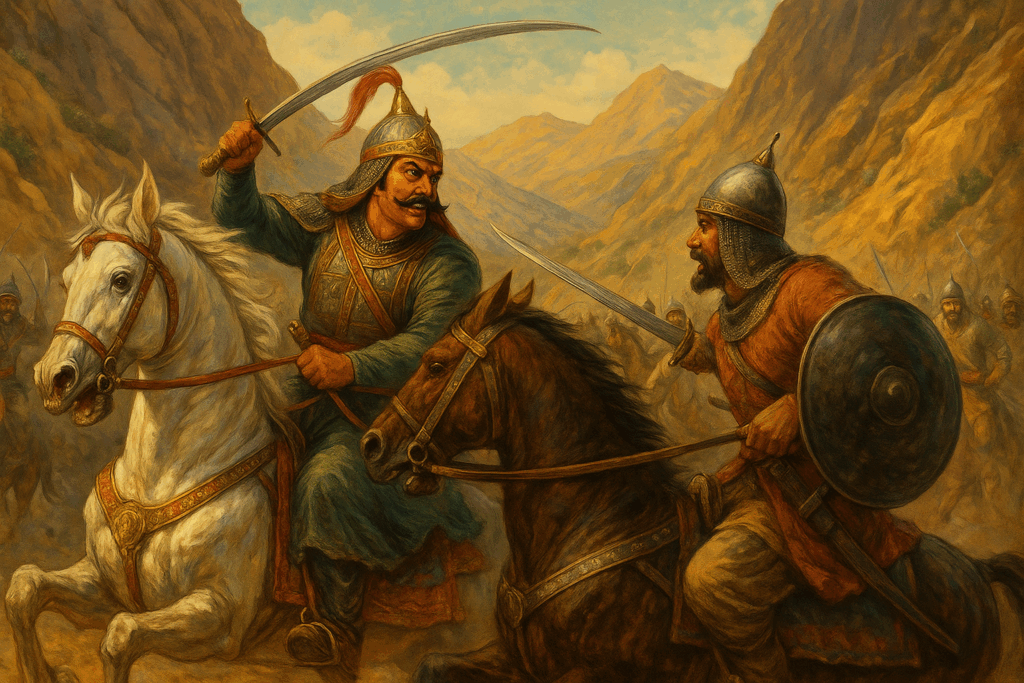
The battle commenced early in the morning and raged for several hours. Maharana Pratap, riding his loyal horse Chetak, displayed exceptional bravery, even managing to strike Raja Man Singh’s elephant directly. It was a psychological blow, though Man Singh survived the attack. The Rajputs used guerrilla tactics, hill warfare, and their superior knowledge of the terrain to neutralise the Mughal advantage in numbers.
Eventually, as the day wore on, the Mughals gained a slight tactical edge due to their sheer numbers and firepower. However, they failed to achieve their primary goals:
- Maharana Pratap was not captured
- Mewar was not annexed
- Rajput morale remained unbroken
Pratap’s retreat was strategic, not cowardly. He withdrew to the hills to preserve his army and fight another day, understanding that survival was key to resistance.
The terrain of Haldighati played a crucial role. The narrow mountain passes and hilly outcrops favoured the Rajput light cavalry. Chetak, who carried Pratap through the bloodiest segments of the battle, became a legend in his own right. Even mortally wounded, the horse leapt across a river to save his master. This act of loyalty and sacrifice remains etched in folklore and bardic poetry.
Unity in Diversity: The Bhils and Allied Communities in the Fight for Dharma
One of the most overlooked aspects of the Battle of Haldighati is the unifying role played by indigenous communities, particularly the Bhils, who fought shoulder-to-shoulder with Maharana Pratap. These forest-dwelling tribes had historically inhabited the Aravalli ranges and shared a profound relationship with the Rajput rulers of Mewar.
The Bhils were not merely passive supporters. They provided vital logistical support, acted as scouts, and even fought on the frontline. Their knowledge of forest paths, water sources, and hidden trails proved invaluable in both battle and the years of resistance that followed. It was this bond between the Rajput aristocracy and the tribal communities that made the Mewar resistance uniquely resilient.
Pratap’s reliance on Bhil warriors signified a radical departure from the feudal exclusivity of the time. He saw them as equal stakeholders in the fight for swaraj. Accounts from regional ballads and bardic chronicles often mention how Bhil archers rained arrows upon the advancing Mughal troops from hilltops, causing chaos in their ranks. Their unmatched skill in forest warfare compensated for the numerical and technological gap between the two sides.
Additionally, several other backwards and pastoral communities lent their strength to Pratap’s cause, united not by caste or creed, but by a shared dream of freedom. This unity defied the Mughal policy of divide-and-rule and forged a socio-military coalition that held strong for years.
This inclusive resistance presents an important lesson in Indian history – the fight against tyranny was never limited to kings and courtiers. It was a people’s movement where every caste, tribe, and class contributed.
The Post-Battle Scenario: A Testament to Resilience
While the Mughals claimed a tactical advantage, they did not consolidate any lasting control over Mewar. Akbar had to station garrisons in nearby towns, and Pratap continued to launch surprise attacks on them. Within a few years, he had recaptured several key territories.
Most notably, in 1582, six years after Haldighati, Maharana Pratap achieved a decisive victory at the Battle of Dewair (or Diver). This battle is often criminally overlooked in mainstream history narratives. In this campaign, Pratap’s forces annihilated the Mughal post at Dewair, forcing them to retreat from over 36 military outposts in the region. It marked a turning point in the Rajput-Mughal conflict and symbolised a complete Rajput resurgence in Mewar.
This battle, though lesser known, holds enormous significance. It showcased the long-term strategic success of Maharana Pratap’s approach. He not only preserved his sovereignty but also managed to rebuild Mewar’s administrative structure. He re-established his capital at Chavand and introduced reforms to revitalise the economy and strengthen local governance. His rule in the later years saw a resurgence of arts, architecture, and public works, all built upon the foundation of his military perseverance.
The Continued Resistance of Maharana Pratap: A Legacy Beyond Haldighati
The Battle of Haldighati was not the end; it was a beginning. Following the battle, Maharana Pratap adopted a scorched-earth policy and took refuge in the hills, refusing to surrender or sign any treaty with Akbar. Despite living under dire conditions and his family surviving on rotis made of grass and wild roots, Pratap never deviated from his goal: to free Mewar from Mughal dominance.
Over the years, he waged a persistent and dynamic guerrilla campaign, targeting Mughal outposts, disrupting supply chains, and reclaiming forts. His most notable triumph came in 1582 at the Battle of Dewair, where his forces completely dismantled the Mughal military presence in the region. This decisive victory was followed by the liberation of several strategic towns and villages.
Pratap then shifted his capital to Chavand, where he began the administrative and economic revival of Mewar. New water systems, fortifications, and public granaries were built, showcasing a ruler who balanced the sword with the plough. He minted his own coins, established new trade routes, and reinstituted temples that were destroyed during the conflict.
His life, though constantly under threat, was a portrait of discipline, devotion, and sacrifice. His sons and loyal generals continued the struggle, keeping the flame of resistance alive for decades.
Even after his passing in 1597, Maharana Pratap’s legacy inspired future generations. He was not merely a regional hero; he was a civilizational sentinel. His continued resistance symbolises the fact that true defeat lies not in battlefield losses but in moral surrender—and Pratap never surrendered.
Historiographical Distortion: The Role of Pseudo-Liberal and Leftist Historians
The legacy of the Battle of Haldighati has suffered at the hands of several historians who have either deliberately misrepresented facts or failed to explore indigenous sources. Colonial-era historians laid the groundwork by glorifying the Mughal Empire as a ‘civilising force’ in India, portraying native resistance as futile or regressive. This narrative was perpetuated post-Independence by Marxist and left-leaning historians, who often treated Rajput valour with a reductionist lens.
Rather than recognising the strategic brilliance and moral courage of Maharana Pratap, many textbooks present Haldighati as a defeat. This flawed portrayal undermines the civilizational significance of resistance against tyranny. Worse still, it ignores the Battle of Dewair, which was a textbook case of a victorious comeback – a theme celebrated globally but curiously sidelined in Indian discourse.
Academic gatekeeping and ideological bias led to the omission or downplaying of figures like Pratap, who did not conform to the ‘secular resistance’ model favoured by certain historiographical schools. In this model, only those who collaborated or negotiated were seen as pragmatists, while the defiant ones were considered impractical or regressive. Such a view is not just historically incorrect but intellectually dishonest.
Maharana Pratap: An Icon of Swaraj
Maharana Pratap’s refusal to bow before a foreign empire, his sacrifices (including a life in the forest with his family), and his military acumen make him one of the most honourable and inspirational figures in Indian history. He never compromised on the sovereignty of Mewar, despite immense pressure and hardship.
His story is not just one of military resilience but of moral leadership, strategic patience, and unshakeable commitment to Dharma and Desh.
He is often quoted in nationalistic and cultural discourses not merely as a warrior but as a civilizational symbol. His memory continues to inspire millions, especially in the modern era, where identity, sovereignty, and dharma are regaining importance in public consciousness. Statues, memorials, and literature across Rajasthan and beyond commemorate his life, but more importantly, his spirit.
Conclusion: Reclaiming the Historical Narrative
It is high time we reclaim our narratives from the clutches of distorted historiography. The Battle of Haldighati was not a story of Rajput defeat—it was a saga of defiance. The real failure was on the part of the Mughals, whose imperial ambitions were thwarted by a man far outnumbered but not outwilled. Maharana Pratap’s eventual triumph at Dewair reinforces the fact that truth, courage, and conviction can outlive empires.
In the current era of reclaiming civilizational pride and rewriting history with facts and fairness, the story of Haldighati and Dewair must be retold, not just for posterity but for inspiration. Historical justice demands that we honour not just victors on the battlefield but also those who never surrendered their ideals.
Let it be known: Maharana Pratap did not lose. Bharat did not kneel.