Table of Contents
The National Council of Educational Research and Training (NCERT), established in 1961, serves as a pivotal state-run body under India’s Ministry of Education. Its core mandate encompasses a broad spectrum of educational responsibilities, including undertaking, aiding, promoting, and coordinating research in school education, as well as preparing and publishing model textbooks for over 24,000 schools affiliated with the Central Board of Secondary Education (CBSE).
NCERT’s foundational objectives extend to developing and disseminating innovative educational techniques and acting as a central clearinghouse for educational information. Fundamentally, NCERT aims to design and support a common system of education that is national in character, while simultaneously fostering and respecting the diverse cultural practices across the country. The council’s motto, “life eternal through learning”, encapsulates its integrated approach to research, development, training, and extension.
From its very beginning, NCERT history textbooks were conceived to offer ‘secular’ and rational explanations of the past, aligning with the vision of figures like M.C. Chagla. The initial history textbooks, often referred to as “Set 1 books”, developed in the 1960s, were specifically crafted by professional historians to promote a ‘secular’ identity among learners, consistent with the prevailing Nehruvian ideology.
Despite its foundational principles, NCERT textbooks have consistently found themselves at the epicentre of ideological contention regarding the nation’s historical narrative. These textbooks are frequently accused of reflecting the political viewpoints of the party in power at the Centre. The enduring nature of this debate revolves primarily around accusations of a “leftist bias” in textbooks published before 2014 and alleged “saffronization” – the integration of Hindu nationalist perspectives – in the period from 2014 to the present. This persistent controversy highlights the dual function of school history: it not only transmits historical knowledge but also actively constructs and instils a shared national identity.
The content of educational textbooks in India is not merely an academic exercise; it is deeply intertwined with the prevailing political and ideological goals of the state. When the political landscape undergoes significant shifts, the historical narrative deemed appropriate for national identity formation often changes in tandem. This suggests that the revisions in NCERT textbooks are more than just academic corrections; they are integral to broader political and cultural projects aimed at shaping how future generations perceive their nation’s past and, by extension, their contemporary identity.
The contested terrain of Indian history education is therefore not solely about factual accuracy but fundamentally about the very definition and projection of “Indianness” in the collective consciousness. Moreover, the article explicitly highlights that controversies surrounding NCERT textbooks are not a recent phenomenon but have been a recurring feature “from the inception”, with notable periods of contention in 1969, the late 1970s, late 1990s, and post-2014.
This demonstrates a consistent pattern of ideological struggle over historical interpretation. This recurring pattern suggests that the current debate is part of a larger, ongoing struggle over historical narratives in India, rather than an isolated incident. It underscores the persistent tension between academic autonomy and political influence in curriculum development. The “contested terrain” is a permanent and evolving feature of Indian education, reflecting deeper societal divisions and competing visions of India’s past and future.
Part I: The Alleged Glorification of Mughals in Pre-2014 NCERT Textbooks
Prior to the more recent revisions, NCERT textbooks faced significant criticism for allegedly glorifying Mughal emperors and for not being sufficiently critical of certain Muslim invaders during the medieval period. The previous curricula were widely perceived to present a whitewashed version of history, particularly by downplaying the gory details of the Islamic conquests. This approach was sometimes justified as an effort to “help integrate religious minority learners into the nation”. The narrative often emphasised aspects such as ‘cultural contributions’ and the ‘tolerance’ of Mughal rulers, while elements considered “Mughal-era tyranny” were allegedly whitewashed.
Specific examples illustrate this perceived downplaying or omission:
- Babur: The Class 7 textbook, in its older version, described Babur primarily as an individual “forced to leave his ancestral throne, seize Kabul, and then Delhi and Agra”, largely omitting details of his more brutal actions. In stark contrast, the new Class 8 textbook now explicitly describes Babur as a “brutal and ruthless conqueror, slaughtering entire populations of cities, enslaving women and children, and taking pride in erecting ‘towers of skulls’ in plundered cities”.
- Akbar: While the new textbook acknowledges Akbar’s reign as a “blend of brutality and tolerance,” it now explicitly includes details such as his order for the massacre of 30,000 civilians during the seizure of the Chittor fort. Furthermore, the new textbook quotes Akbar’s victory message, which explicitly states: “We have succeeded in occupying a number of forts and towns belonging to infidels and have established Islam there. With the help of our bloodthirsty sword, we have erased signs of infidelity from their minds and have destroyed temples in those places and also all over Hindustan”. These specific details were largely absent or significantly downplayed in earlier versions of the textbooks.
- Aurangzeb: The revised textbooks provide detailed accounts of Aurangzeb’s controversial policies, including his issuance of farmans (edicts) to demolish schools and temples, specifically mentioning the destruction of prominent sites such as those at Banaras, Mathura, Somnath, as well as Jain temples and Sikh gurdwaras. The texts also speak of his persecution of Sufis and Zoroastrians. Earlier portrayals of Aurangzeb were often less critical, tending to emphasise political motivations for his actions over religious ones.
- General Omissions and Rationalisation: As part of a “rationalisation” effort, several pages referring to Delhi Sultanate rulers (such as the Mamluks, Tughlaqs, Khiljis, and Lodis) were deleted from the Class 7 history textbook. Additionally, a two-page table detailing the “milestones and achievements of the Mughal emperors” and a chapter titled ‘Kings and Chronicles: The Mughal Courts’ were removed from Class 7 and Class 12 history textbooks, respectively. This suggests that even the more positive or neutral aspects of Mughal rule were deemed less essential for inclusion, reinforcing the perception of a previous overemphasis.
The supporting information indicates that pre-2014 textbooks, often associated with a secular or “Nehruvian” ideology, intentionally downplayed Mughal brutalities. This “sanitisation” was reportedly done to help integrate religious minority learners into the nation, suggesting a deliberate choice to omit or soften negative aspects of Muslim rulers in pursuit of national unity. While aiming for social cohesion and national integration, this “secular” approach inadvertently created a historical narrative that was perceived as incomplete, biased, and even dishonest by a significant segment of the population.
This perception, in turn, fueled the demand for a “course correction” when a different ideological perspective gained political ascendancy. It highlights the inherent tension between promoting social harmony and presenting a comprehensive, unvarnished historical account, indicating that well-intentioned historical omissions can ultimately lead to a backlash and accusations of historical distortion.
The distinct shift from a “whitewashed” or “sanitised” Mughal history to one that explicitly emphasises brutality and religious motivations also directly corresponds with a change in the ruling government (post-2014, BJP-led NDA). This strong correlation suggests that historical narratives are not merely academic interpretations but are actively instrumentalised by political regimes to align with and reinforce their prevailing ideological agendas.
This reveals that both the “glorification” in the past and the “criticism” in the present are products of significant political influence on education. It raises critical questions about the objectivity and neutrality of history education in India, as it appears to be continually shaped by the dominant political discourse. This politicisation can lead to the presentation of a “skewed past” and contribute to “polarisation” within the country, as historical events are selectively highlighted or suppressed to serve contemporary political objectives.
The following table illustrates the evolution of Mughal portrayal in NCERT textbooks, highlighting the shift from alleged glorification to a more critical depiction:
Table 1: Evolution of Mughal Portrayal in NCERT Textbooks (Pre-2014 vs. Post-2014)
| Mughal Ruler/Aspect | Portrayal in Pre-2014 Textbooks (Alleged Glorification/Omission) | Portrayal in Post-2014 Textbooks (Emphasis on Brutality/Criticism) |
| Babur | Primarily as a displaced ruler, seizing Kabul, Delhi, Agra, focus on intellectual curiosity, appreciation of the arts. | Described as a “brutal and ruthless conqueror,” slaughtering populations, enslaving women/children, erecting “towers of skulls”. |
| Akbar | Emphasis on tolerance, cultural synthesis, and later leanings towards peace; details of brutalities are largely absent or downplayed. | Portrayed as a “blend of brutality and tolerance”; explicit mention of the Chittor massacre (30,000 civilians), enslavement, and a victory message detailing temple destruction and establishment of Islam by “bloodthirsty sword”. |
| Aurangzeb | Often emphasised political motivations for actions; less critical of religious policies. | Detailed accounts of issuing farmans to demolish schools and temples (Banaras, Mathura, Somnath, Jain, Sikh gurdwaras); persecution of Sufis and Zoroastrians; personal religious motives made clear. |
| Delhi Sultanate (General) | Significant coverage in Class 7; details of rulers like Mamluks, Tughlaqs, Khiljis, Lodis. | Several pages removed from Class 7 textbook; shifted to Class 8 with explicit focus on “religious intolerance,” “numerous attacks on sacred images,” and jiziya tax as public humiliation/conversion incentive. |
| Mughal Courts/Achievements | Two-page table detailing “milestones and achievements”; chapter ‘Kings and Chronicles: The Mughal Courts’ in Class 12. | Two-page table removed; Class 12 chapter on Mughal Courts removed. |
Part II: The Influence of “Leftist” Historiography on NCERT Curriculum
A prominent and influential group of historians, often identified as “Marxist” or “Leftist,” including figures such as Romila Thapar, Irfan Habib, Bipan Chandra, and R.S. Sharma, is understood to have exerted considerable influence over academic institutions and curriculum development for several decades. Romila Thapar, for instance, directly contributed to writing history textbooks for the Indian government in the 1960s, with a stated aim of providing “researched and rational explanations of the past”. Her academic approach was characterised by a refusal to “perpetuate pious myths or distorted colonial interpretations”.
These historians are broadly associated with a Marxist interpretation and a materialist framework, which sidelines religious, civilizational, or dharmic dimensions of Indian history. Their work was often aligned with the “Nehruvian ideology of the separation of religion from nationalism”, actively seeking to promote a “secular identity” for learners through the curriculum.
But Arun Shourie’s book, “The Eminent Historians: Their Technology, Their Line, Their Fraud”, serves as a forceful critique of these historians, presenting a “two-pronged attack” on their historical integrity. Shourie alleges that official historians at the Indian Council of Historical Research (ICHR), including the aforementioned figures, consumed millions of rupees in public funds with precious little output to show for it. Reviewers corroborate this, suggesting that these historians charge money in the name of so-called ‘honorary’ and they took so much money in the name of a project which they haven’t completed or even submitted any progress.
Shourie’s more central and severe accusation is the purposeful distortion of Indian history. He contends that these historians purposefully distorted Indian history by not mentioning the atrocities of Muslim invaders against Hindus and Buddhists. He supports this by citing accounts from court historians of Aurangzeb that detail the destruction of places of worship of the infidels, arguing against the official line that this was just to acquire booty. Conversely, they are accused of “inventing Hindu atrocities against Buddhists and Jains on the most tenuous evidence”.
Furthermore, Shourie criticises their promotion of the “Aryan invasion theory,” which he views as “flogging the dead horse of the Hindutva contention that Hinduism originated in India in times immemorial and there were no Aryan intrusions into the country”. A significant criticism is that Indian history was written from a “Delhi-centric or Delhi point of view”, leading to the neglect of rich regional histories and diverse dynasties. Specific examples cited include the limited coverage of the Cholas, Cheras, and Pandyas, and the omission of histories related to Nagpur, the Bhosale family, the Battle of Bhopal (where Baji Rao defeated the Mughals), Raja Bhoj, and Ahilya Bai.
Shourie also argues that these historians degrade our scriptures by saying all fault and “utter bullshit”. Belittling Hindu scriptures is their main purpose in the name of freedom of speech. They are accused of maintaining a monopoly on academia and, consequently, the thought process of an entire nation, using public institutions like the ICHR to propagate their ideology and impose their views on the common people.
Beyond Shourie, NCERT textbooks were criticised for not being sufficiently critical of certain Muslim invaders during the medieval period, and for emphasising the role of leaders like Tilak and Aurobindo in the development of Hindu-Muslim antagonisms. There were accusations of downplaying the gory details of the Islamic conquests to help integrate religious minority learners into the nation.
For instance, Islamic invasions were “often euphemised as political expansions, while temple destruction was justified as re-use of temple sites”. This approach, while defended by figures like Bipan Chandra as a “secular narrative” and a “vital safeguard against communal polarisation”, is criticised for leading to a “whitewashing of Mughal-era tyranny and an overemphasis on Islamic contributions to art, governance, and culture, while simultaneously marginalising the Indigenous. The recent NCERT revisions explicitly aim to counteract this by including a “note on the darker chapters of history”.
The criticisms levelled against these historians extend beyond mere factual inaccuracies to their fundamental “Marxist interpretation”, “materialist frameworks”, and “Nehruvian ideology”. This indicates that historical writing in India is rarely a neutral academic exercise; rather, it is profoundly shaped by underlying ideological lenses. The “secular” narrative, while aiming for national integration, is seen by critics as a specific ideological choice that led to selective historical representation. This highlights that the ongoing debate is fundamentally about which ideological framework should govern the understanding and teaching of India’s past.
The “Leftist” approach prioritised a composite national identity and secularism, potentially at the cost of detailing communal violence or religious motivations, whereas the “Hindutva” perspective seeks to foreground indigenous resistance and the perceived “dark periods” of foreign rule. This underscores that history is not just a collection of objective facts, but a contested narrative, reflecting deeper power struggles over national identity and cultural memory.
Shourie’s book alleges “academic feudalism” and a “monopoly on academia” by these historians, suggesting that their influential academic positions were leveraged to propagate a specific ideology through textbooks. This was seemingly reinforced by political patronage, such as the perceived support of the Congress government for a “Mughal-centric” narrative, as alleged by groups like Hindu Janajagruti Samiti. The current curriculum changes are a direct consequence of a new political dispensation gaining power.
This reveals a complex and dynamic ecosystem where academic institutions, political parties, and public sentiment constantly interact and challenge each other in shaping the historical narrative taught to students. It implies that control over educational content is a significant lever of power in shaping national consciousness, and that sustained public dissatisfaction, as expressed by various Hindu organisations, can eventually translate into policy changes when the political climate is favourable. This process demonstrates how historical narratives are not static but are continually renegotiated within a broader socio-political context.
Part III: The Overlooked and Vilified Heroes of Indian History
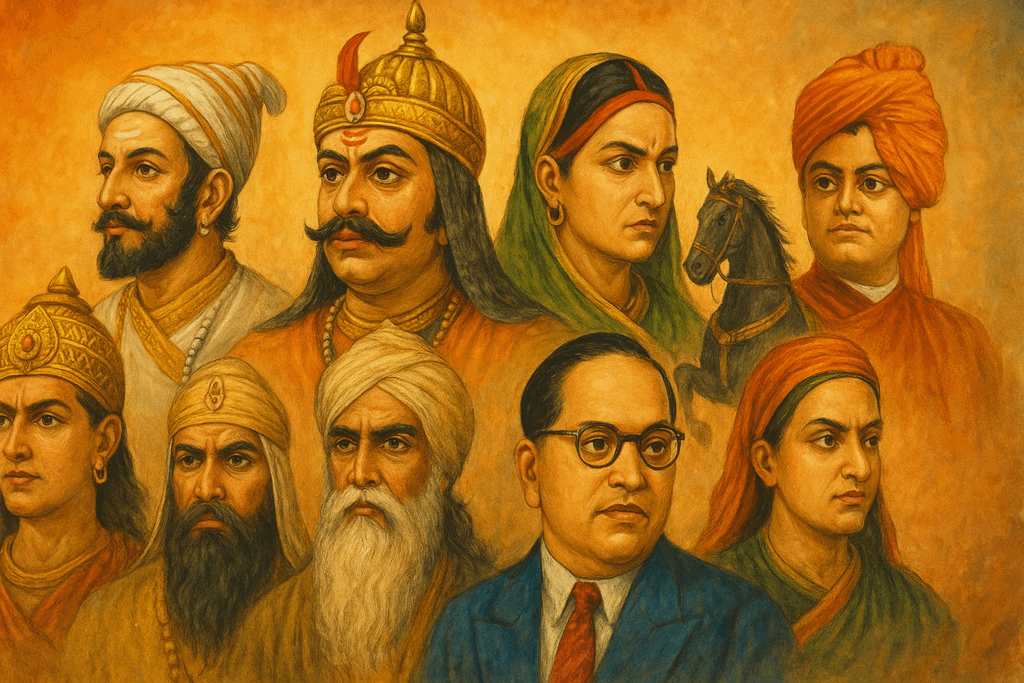
The pre-2014 NCERT textbooks were criticised for ignoring Hindu kings while simultaneously glorifying Mughal emperors. Specific complaints highlighted that the history of Chhatrapati Shivaji Maharaj was reportedly covered in just 6 lines in NCERT textbooks, and Maharana Pratap received only a passing mention, whereas the history of Mughal invaders occupied page after page. Hindu organisations, including Shiv Sena and Hindu Janajagruti Samiti, had long agitated for revisions, pointing out the absence of images of Shivaji while photos of atrocious, tyrannical Muslim kings, Babar and his descendants, were featured.
Arun Shourie’s critique further supports this by highlighting the Delhi-centric nature of historical writing, which led to the neglect of various regional dynasties and figures. He cites examples such as the limited coverage of the Cholas, Cheras, and Pandyas, and the omission of the Bhosale family (associated with the Marathas), Raja Bhoj, Ahilya Bai, and significant events like the Battle of Bhopal, where Baji Rao defeated the Mughal Empire. This directly substantiates the user’s assertion regarding overlooked heroes.
In contrast, the newly introduced Class 8 NCERT social science textbook now includes a dedicated section on heroic resistance to the Mughals. This includes significantly expanded coverage of:
- Maharana Pratap: His escape from Mewar and resistance against Akbar are now explicitly included. The new textbook makes claims that he did not succumb to Mughal authority. Notably, the Union Home Minister had previously urged historians to re-evaluate his contributions, questioning why he was not referred to as “the Great” like Akbar.
- Marathas (Chhatrapati Shivaji Maharaj): The chapter on the Marathas has been substantially expanded from a mere 1.5 pages to 22 pages, commencing with Shivaji’s rise in the 17th century and his coronation at Raigad Fort. Information on Shivaji was added to the Class 7 history textbook following widespread criticism. The inclusion of Shivaji Maharaj is explicitly celebrated as a “success of Hindu organisations”.
- Sikh Gurus (Guru Tegh Bahadur, Guru Gobind Singh Ji): The Sikh chapter now comprehensively traces the community’s evolution from a spiritual movement under Guru Nanak to militarised resistance under Guru Gobind Singh. It highlights how Sikh Gurus “stood against Mughal persecution”, explicitly mentioning the execution of Guru Tegh Bahadur. Historical sources like Niccolao Manucci’s
Storia do Mogor and Maasir-i-Alamgiri are cited as documenting Aurangzeb’s persecution of Sikhs. - Other Resistance Movements: New sections have been added detailing the resistance of Jat peasants (who killed a Mughal officer), various tribal communities (Bhil, Gond, Santhal, and Koch) who fought to protect their territories, and Rani Durgavati of the Gond kingdom, who resisted Akbar. The resistance of the Ahoms to Aurangzeb’s army in northeastern India is also now covered.
- Broader Regional Powers: The new textbook features “detailed chapters on the Sikh and Maratha empires, which were previously limited to a few pages or passing references”. It also provides enhanced context for well-known Rajput rulers such as Rana Kumbha and Maharana Pratap, portraying them not just as warriors but as figures of strategic importance. The Vijayanagara Empire also receives in-depth treatment, including its economic policies, temple architecture, and resistance to Turkic invasions.
The perceived past neglect of these indigenous heroes, especially in contrast to the extensive coverage of Mughals, is interpreted as a deliberate act of “hiding the true (glorious) history of India.” The current revisions are therefore not merely about correcting historical omissions but are actively engaged in constructing a new pantheon of national heroes.
This serves to bolster a specific nationalist narrative, fostering a sense of pride and historical continuity rooted in indigenous resistance against foreign rule. This ideological shift highlights that the selection and emphasis of “heroes” in textbooks is a political act that profoundly shapes collective memory and national identity, often simplifying complex historical interactions into a binary of “heroes” and “villains.”
The snippets explicitly state that the increased coverage and positive portrayal of figures like Shivaji and Maharana Pratap were a direct result of “criticism” and “agitations” by Hindu organisations such as Shiv Sena and Hindu Janajagruti Samiti.12 The Union Home Minister’s public statement on Maharana Pratap also preceded his enhanced inclusion in the curriculum.
This demonstrates that curriculum changes in India are not solely determined by academic consensus or pedagogical principles but are significantly influenced by sustained public advocacy and the political will of the ruling government. It underscores the often contentious, yet ultimately responsive, nature of shaping educational content in a diverse society, where various groups actively vie for their historical interpretations to be recognised, validated, and taught within the national curriculum.
The following table contrasts the representation of key Indian heroes and resistance movements in NCERT textbooks before and after the recent revisions:
Table 2: Representation of Indian Heroes in NCERT Textbooks (Pre-2014 vs. Post-2014)
| Indian Hero/Movement | Portrayal in Pre-2014 Textbooks (Limited/Negative Coverage) | Portrayal in Post-2014 Textbooks (Expanded/Positive Coverage) |
| Chhatrapati Shivaji Maharaj | “Just 6 lines” of coverage; often ignored; no pictures. | Chapter expanded to 22 pages, beginning with his rise and coronation; explicit inclusion in Class 7; celebrated as a success of Hindu organisations. |
| Chhatrapati Sambhaji Maharaj | Limited or no explicit mention. | Included in the new curriculum alongside Shivaji Maharaj. |
| Bajirao Peshwa | Limited or no explicit mention; Battle of Bhopal (where he defeated Mughals) omitted. | Increased focus on the Maratha Empire. |
| Maharana Sanga | Limited or no explicit mention. | Increased focus on Rajput resistance. |
| Maharana Pratap | “Passing mention”; criticised for not being called “the Great”; perceived as ignored. | Explicit section on his escape & resistance, portrayed as not giving in to Mughal authority; re-evaluation encouraged by the government. |
| Guru Teg Bahadur | Limited coverage; persecution by Mughals often downplayed. | Explicit mention of his execution by the Mughals for opposing forced conversions. |
| Guru Gobind Singh Ji | Limited coverage; militarised resistance downplayed. | Detailed tracing of Sikhism’s rise to militarised resistance under him, culminating in the Khalsa formation. |
| Banda Singh Bahadur | Limited or no explicit mention. | Increased focus on Sikh resistance. |
| Harisingh Nalwa | Limited or no explicit mention. | Increased focus on the Sikh Empire and its figures. |
| Maratha Empire (General) | “Only 1.5 pages long”. | Expanded to 22 pages; detailed views on Maratha leaders. |
| Sikh Empire (General) | Limited to a few pages or passing references. | Detailed chapters on its rise, resistance to the Mughals, and unified empire under Maharaja Ranjit Singh. |
| Rajput Rulers (General) | Limited context; often not presented as figures of strategic importance. | Provides context to Rana Kumbha & Maharana Pratap as strategic figures during shifting power dynamics. |
| Tribal Communities (Jat, Bhil, Gond, Santhal, Koch), Rani Durgavati, Ahoms | Largely overlooked or ignored. | New sections added on their heroic resistance to the Mughals, including specific instances of fighting to protect territories. |
Part IV: Contemporary Sources Documenting Mughal and Delhi Sultanate Brutality
Contemporary sources, which include court chronicles, official histories, and travelogues, offer invaluable first-hand insights into the periods they describe. These documents provide direct evidence of events, policies, and societal conditions from the perspective of those who lived through or closely recorded them. However, it is crucial to approach these sources with an understanding of their inherent biases.
Court chronicles, for instance, were often commissioned by rulers and thus might contain “nauseating flattery” and attribute undeserved credit to emperors, though they are generally considered not to have “falsified” core facts. European accounts, while offering an external perspective, could also be influenced by their own cultural or political agendas (e.g., British historians portraying Aurangzeb as barbaric to make colonial rule appear more civilised). Historians like Ziya-ud-Din Barani, despite being dismissed by some secular historians as a “bigoted theologian”, are increasingly recognised as fine historians whose works provide critical insights into the political and social dynamics of their time.
The existence of a diverse array of contemporary sources – including Persian court chronicles, Mughal autobiographies, European travelogues, and accounts by independent Muslim historians – each offering distinct perspectives and biases, highlights the inherent complexity of historical inquiry. For example, while Ain-i-Akbari generally portrays Akbar’s tolerance, the new NCERT textbook uses his own victory message to reveal a more brutal aspect. Similarly, European accounts, while valuable, may carry their own colonial biases.
This multiplicity underscores the profound challenge of constructing a national historical narrative that is both comprehensive and balanced. A truly comprehensive history necessitates synthesising these diverse, sometimes contradictory, accounts rather than relying on a single, simplified narrative. The recent NCERT changes, by explicitly incorporating complexities and darker chapters, represent an attempt to move towards this more multi-faceted understanding, albeit from a specific ideological vantage point that prioritises previously downplayed aspects.
The snippets reveal that detailed accounts of historical brutalities, such as temple destruction, massacres, and forced conversions, are not merely academic points of discussion but are deeply emotive issues that continue to fuel contemporary debates, public protests, and even inter-community tensions and violence (e.g., the controversy surrounding Aurangzeb’s grave).
The justification for some modern violence is explicitly linked to claims of past massacres against Hindus by Muslim rulers. This demonstrates that historical narratives, particularly those concerning religious conflict and violence, have a profound and active impact on present-day social and political dynamics. The demand for a true or unvarnished history is often driven by a desire to acknowledge past suffering, to validate collective memory, and to shape contemporary identity and inter-community relations.
The following table provides a detailed list of contemporary sources that document the brutality of Mughal and Delhi Sultanate rulers, offering direct evidence of their actions and policies:
Table 3: Key Contemporary Sources on Mughal and Delhi Sultanate Brutality
| Source Title/Author | Type of Source | Ruler & Timelines | Specific Brutality/Policies Documented |
| Maasir-i-Alamgiri (Saqi Mustad Khan) | Mughal Court Chronicle | Aurangzeb (1658-1707) | Execution of Guru Tegh Bahadur (1675) for opposing forced conversions; orders for demolition of schools and temples (Banaras, Mathura, Somnath, Jain, Sikh gurdwaras); mutilation of “Idol-Bamian”. |
| Muntakhab-ul-Lubab (Khafi Khan) | Contemporary Mughal Historian | Aurangzeb | Details of Aurangzeb’s “strict Islamic policies” and efforts to enforce Sharia law. |
| Baburnama (Babur) | Autobiography | Babur (1483-1530) | Describes him as a “brutal and ruthless conqueror,” slaughtering populations, enslaving women and children, and erecting “towers of skulls”. |
| Ain-i-Akbari (Abul Fazl) | Administrative Document/Records | Akbar (1556-1605) | Quotes Akbar’s victory message after the Chittor massacre, detailing the establishment of Islam by “bloodthirsty sword,” erasure of “signs of infidelity,” and destruction of temples. |
| Jean-Baptiste Tavernier | French Traveller’s Account | 17th Century (Mughal rule under Aurangzeb) | Mentions Mughal treatment of Sikhs and Hindus under Aurangzeb, describing instances of religious intolerance. |
| Niccolao Manucci: Storia do Mogor | Italian Traveller’s Account | 1653-1708 (Mughal rule under Aurangzeb) | Describes “brutal measures taken by Aurangzeb against non-Muslims, including Sikhs”; references widespread “oppression” and “torture”. |
| Alexander Dow | British Historian | 18th Century (Mughal history) | References the “persecution of Sikh Gurus and their followers” under Mughal rule. |
| Ziya-ud-Din Barani: Tarikh-i-Firuz Shahi | Contemporary History/Chronicle | Mid-14th Century (Delhi Sultans: Balban, Ala-ud-Din Khalji, Muhammad bin Tughluq) | Detailed accounts of “genocidal massacres”; opponents “brutally killed in large numbers”; captured individuals “massacred in cold blood”; women and children imprisoned, enslaved, harmed, killed, and raped. |
| Amir Khusrau, Izz-ud-Din Isami, Ibn Batuta | Contemporary Histories and Travelogues | Delhi Sultanate (1206-1526) | Provide “specific evidence of political violence and massacres”. |
| Ghulam Hussain Khan: Siyar-ul-Mutakhkhirin | Contemporary Muslim Historian | Mughal period (rise of Sikh militancy) | Discusses the “rise of Sikh militancy in response to Mughal oppression and forced conversions”. |
Conclusion: Rebalancing the Historical Narrative and Future Directions
This article has meticulously demonstrated that pre-2014 NCERT textbooks were indeed subject to significant criticism for a perceived glorification of Mughal rulers. This portrayal often downplayed their violent conquests, instances of religious intolerance, and the suffering inflicted upon indigenous populations. This narrative was largely attributed to a dominant historiographical school, frequently labelled “Leftist” or “Marxist,” which, as analysed, prioritised secular integration and materialist interpretations of history.
As critically articulated by Arun Shourie in “The Eminent Historians,” this approach allegedly resulted in a “Delhi-centric” historical narrative that led to the neglect, marginalisation, or even vilification of significant indigenous Indian heroes and the rich tapestry of regional histories.
The recent revisions in NCERT textbooks, particularly those introduced for the 2025-26 academic year, mark a significant departure from previous curricula. These changes explicitly incorporate the darker chapters of history, including detailed accounts of Mughal brutalities, such as Babur’s “towers of skulls,” Akbar’s massacre at Chittor, and Aurangzeb’s temple demolitions.
Concurrently, there is a substantial increase in the coverage of previously overlooked Indian heroes and resistance movements. Figures like Chhatrapati Shivaji Maharaj, Maharana Pratap, and the Sikh Gurus, along with Maratha, Sikh, and Rajput empires and various tribal resistances, now receive more comprehensive and prominent treatment, providing a more balanced account of indigenous contributions and resistance against foreign rule.
These changes are largely presented by their proponents as a “necessary correction” to a narrative that was perceived to have glorified invaders and suppressed the true history of Indian resistance.
While supporters of the recent revisions view them as a crucial step towards factual accuracy and the promotion of a more “Indian history”, a few critics express profound concern. They argue that this new framing could instigate and sow hatred in young students, reducing complex historical figures to mere heroes and villains, and is primarily driven by a “political agenda” rather than academic rigour.
The ongoing debate highlights the inherent tension between presenting historical accuracy, fostering national pride, and upholding educational responsibility in a diverse society. It underscores that history education in India remains a deeply contested terrain for ideological struggles, with the curriculum perpetually vulnerable to political influence and capture. Given the contentious nature of these historical narratives, the importance of encouraging students to refer to multiple sources and develop critical thinking skills remains paramount for a nuanced understanding of the past.
The current efforts to rectify past glorification by explicitly detailing Mughal brutalities, while seemingly a direct response to perceived historical omissions, carry a specific challenge. This correction itself is viewed by some critics as a “dangerous oversimplification and falsification of history,” potentially reducing complex historical figures and periods to simplistic binaries of “heroes and villains”. This suggests that attempts to rebalance history, especially when driven by a strong ideological stance, can inadvertently introduce new forms of bias or overemphasis, shifting the narrative pendulum rather than achieving true neutrality. This points to a deeper, systemic challenge in historical education: how to present a nuanced, multi-faceted past that acknowledges uncomfortable truths without either sanitising them or, conversely, instigating communal divisions.
The “rebalancing” itself becomes a new point of contention, demonstrating the complex and ongoing negotiation of historical memory in a diverse and politically charged society.
Prominent Sources:
- Mughals, RSS, evolution: Outrage as India edits school textbooks – Al Jazeera, accessed July 23, 2025, https://www.aljazeera.com/news/2023/4/14/mughals-rss-evolution-outrage-as-india-edits-school-textbooks
- Objectives of NCERT – PIB, accessed July 23, 2025, https://www.pib.gov.in/newsite/PrintRelease.aspx?relid=132676
- National Council of Educational Research and Training – Wikipedia, accessed July 23, 2025, https://en.wikipedia.org/wiki/National_Council_of_Educational_Research_and_Training
- NCERT textbook controversies – Wikipedia, accessed July 23, 2025, https://en.wikipedia.org/wiki/NCERT_textbook_controversies
- The History Debate and School Textbooks in India: a Personal Memoir – ResearchGate, accessed July 23, 2025, https://www.researchgate.net/publication/31180888_The_History_Debate_and_School_Textbooks_in_India_a_Personal_Memoir
- Facts or Fables? The NCERT Textbook Debate India Can’t Ignore – TwoCircles.net, accessed July 23, 2025, https://twocircles.net/2025jul21/452264.html
- The debate between secularism and Hindu nationalism – how India’s textbooks have become the government’s medium for political communication – UCL Discovery, accessed July 23, 2025, https://discovery.ucl.ac.uk/10148572/1/The%20debate%20between%20secularism%20and%20Hindu%20nationalism%20how%20India%20s%20textbooks%20have%20become%20the%20government%20s%20medium%20for%20political%20communication.pdf
- Full article: The debate between secularism and Hindu nationalism – how India’s textbooks have become the government’s medium for political communication, accessed July 23, 2025, https://www.tandfonline.com/doi/full/10.1080/14736489.2021.2018203
- Reclaiming the Roots: Challenging Marxist Control of Indian History – Hindu Dvesha, accessed July 23, 2025, https://stophindudvesha.org/reclaiming-the-roots-challenging-marxist-control-of-indian-history/
- Who Writes History? Romila Thapar and the Textbooks of India …, accessed July 23, 2025, https://blogs.loc.gov/kluge/2015/03/who-writes-history/
- Bipan Chandra: Defence of History | Economic and Political Weekly, accessed July 23, 2025, https://www.epw.in/journal/2016/21/commentary/bipan-chandra-defence-history.html
- Maharana Pratap Now Also a Part of New NCERT History Textbooks – The Wire, accessed July 23, 2025, https://m.thewire.in/article/news/maharana-pratap-now-also-a-part-of-new-ncert-history-textbooks/item/1
- Inclusion of Shivaji Maharaj, Maharana Pratap in ‘NCERT’ books is a success of Hindu organisations, accessed July 23, 2025, https://www.hindujagruti.org/news/108479.html
- NCERT’s ‘Brutal’ Mughals Textbook Revision Ignites Political Firestorm – YouTube, accessed July 23, 2025, https://www.youtube.com/watch?v=ke_KUZk1Z5w
- NCERT flags ‘brutality’ of Mughals, but conditions apply. About the major changes made to class 8 social science textbook – BusinessToday, accessed July 23, 2025, https://www.businesstoday.in/education/story/ncert-flags-brutality-of-mughals-but-conditions-apply-about-the-major-changes-made-to-class-8-social-science-textbook-484814-2025-07-16
- New NCERT textbook features ‘complexities’ of Mughal rulers …, accessed July 23, 2025, https://www.thehindu.com/education/new-class-8-ncert-textbook-features-complexities-of-mughal-rulers-akbar-reign/article69815953.ece
- Aurangzeb: Religious Bigot or Political Ruler? Historians Debate Emperor’s Legacy | News Today – YouTube, accessed July 23, 2025, https://www.youtube.com/watch?v=6ExXAj9Od0A
- Erasing the Past – AHA – American Historical Association, accessed July 23, 2025, https://www.historians.org/perspectives-article/erasing-the-past-the-indian-governments-dishonest-history-january-2024/
- Revised NCERT textbooks that reflect on the atrocities of Mughal rulers trigger AIMPLB, and Leftist ‘historians’ – OpIndia, accessed July 23, 2025, https://www.opindia.com/2025/07/revised-ncert-books-atrocities-of-mughals-triggers-aimplb-leftists-historians/
- History textbooks: Our own theatre of the absurd – Deccan Herald, accessed July 23, 2025, https://www.deccanherald.com/opinion/history-textbooks-our-own-theatre-of-the-absurd-3638790
- NCERT History Row: Course Correction or Villainizing the Mughals? – YouTube, accessed July 23, 2025, https://www.youtube.com/watch?v=L8TroLz43b8
- How Aurangzeb Destroyed Temples, Hounded Sikhs | Arunachal’s Anti-Conversion Move | Get Me Right – YouTube, accessed July 23, 2025, https://www.youtube.com/watch?v=G1WsYyCjfPw
- How Aurangzeb Destroyed Temples | Get Me Right With Abhishek Kapoor – YouTube, accessed July 23, 2025, https://www.youtube.com/watch?v=TfLFXLEuAJQ
- Eminent Historians: Their Technology, Their Line, Their Fraud by …, accessed July 23, 2025, https://www.goodreads.com/book/show/651154
- Latest Review of Eminent Historians Their Technology Line Fraud | Price in India – Flipkart, accessed July 23, 2025, https://www.flipkart.com/eminent-historians-their-technology-line-fraud/product-reviews/itmeytznrckbgxrh?pid=9789351365914&lid=LSTBOK9789351365914VLQJHZ&marketplace=FLIPKART
- Genocidal Massacres in Medieval India (Chapter 21) – Cambridge University Press, accessed July 23, 2025, https://www.cambridge.org/core/books/cambridge-world-history-of-genocide/genocidal-massacres-in-medieval-india/FF494B522FF6CE383CAADA31B40DF1BB
- NCERT’s New History: Dark Past of Mughals, Brutality Of Akbar Revealed | India Today, accessed July 23, 2025, https://www.youtube.com/watch?v=92om1ZTmzLo
- History must be taught through many lenses – Newslaundry, accessed July 23, 2025, https://www.newslaundry.com/2025/07/17/history-must-be-taught-through-many-lenses
- Punjab: NCERT’s new class 8 textbook brings Sikh history to the fore …, accessed July 23, 2025, https://www.hindustantimes.com/cities/chandigarh-news/punjab-ncert-s-new-class-8-textbook-brings-sikh-history-to-the-fore-101752780205275.html
- Is there any sources that states Mughal converted Sikhs forcefully? Prefer non Sikh sources – Reddit, accessed July 23, 2025, https://www.reddit.com/r/Sikh/comments/1itiv48/is_there_any_sources_that_states_mughal_converted/
- MAASIR-I-‘ALAMGIRI – DSpace@GIPE, accessed July 23, 2025, https://dspace.gipe.ac.in/xmlui/bitstream/handle/10973/19784/GIPE-108534-Contents.pdf?sequence=2&isAllowed=y
- The great Aurangzeb is everybody’s least favourite Mughal | Aeon Essays, accessed July 23, 2025, https://aeon.co/essays/the-great-aurangzeb-is-everybodys-least-favourite-mughal
- Indo-Persian historiography: Ziya-ud-Din Barani and his Tarikh-i Firuzshahi, accessed July 23, 2025, http://itihasnama.blogspot.com/2019/02/indo-persian-historiography-ziya-ud-din.html
- Why 17th-century emperor Aurangzeb’s grave is India’s latest flashpoint – Al Jazeera, accessed July 23, 2025, https://www.aljazeera.com/features/2025/3/19/why-17th-century-emperor-aurangzebs-grave-is-indias-latest-flashpoint
- A Geographical Study of Temple Desecration: The Reign of Emperor Aurangzeb in India, accessed July 23, 2025, https://www.researchgate.net/publication/366590198_A_Geographical_Study_of_Temple_Desecration_The_Reign_of_Emperor_Aurangzeb_in_India
- Storia do Mogor; or, Mogul India 1653-1708;, accessed July 23, 2025, https://archive.org/download/storiadomogororm03manuuoft/storiadomogororm03manuuoft.pdf
- Democratic Newsroom: History Rewritten in NCERT Books? Mughals Called ‘Brutal’, Debate Erupts – YouTube, accessed July 23, 2025, https://www.youtube.com/watch?v=JcXQI6XU7ew
- Storia do mogor (or) Mogul India 1653-1708 : Manucci, Niccolao : Free Download, Borrow, and Streaming – Internet Archive, accessed July 23, 2025, https://archive.org/details/dli.csl.7492