Table of Contents
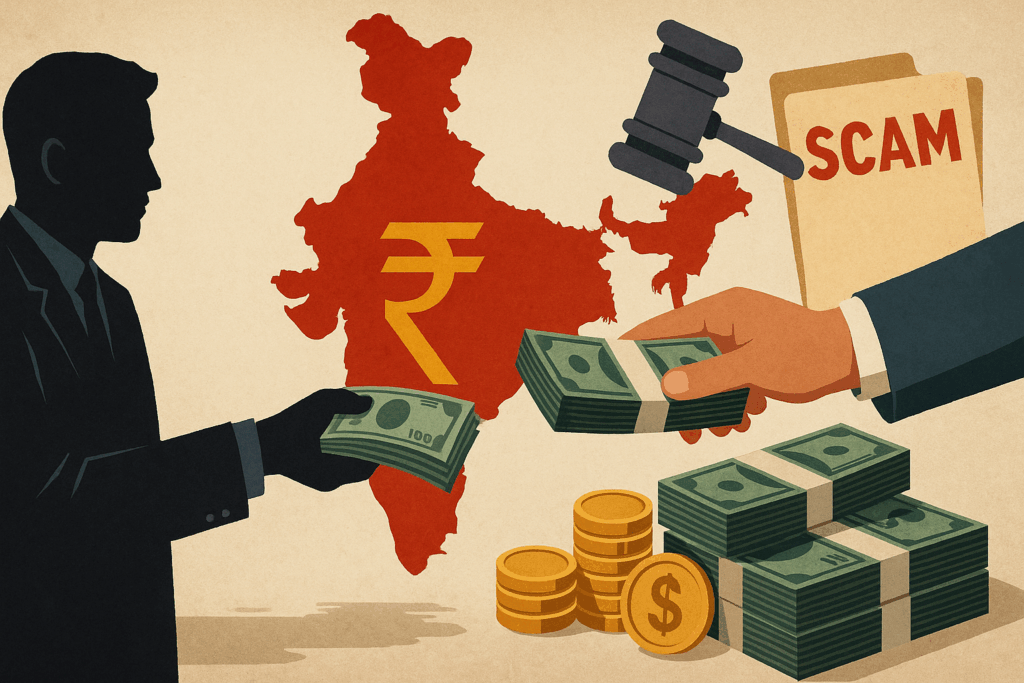
India’s journey since independence in 1947 has been punctuated by numerous instances of corruption and large-scale financial irregularities, commonly referred to as scams. These events, ranging from the early post-independence period to the contemporary digital age, reveal a dynamic evolution in the nature, scale, and methods of illicit activities.
This article (report) provides an in-depth analysis of these major and minor scams, examining the political regimes under which they occurred, the diverse motivations driving them, and their profound implications for India’s governance, economy, and societal trust.
A consistent thread throughout this history is the involvement of political and bureaucratic actors, often in collusion with private entities, exploiting systemic vulnerabilities. The nation’s regulatory and legal frameworks have largely developed reactively, strengthened in response to these crises, yet new forms of malfeasance continue to emerge, adapting to the changing economic and technological landscapes. The cumulative effect of these scams extends beyond immediate financial losses, significantly eroding public confidence, distorting markets, and impeding India’s developmental trajectory.
Introduction: Defining Corruption and Scams in Independent India
Corruption, in the Indian context, encompasses a broad spectrum of illicit practices, from petty bribery for everyday services to large-scale systemic fraud involving significant financial values and high-profile individuals. The perception and definition of a “scam” in public discourse have evolved considerably since 1947. Initially, incidents might have been viewed as isolated acts of malfeasance.
However, with increasing economic complexity and media scrutiny, particularly post-liberalisation, the term “scam” has come to denote large-scale, often politically connected, financial irregularities that expose systemic failures rather than mere individual misconduct. The debate surrounding events like the 2G Spectrum allocation, where it was questioned whether it constituted a “scam” or a “policy misjudgment”, illustrates how political narratives can significantly shape public understanding and impact legal outcomes.
India’s post-independence journey began with the challenges of nation-building, establishing democratic institutions, and fostering economic growth, often through centralised planning and the creation of public sector enterprises. Subsequent decades saw shifts towards economic liberalisation and, more recently, a rapid embrace of digital technologies. Each phase presented unique opportunities and vulnerabilities for illicit activities.
A recurring observation across decades is that India’s regulatory and legal frameworks have predominantly been reactive, undergoing significant enhancements only after major crises expose systemic weaknesses. For instance, the establishment of the National Stock Exchange (NSE) and the strengthening of the Securities and Exchange Board of India (SEBI) followed the Harshad Mehta scam, while the Insolvency and Bankruptcy Code (IBC) was introduced after the Vijay Mallya loan defaults.
This reactive approach means that vulnerabilities often persist until a large-scale fraud brings them to light, leading to a cycle where new types of illicit schemes emerge as perpetrators exploit existing or newly created loopholes.
This report aims to chronologically document major and minor scams, analyse their political context, identify underlying motives, and assess their broader implications for India’s governance and socio-economic fabric. The following table provides a chronological overview of some of the most prominent scams that have shaped India’s post-independence history.
Table 1: Major Scams in India (1947-Present) – Chronological Overview
| Year(s) | Scam Name | Estimated Amount Involved (₹ Crore) | Political Regime in Power (Central/State) | Key Sector/Area | Brief Description/Core Issue |
| 1948 | Jeep Scandal | 0.8 (lakhs) | Indian National Congress (J. Nehru) | Defense Procurement | High Commissioner bypassed protocols for unserviceable jeeps; significant upfront payment without inspection. |
| 1958 | Mundhra Scandal | 1.24 (crore) | Indian National Congress (J. Nehru) | Finance (LIC) | LIC pressured to buy shares in troubled companies, leading to losses; exposed nexus between business and bureaucracy. |
| 1971 | Nagarwala Case | 0.6 (lakhs) | Indian National Congress (I. Gandhi) | Banking | Fake voice call to withdraw funds from SBI; mysterious death of the accused in custody, no inquiry. |
| 1981 | Cement Scam | Crores | Indian National Congress (I. Gandhi) | Public Resources | CM allegedly collected “donations” for trusts in exchange for excess cement quotas. |
| 1985 onwards | Fodder Scam | 940 | INC / Janata Dal (Bihar State) | Government Treasury | Embezzlement through fictitious livestock procurement: a deep nexus of politicians, bureaucrats, and businesses. |
| 1986 | Bofors Scandal | 64 (bribes) | Indian National Congress (R. Gandhi) | Defense Procurement | Kickbacks paid to politicians and bureaucrats for a howitzer deal led to the government’s downfall. |
| 1992 | Harshad Mehta Stock Market Scam | 4000-5000 | Indian National Congress (P.V. Narasimha Rao) | Financial Markets | A stockbroker manipulated the market using forged bank receipts and banking loopholes, causing a market crash. |
| 2008 | 2G Spectrum Scam | 1.76 lakh | United Progressive Alliance (Manmohan Singh) | Telecom (Resource Allocation) | Underpricing and irregular allocation of spectrum licenses; massive notional loss to the exchequer. |
| 2009 | Satyam Scam | 7000 | United Progressive Alliance (Manmohan Singh) | Corporate Governance | Corporate fraud involving forged accounts, inflated profits, and fake employees by the company chairman. |
| 2010 | Commonwealth Games Scam | 70,000 | United Progressive Alliance (Manmohan Singh) | Public Projects | Inflated contracts, embezzlement, and lack of transparency in CWG preparations. |
| 2012 | Coalgate Scam | 1.86 lakh | United Progressive Alliance (Manmohan Singh) | Natural Resources | Non-transparent allocation of coal blocks without competitive bidding, leading to notional losses. |
| 2012-2016 | Vijay Mallya Loan Default | 9000 | UPA / NDA | Banking | Defaulted loans for Kingfisher Airlines; fund diversion, false financials, and Mallya fled. |
| 2018 | Nirav Modi PNB Scam | 14000 | National Democratic Alliance (N. Modi) | Banking | Fraudulent Letters of Undertaking (LoUs) from PNB for massive credit without collateral. |
| 2023 | Adani Group Scandal | 150 billion (USD value lost) | National Democratic Alliance (N. Modi) | Corporate/Financial Markets | Allegations of stock manipulation and accounting fraud; close ties to the ruling party. |
| Ongoing | Online Scams and Frauds | 1400+ (crore, RBI data) | Various | Digital Transactions | Phishing, fake apps, and impersonation to steal money from bank accounts/UPI. |
The Formative Years: Early Scams and the Nehruvian Era (1947-1960s)
The initial decades of independent India were characterised by the formidable task of nation-building under the dominant leadership of the Indian National Congress, led by Prime Minister Jawaharlal Nehru. This era saw the establishment of key public sector enterprises and a nascent regulatory environment, often guided by socialist ideals. However, even in these formative years, instances of corruption began to surface, laying the groundwork for more complex challenges in later decades.
Jeep Scandal (1948)
Independent India’s first significant public scrutiny of political corruption emerged with the Jeep Scandal in 1948. V.K. Krishna Menon, then the Indian High Commissioner to the United Kingdom, was at the centre of the controversy. He bypassed standard protocols to sign an ₹80 lakh contract (equivalent to ₹8 million) for the purchase of 2,000 army jeeps with a little-known foreign firm, Anti-Mistantes. A substantial upfront payment of 65% was made without proper inspection, a deviation from the stipulated 65% payment upon inspection, 20% on delivery, and the remainder a month after delivery. Ultimately, only 155 jeeps were delivered, none of which were found to be serviceable.
This scandal occurred during the interim government period, with Jawaharlal Nehru serving as Prime Minister. Despite the controversy, Menon was later inducted into Nehru’s cabinet as a minister without portfolio in 1956 and subsequently became a trusted ally as Defence Minister. The primary motives behind this scandal appeared to be bypassing protocol and the urgent military procurement needs during the Indo-Pakistani War of 1947-1948.
While Menon was cleared of personal integrity doubts in the investigation, the case was closed in 1955 without significant action against anyone. The lack of conclusive punitive action in this early case may have inadvertently set a precedent for a perceived lack of accountability, which would become a recurring theme in later instances of corruption.
Mundhra Scandal (1958)
Less than a year after its nationalisation in 1956, the Life Insurance Corporation (LIC) became embroiled in independent India’s first major financial scandal. The LIC was reportedly pressured by the Finance Ministry to purchase shares worth ₹1.24 crore (equivalent to ₹12.4 million) in six struggling companies owned by Calcutta-based businessman Haridas Mundhra. This investment bypassed LIC’s own investment committee, which was informed only after the deal was finalised, leading to significant losses for the corporation.
This scandal unfolded under Jawaharlal Nehru’s Indian National Congress government. It was brought to light in 1958 by Feroze Gandhi, an Indian National Congress Member of Parliament and Nehru’s son-in-law, who raised questions in Parliament about the sale of “fraudulent” shares to LIC.
The ensuing public outcry led Prime Minister Nehru to appoint a one-man commission headed by Justice M.C. Chagla to investigate. Chagla’s findings confirmed that Mundhra had defrauded LIC, and the then Finance Minister T.T. Krishnamachari was compelled to resign due to his constitutional responsibility for his secretary’s actions.
The motivations behind the Mundhra scandal included propping up Mundhra’s failing companies, engaging in market rigging, and an alleged connection between bureaucracy, stock market speculators, and unscrupulous businessmen. This case explicitly exposed a pattern of collusion between state actors (bureaucrats, politicians) and private entities, demonstrating that even in the initial decades post-independence, a “political nexus” was emerging.
This was not merely about individual greed but about leveraging state power and public institutions for private gain, often by circumventing established norms. The Mundhra episode was also perceived by some as an early challenge to Nehruvian socialism. The very institutions created to serve the public good, such as the nationalised LIC, became avenues for private enrichment, indicating an early and fundamental tension between India’s stated socialist goals and the realities of its economic and political practices when robust oversight was lacking.
Other Notable Early Cases
Beyond these prominent incidents, other cases of corruption surfaced in the early decades. The Cycle Import Scam (1951) saw the Secretary of the Ministry of Commerce and Industry imprisoned for accepting a bribe to grant an import quota. In 1956, officials at Benaras Hindu University were accused of misappropriating ₹50 lakh in funds. The Jayanti Shipping Company case (1963) involved Dharma Teja defrauding the Indian government and Japanese shipyards. Additionally, Partap Singh Kairon, Chief Minister of Punjab from 1956 to 1964, faced allegations of corruption, nepotism, and favouritism for promoting the economic interests of his sons and relatives.
Analysis of the Era
The nature of corruption in this period was primarily characterised by bypassing established rules, personal enrichment through direct bribes, and the misuse of discretionary power within a largely controlled economy. The scale of these incidents was relatively smaller compared to the mega-scams of later decades. The early cases revealed a lack of robust oversight mechanisms, as evidenced by LIC bypassing its own investment committee and the disregard for protocols in the Jeep scandal. While some political accountability was demonstrated through resignations, such as that of T.T. Krishnamachari, the overall political system exhibited a mixed response to accountability, with some cases being closed without conclusive action, potentially fostering a sense of impunity.
Turbulence and Transition: Scams of the Indira and Post-Indira Eras (1970s-1980s)
This period witnessed significant political shifts, including the centralisation of power under Indira Gandhi, the declaration of the Emergency, and subsequent transitions between Congress and coalition governments (like the Janata Dal). The political landscape, marked by populist policies and, at times, a weakening of institutional checks, provided fertile ground for corruption to escalate in both scale and complexity.
Nagarwala Case (1971)
The Nagarwala case in 1971 remains shrouded in mystery. Rustom Sohrab Nagarwala, a former Army officer, was accused of impersonating Prime Minister Indira Gandhi’s voice to withdraw ₹60 lakhs from the State Bank of India. Nagarwala was arrested but subsequently died in police custody, and, notably, no official inquiry was ordered into the serious allegations surrounding the incident. This occurred during Indira Gandhi’s tenure, a period characterised by a significant concentration of political power. The unresolved nature of the case fueled public suspicion about high-level involvement and a lack of transparency in the handling of sensitive matters.
Cement Scam (1981)
In 1981, A.R. Antulay, the then Chief Minister of Maharashtra, was implicated in what became known as the Cement Scam. He allegedly collected crores of rupees as “donations” from Mumbai builders, channelling these funds into fictitious trusts, including one named after Indira Gandhi. In exchange for these donations, builders reportedly received cement allocations beyond their official quotas, circumventing government controls.
This scandal took place during Indira Gandhi’s government, and Antulay was reportedly acquitted, an outcome often attributed to his close association with Mrs. Gandhi. This case starkly highlighted the direct link between holding political office, illicit fundraising, and the manipulation of public resources for personal enrichment and political gain.
Fodder Scam (1985 onwards)
The Fodder Scam, which began surfacing in 1985 but had been ongoing for over two decades, was a multi-year, multi-crore embezzlement scheme involving approximately ₹940 crore (equivalent to ₹48 billion or US$570 million in 2023) from the Bihar government treasury. The corruption scheme involved the fabrication of “vast herds of fictitious livestock” for which fodder, medicines, and animal husbandry equipment were supposedly procured.
The theft spanned multiple administrations, implicating numerous administrative and elected officials from both the Indian National Congress and Janata Dal parties in Bihar. Key figures, including then Chief Minister Lalu Prasad Yadav (Janata Dal) and former Chief Minister Jagannath Mishra (INC), were among those implicated and arrested.
This scandal went beyond individual acts of corruption, revealing a deeply entrenched “Mafia Raj” – a pervasive nexus between tenured bureaucrats, elected politicians, and businesspeople that had captured several state-run economic sectors. Warnings from auditing bodies, such as the Comptroller and Auditor General (CAG), about delayed account submissions and financial irregularities were consistently ignored across multiple chief ministerial tenures, suggesting deliberate systemic complicity.
The Fodder Scam ultimately led to the end of Lalu Prasad Yadav’s reign as Chief Minister and underscored how corruption had become interwoven with the political culture and governance structure, significantly impacting public service delivery and resource allocation.
Bofors Scandal (1986)
The Bofors Scandal was a major weapons-contract political scandal that erupted in 1987, involving a ₹1437 crore defence deal for 155 mm howitzers from Sweden’s Bofors AB. A Swedish radio broadcast revealed that bribes of ₹64 crore (equivalent to ₹8.2 billion or US$97 million in 2023) had been paid by Bofors to Indian politicians, members of the Congress party, and bureaucrats to secure the contract.
This scandal occurred under Prime Minister Rajiv Gandhi’s Indian National Congress government. The allegations of kickbacks and the government’s perceived overreaction to the revelations severely damaged India’s reputation in defence procurement and directly contributed to the defeat of the Congress party in the November 1989 general elections.
The motivations included personal bribes and alleged contributions to political parties; indeed, former CBI director Dr. A.P. Mukherjee later wrote that Rajiv Gandhi reportedly wanted commissions from defence suppliers used exclusively for running the Congress party. The Bofors case became a potent symbol of high-level political corruption, leading to a ban on middlemen in defence deals, a policy that remains in effect.
Analysis of the Era
The period from the 1970s to the 1980s marked a significant escalation in the scale of corruption, with scams moving from lakhs to crores, indicative of growing audacity and sophistication in financial fraud. The Fodder Scam, in particular, highlighted the deepening entrenchment of a “Mafia Raj” involving politicians, bureaucrats, and businesses at the state level. The Bofors scandal explicitly revealed the use of kickbacks not just for personal gain but also for political party funding, a motive that would recur in later large-scale scams.
The political accountability during this era appeared highly influenced by political power and connections. While some scandals, like Bofors, had immediate and dramatic political consequences, others, such as the Nagarwala case or the Cement Scam, were seemingly suppressed or diluted due to political patronage. This pattern indicated that investigative and legal processes could be compromised by political influence, leading to selective accountability and further eroding public trust.
Economic Liberalisation and Market Frauds (1990s-Early 2000s)
The 1990s marked a pivotal period for India, characterised by significant economic reforms, including Liberalisation, Privatisation, and Globalisation (LPG), primarily initiated under Congress governments. While these reforms aimed to boost economic growth and efficiency, they also inadvertently created new avenues and vulnerabilities for large-scale financial fraud.
The transition from a highly controlled economy to a more open one meant that existing regulatory bodies were often ill-equipped to handle the new complexities and scale of market operations. This period saw a shift like corruption from direct government treasury embezzlement to exploiting newly liberalised financial markets and banking systems.
Harshad Mehta Stock Market Scam (1992)
The Harshad Mehta Stock Market Scam, amounting to approximately ₹4000-5000 crore, was one of India’s largest financial frauds. Harshad Mehta, a prominent stockbroker, manipulated the Indian stock market by exploiting systemic loopholes in the banking system.
He used forged bank receipts (BRs) and diverted funds from banks into the stock market to artificially inflate stock prices (a “pump and dump” scheme), particularly for companies like Associated Cement Company (ACC), whose price soared from ₹200 to ₹9,000 in just three months. The scam was exposed by journalist Sucheta Dalal in 1992, leading to a dramatic crash in the stock market and significant losses for millions of investors.
This scandal occurred during the early phase of economic liberalisation under the Congress government, with P.V. Narasimha Rao as Prime Minister. The primary motivations were personal gain through market manipulation and exploiting regulatory and banking system loopholes.
The profound impact included a severe shaking of public trust in the financial system and led to significant reforms, notably the establishment of the National Stock Exchange (NSE) and enhanced powers for SEBI (Securities and Exchange Board of India) to oversee financial markets. The fact that this scam occurred “right under the nose” of SEBI and RBI and involved “corrupt officials” indicated that the problem was not just the absence of rules, but also weak enforcement and potential complicity within the regulatory and banking institutions themselves.
Hawala Scandal (1991)
The Hawala scandal, which came to light in 1991, involved illegal financial transactions and alleged payments to several politicians.11 This case, occurring under the Congress government, highlighted concerns about illicit money flows and their connections to political figures, often bypassing official financial channels for purposes of political funding and personal gain.
Ketan Parekh Scam (2001)
Another significant stock market manipulation scam, the Ketan Parekh Scam in 2001, involved Ketan Parekh artificially inflating the prices of certain stocks, known as “K-10 stocks,” through circular trading and pump-and-dump schemes. This scam, which took place during the National Democratic Alliance (NDA) government led by Atal Bihari Vajpayee, was driven by personal gain through exploiting existing regulatory weaknesses in the financial markets. Its impact was substantial, causing considerable losses to small and retail investors and further eroding confidence in the capital markets, much like its predecessor.
Analysis of the Era
This era marked a distinct shift in the modus operandi of corruption, moving from direct government treasury embezzlement to exploiting the newly liberalised financial markets and banking systems. The scams exposed significant gaps in regulatory oversight by bodies like SEBI and RBI, which were evidently not fully prepared for the complexities and scale of an open economy.
Small investors were particularly vulnerable to these sophisticated market manipulations, leading to widespread financial losses and a deep erosion of trust. The nature of corruption adapted to the economic environment, transitioning from the “license raj” era’s patronage-based corruption to more complex, market-based financial crimes. This demonstrated that economic reforms, while beneficial for growth, must be accompanied by robust and proactive regulatory strengthening to prevent systemic risks and financial malfeasance.
The Era of Mega Scams: Resource Allocation and Corporate Governance Failures (Mid-2000s-2010s)
The mid-2000s to the 2010s saw a new wave of large-scale corruption cases, often involving unprecedented financial magnitudes and complex schemes. This period was largely dominated by the United Progressive Alliance (UPA) government (2004-2014), followed by the National Democratic Alliance (NDA) government (2014 onwards). The implications of coalition politics, increased public scrutiny, and rapid economic growth played a significant role in shaping the nature and exposure of these mega-scams. This era witnessed a maturation of corrupt practices, shifting from direct embezzlement to exploiting the immense value of public resources and manipulating corporate structures.
2G Spectrum Scam (2008)
The 2G Spectrum Scam, occurring in 2008, involved the underpricing and irregular allocation of 122 2G spectrum licenses by the government. Telecom licenses were granted to select companies at significantly lower prices without a transparent auction process, leading to a “presumptive loss” of ₹1.76 lakh crore (approximately US$40 billion) to the government exchequer. This scandal took place under the UPA coalition government, with A. Raja, the then Telecom Minister, was the prime accused.
Motivations included favouring specific firms, alleged bribes (reportedly ₹30 billion to Raja), and political corruption facilitated by non-transparent allocation processes. The scandal severely damaged public trust in government institutions and eventually led to the Supreme Court cancelling all telecom licenses. This prompted a shift to auction-based spectrum allocation. The acquittal of the accused in 2017 reignited public debate on whether the event was truly a “scam” or a case of policy misjudgment, highlighting the complexities of proving criminal intent in policy decisions.
Satyam Scam (2009)
The Satyam Scam, exposed in 2009, was India’s largest corporate fraud until 2010. Ramalinga Raju, the Founder & Chairman of Satyam Computers, confessed to falsifying the company’s accounts, inflating profits by ₹7000 crore, creating fake documents, and even creating fake employees to siphon off funds. The falsified accounts were also used to obtain cheap loans from US banks, which were then diverted into private real estate ventures.
This scandal occurred during the UPA government, and the Corporate Affairs Ministry and SEBI intervened swiftly. The motivations were primarily misappropriation of funds, inflating share prices to attract investors, personal enrichment, and covering up losses from failed real estate investments. The Satyam scam profoundly shook confidence in Indian corporate governance, leading to calls for stricter corporate governance laws, culminating in the Companies Act of 2013, and intense scrutiny of auditing firms like PricewaterhouseCoopers (PwC).
Commonwealth Games Scam (2010)
The preparations for the 2010 Commonwealth Games in Delhi were marred by a scandal involving inflated contracts (some marked up by as much as 400%), embezzlement of funds, and a significant lack of transparency in spending, with an estimated amount involved of ₹70,000 crore. This occurred under the UPA government, and Suresh Kalmadi, then Chairman of the CWG Organising Committee and a member of the Indian National Congress, was the main accused.
Prime Minister Manmohan Singh himself was forced to intervene to address the organisational failures. The primary motives were personal gain through inflated contracts, embezzlement, and corruption in the awarding of tenders. The scandal caused national embarrassment, severely harmed India’s reputation for hosting major international events, and led to calls for the Public Procurement Bill and a stronger emphasis on audit trails for public funds.
Coalgate Scam (2012)
The Coalgate Scam involved the non-transparent allocation of coal blocks to private companies by the Indian government between 2004 and 2009, primarily through a nomination system rather than competitive bidding. The Comptroller and Auditor General (CAG) estimated a “notional loss” of ₹1.86 lakh crore to the government exchequer due to this flawed allocation process. This scandal took place under the UPA government, with then Prime Minister Manmohan Singh also holding the Coal Ministry portfolio during much of the period.
The motivations included undue gains for private companies with political connections, favouritism, and a lack of transparency in the allocation of valuable natural resources. The scandal led to the Supreme Court cancelling 214 coal block allocations. It also caused a significant reduction in foreign investment and prompted a shift to an auction model for coal blocks. The opposition Bharatiya Janata Party (BJP) heavily criticised the UPA government over this scam, using it as a major political issue.
Vijay Mallya Loan Default Scam (2012-2016)
The Vijay Mallya Loan Default Scam involved Vijay Mallya, owner of Kingfisher Airlines, defaulting on loans worth over ₹9000 crore from a consortium of public sector banks. Investigations revealed reckless borrowing, significant fund diversion, and the submission of false financial statements. Mallya eventually fled India in 2016, leaving behind massive unpaid debts.
While the loans were largely disbursed between 2007 and 2012, during the UPA government, the issue gained prominence, and legal action continued under the subsequent NDA government, which criticised the previous “Phone Banking Scam” where loans were allegedly sanctioned under political pressure without proper checks. The primary motivations were reckless expansion, fund diversion for personal enrichment, and exploiting loopholes in banking oversight, emblematic of crony capitalism. The scam resulted in substantial losses to public sector banks, exposed systemic weaknesses in high-value lending, and triggered a national debate on crony capitalism. It also led to significant reforms, including the introduction of the Insolvency and Bankruptcy Code (IBC) in 2016 and the Fugitive Economic Offenders Act.
Nirav Modi PNB Scam (2018)
The Nirav Modi PNB Scam, exposed in 2018, involved fraudulent Letters of Undertaking (LoUs) issued by Punjab National Bank (PNB), which allowed diamond merchants Nirav Modi and Mehul Choksi to obtain massive credit from Indian banks overseas without collateral or proper records.
The amount involved was approximately ₹14000 crores. This scandal came to light during the NDA government’s tenure, though the ruling BJP alleged that the “original sin” was committed during the UPA regime in 2011. The motivations were fraudulent financial instruments, exploiting banking loopholes, and personal enrichment. The scam resulted in a significant loss of public trust in public sector banks and caused a crash in PNB’s stock and the broader Bank Nifty index. In response, the Reserve Bank of India (RBI) immediately tightened LoU rules.
Analysis of the Era
This period witnessed scams reaching unprecedented financial scales, often involving highly complex financial engineering and the large-scale misallocation of public resources. The Satyam case brought corporate governance failures to the forefront, emphasising the critical need for stricter regulations and auditor accountability. The Coalgate and Mallya scams underscored the deep-seated issue of crony capitalism, where political connections facilitated undue economic advantages. The concept of “presumptive loss,” particularly in cases like 2G and Coalgate, became a significant point of contention, heavily influencing public perception and political discourse, even if it did not always translate into criminal convictions.
A notable observation from this era is the shift like corrupt practices. While earlier scams often involved direct siphoning of funds or smaller-scale market manipulation, these mega-scams involved complex manipulation of entire systems – financial markets, resource allocation mechanisms, and corporate accounting structures – to generate massive, often indirect, profits.
This indicates a higher degree of sophistication in criminal intent, requiring a deeper understanding of economic mechanisms and often involving a larger network of collaborators across government and corporate entities.
Furthermore, unlike earlier eras where political power could sometimes suppress investigations, the mid-2000s onwards saw a more active role of the judiciary and independent auditing bodies like the CAG in exposing and forcing action on high-level corruption. The increased scrutiny from these institutions, coupled with a more vocal media and opposition, made it more challenging to conceal large-scale scandals. This indicates a strengthening, albeit still imperfect, system of checks and balances within India’s democracy, where institutions are increasingly asserting their roles in demanding accountability, even if the path to conviction remains challenging, as seen in the 2G acquittal.
Contemporary Challenges: Digital Frauds and Emerging Scandals (2020s onwards)
The current decade, primarily under the National Democratic Alliance (NDA) government led by Prime Minister Narendra Modi, presents evolving challenges in the landscape of corruption. This era is marked by a strong focus on digital initiatives and a continued struggle with traditional forms of corruption, alongside the emergence of new, technologically-driven illicit activities.
Adani Group Scandal (2023)
In January 2023, Hindenburg Research published a report alleging “brazen stock manipulation and accounting fraud scheme for decades” by the Adani Group. This report led to a significant decline in Adani Group share prices, with the conglomerate losing an estimated $150 billion in market value, and a substantial fall in Gautam Adani’s net worth.
The Adani Group is noted for its “close association with the ruling Bharatiya Janata Party” and Prime Minister Narendra Modi, which has led to allegations of cronyism. Opposition leaders quickly termed it the “biggest scam” and criticised the Prime Minister’s perceived lack of reaction. The motivations alleged include stock manipulation, accounting fraud, and personal enrichment, leveraging alleged political connections. The scandal has resulted in massive market value losses, significant political controversy, and a renewed focus on corporate governance and the intricate relationship between large businesses and political power in India.
Online Scams and Frauds (Ongoing)
With the rapid proliferation of digital transactions and the push for a cashless economy, online scams and fraud have become an ongoing and pervasive challenge. Fraudsters employ various deceptive methods, including phishing, fake applications, scam QR codes, and impersonation, to directly steal money from individuals’ bank accounts and UPI apps.
While not tied to a specific political regime, this type of fraud is exacerbated by the increasing digital footprint of the economy. The primary motivation is digital exploitation for personal financial gain from unsuspecting citizens. These frauds affect millions of innocent Indians monthly, highlighting the urgent need for increased digital literacy, robust cybersecurity measures, and effective law enforcement responses to this decentralised yet cumulatively massive form of financial crime.
Other Recent/Emerging Cases
Several other cases have garnered attention in recent years. These include controversies surrounding the PM CARES Fund (2020) regarding its transparency, the Kerala Gold Smuggling Scandal (2020), which involved high-profile individuals and diplomatic channels, and the Delhi Liquor Scam (2021) involving allegations of irregularities in liquor policy.
The Pegasus Snooping Scandal (2021) involved allegations of government surveillance. More recently, the Sandeshkhali violence (2024) brought to light allegations of land grab and sexual assault with political links, and the NEET controversy (2024) involved allegations of paper leaks and irregularities in medical entrance examinations.
Analysis of the Era
The contemporary era is marked by the emergence of new modus operandi in corruption, particularly the rise of digital frauds that leverage technological advancements. While large-scale corporate and political scams persist, the proliferation of online fraud represents a more decentralised, pervasive form of financial crime directly impacting individuals.
This new frontier poses a different challenge for governance, requiring not only high-level political will and institutional reforms but also widespread public awareness, robust cybersecurity infrastructure, and international cooperation.
Despite changes in political regimes and anti-corruption rhetoric, the narrative of “crony capitalism”- where political connections facilitate undue business advantages – remains a potent and recurring theme in Indian corruption. The Adani scandal, for instance, highlights that allegations of close ties between large corporations and the ruling party continue to be a significant concern, echoing themes from previous eras.
Such allegations are also frequently leveraged by opposition parties, irrespective of who is in power, becoming central to political discourse and electoral battles. This indicates that while specific methods of corruption evolve, the underlying structural issue of political influence on economic opportunities persists, and the public’s perception of fairness and transparency in business-government relations remains a critical vulnerability.
Cross-Cutting Analysis: Patterns in Political Regimes and Motives
An examination of India’s scam history reveals distinct yet interconnected patterns across different political regimes and a consistent evolution in the motivations and methods employed by corrupt actors.
Political Regimes and Corruption
The nature of corruption has adapted to the prevailing political and economic structures of the time.
- Single-Party Dominance (Nehruvian & Indira Eras): In periods dominated by a single political party, such as the Nehruvian and Indira Gandhi eras, scams were often characterised by the misuse of discretionary power, political patronage, and early forms of collusion between politicians and businessmen. Accountability could be selective, heavily influenced by political clout, as seen in the handling of the Nagarwala case or the Cement Scam. This suggests that highly centralised power, without sufficient checks and balances, can lead to corruption through unchecked discretion and political patronage.
- Coalition Governments (1990s-2010s): The era of coalition governments, particularly from the 1990s to the 2010s, introduced new complexities. While coalition politics could sometimes lead to diffused accountability, it also coincided with increased media and judicial scrutiny, which often resulted in larger exposures and greater pressure for reforms (e.g., 2G, Coalgate). The shift from a tightly controlled economy to a more open, market-driven one, if poorly regulated, facilitated sophisticated financial and corporate fraud. This indicates that decentralisation and market liberalisation, without robust oversight, can open new, more complex avenues for illicit activities that are harder to track and regulate.
- Contemporary Eras: In recent times, while large-scale resource allocation scams persist, there is a growing focus on corporate governance, financial market integrity, and the new challenges posed by digital economy frauds. Allegations of cronyism continue to be a significant political flashpoint, regardless of the ruling party.
Despite these variations, a common thread persists: high-level political involvement and the exploitation of systemic weaknesses remain consistent across all regimes. The nature of corruption dynamically adapts to the prevailing governance model, necessitating anti-corruption strategies that are equally dynamic and tailored to the specific economic and political structures.
Typology of Motives
The motivations behind scams in India have evolved from simple direct theft to complex systemic manipulation, reflecting the increasing sophistication of criminal intent.
Table 2: Typology of Scam Motives and Methods
| Motive Category | Description | Common Methods/Modus Operandi | Illustrative Scams (Examples) |
| Personal Enrichment | Direct financial gain for individuals through illicit means. | Bribes, embezzlement, siphoning off funds, and creating fake entities/transactions. | Cycle Import Scam (1951), Fodder Scam (1985), Satyam Scam (2009), Vijay Mallya Loan Default (2012), Nirav Modi PNB Scam (2018), Online Scams (Ongoing) |
| Political Funding/Kickbacks | Raising illicit funds for political parties or individual politicians, often in exchange for favours or contracts. | Commissions on deals, “donations” to trusts, illicit payments for policy changes. | Bofors Scandal (1986), Cement Scam (1981), Hawala Scandal (1991), Allegations in 2G Spectrum Scam (2008) |
| Crony Capitalism/Favouritism | Leveraging political connections to gain undue business advantages, preferential treatment, or monopolistic control. | Preferential allocation of resources, lax loan approvals, and influencing tender processes. | 2G Spectrum Scam (2008), Coalgate Scam (2012), Vijay Mallya Loan Default (2012), Adani Group Scandal (2023) |
| Market Manipulation | Exploiting regulatory loopholes and systemic weaknesses in financial markets to artificially inflate or deflate asset prices for personal gain. | Forged bank receipts, circular trading, “pump and dump” schemes, insider trading. | Harshad Mehta Stock Market Scam (1992), Ketan Parekh Scam (2001), Adani Group Scandal (2023) |
| Regulatory Capture | Influencing regulatory bodies or officials to ensure favourable policies, lax enforcement, or to avoid scrutiny. | Collusion with auditors, bank officials, or government regulators; exploiting policy ambiguities. | Implied in Harshad Mehta Scam (1992), Satyam Scam (2009), Nirav Modi PNB Scam (2018) |
| Systemic Exploitation | Deeply entrenched networks exploiting public funds or resources over extended periods with multi-layered complicity. | Fabrication of records, creation of fictitious beneficiaries, and ignoring audit warnings. | Fodder Scam (1985) |
| Digital Exploitation | Using technological advancements to defraud individuals or systems. | Phishing, fake apps, QR code scams, impersonation, cyberattacks. | Online Scams and Frauds (Ongoing) |
The evolution of motivations from direct theft to systemic manipulation highlights a growing sophistication in criminal intent. As the Indian economy grew and became more complex, the focus shifted from simple “theft from the public purse” to manipulating entire systems – financial markets, resource allocation, and corporate governance to generate massive, often indirect, wealth.
This requires a deeper understanding of economic mechanisms and often involves a larger network of collaborators. Combating such systemic manipulation necessitates not just traditional law enforcement but also robust regulatory intelligence, inter-agency coordination, and a deep understanding of complex financial and corporate structures.
Common Modus Operandi
Across these diverse scams, several common operational methods emerge:
- Forged Documents/Fake Entities: This includes creating fake bank receipts (Harshad Mehta), fabricating “vast herds of fictitious livestock” (Fodder Scam), or generating fake accounts and employees (Satyam).
- Manipulation of Rules/Policies: Perpetrators often manipulate existing rules or policies to their advantage, such as changing cut-off dates for applications (2G Spectrum Scam), using nomination systems instead of transparent auctions (Coalgate Scam), bypassing established investment committees (Mundhra Scandal), or simply ignoring protocols (Jeep Scandal).
- Illicit Allocation/Underpricing: This involves granting licenses, contracts, or resources at below-market rates to favoured entities, as seen in the 2G Spectrum and Coalgate scams.
- Inflated Contracts/Embezzlement: Over-invoicing and siphoning funds from public projects are common, exemplified by the Commonwealth Games Scam.
- Loan Defaults/Fund Diversion: Obtaining large loans without proper checks and subsequently diverting these funds for unauthorised purposes is a recurring method, as seen in the Vijay Mallya and Nirav Modi PNB scams.
- Shell Companies/Complex Structures: The use of multiple layers of entities and complex financial structures helps hide beneficiaries and obscure illicit transactions, as implied in many large financial frauds.
- Leveraging Political Connections: Direct lobbying, influence peddling, and quid pro quo arrangements are frequently used to secure favourable treatment, licenses, or contracts.
Impact of Scams on India
The cumulative impact of these scams extends far beyond immediate financial figures, casting a long shadow over India’s economic and social development.
Economic Consequences
The most direct consequences are significant financial losses to the exchequer, public sector banks, and individual investors. For instance, the Harshad Mehta scam led to a drastic market crash and severe wealth erosion for investors. The 2G Spectrum and Coalgate scams resulted in massive notional losses to the government, while the Vijay Mallya and Nirav Modi PNB scams caused substantial losses to public sector banks.
Such incidents severely erode investor confidence in financial markets and government institutions, deterring both domestic and foreign investment. They also introduce market volatility, leading to sudden crashes and instability. Furthermore, non-transparent allocation processes, as seen in Coalgate and 2G, lead to the inefficient use and misallocation of crucial national resources.
Social and Political Ramifications
Scams deeply damage the social fabric by fostering cynicism towards politicians, bureaucracy, and the democratic process itself. This erosion of public trust can lead to governance challenges, including policy paralysis and an increased focus on scandal management rather than substantive development initiatives. The disproportionate impact on small investors and taxpayers, coupled with the perception of impunity for the powerful, exacerbates social injustice.
On the international stage, these scandals damage India’s reputation, affecting its ability to attract investment and host major events, as highlighted by the Commonwealth Games scam. The cumulative effect of decades of scams represents a significant drag on India’s potential, diverting resources, distorting markets, discouraging legitimate investment, and undermining the social contract between the state and its citizens. Corruption is not merely an ethical problem but a fundamental impediment to India’s sustained economic and social development, impacting its global standing and the well-being of its citizens.
Regulatory and Legal Reforms
In response to these crises, India has undertaken various regulatory and legal reforms, demonstrating a reactive yet continuous effort to strengthen its governance framework.
- Financial Market Reforms: The Harshad Mehta scam led to the establishment of the National Stock Exchange (NSE) and significantly enhanced the powers of SEBI. Similarly, the Satyam and Sahara scams further expanded SEBI’s powers to protect small investors. The Nirav Modi PNB scam prompted the RBI to immediately tighten Letters of Undertaking (LoU) rules.
- Corporate Governance: The Satyam scam served as a wake-up call, leading to stricter corporate governance laws, including the repeal of the Companies Act of 1956 and the introduction of the Companies Act of 2013.
- Resource Allocation: Following the 2G Spectrum and Coalgate scams, the government shifted to auction-based models for spectrum and coal allocation, aiming for greater transparency and fair pricing.
- Anti-Corruption Legislation: Major legislative reforms include the introduction of the Insolvency and Bankruptcy Code (IBC) in 2016, spurred by cases like Vijay Mallya’s loan defaults. Other key acts include the Prevention of Corruption Act, 1988, the Benami Transactions (Prohibition) Act, 1988, and the Prevention of Money Laundering Act, 2002.
- Judicial Activism: There has been increased intervention by the Supreme Court and the Central Bureau of Investigation (CBI) in investigating and overseeing high-profile corruption cases, signalling a more assertive role for independent institutions in demanding accountability.
While these reforms are crucial and reflect a learning process within the governance system, the continuous emergence of new scams, particularly online fraud and persistent allegations of cronyism, suggests that legislative and regulatory changes alone are insufficient.
Reforms are often reactive and may not fully address the underlying systemic issues or the adaptability of corrupt actors. The cycle of “scam-reform-new scam” indicates that fundamental drivers of corruption, such as a lack of ethical governance, weak enforcement, and a culture of non-compliance, are not being fully eradicated. True progress requires a deeper commitment to ethical governance, proactive risk assessment, robust enforcement mechanisms, and fostering a culture of integrity across all levels of public and private sectors.
Conclusion: Lessons Learned and Future Outlook
India’s post-independence history of scams reveals a complex and evolving landscape of corruption. From early instances of misuse of discretionary power and personal enrichment in a controlled economy to sophisticated market manipulations, large-scale resource misallocations, and contemporary digital frauds, the nature of illicit activities has consistently adapted to the prevailing political and economic environment. A persistent political-bureaucratic-business nexus remains a central feature, exploiting systemic weaknesses across different regimes.
The nation’s response has largely been reactive, with significant regulatory and legal reforms typically following major scandals. While these reforms have strengthened frameworks and introduced greater transparency in certain sectors, the continuous emergence of new forms of corruption underscores that legislative changes, though necessary, are often insufficient on their own. The enduring challenge lies in addressing the underlying drivers of corruption, including the politicisation of accountability, the potential for regulatory capture, and the pervasive narrative of crony capitalism.
Looking ahead, the battle against corruption in India faces new frontiers, particularly with the rapid expansion of the digital economy, which presents opportunities for decentralised, high-volume financial crimes. Combating these requires not only a robust cybersecurity infrastructure but also widespread digital literacy among the populace.
Further efforts must focus on proactive regulatory frameworks that anticipate emerging vulnerabilities, enhance transparency in political funding, strengthen the independence and capacity of investigative agencies, and foster a deep-rooted culture of integrity and accountability across all levels of public and private life. Ultimately, the sustained demand for good governance from an informed citizenry and an active civil society remains paramount in shaping India’s future trajectory, ensuring that economic growth is equitable and built on a foundation of trust and integrity.
Sources:
- Articles – Was 2G Really a Scam? A Comprehensive Analysis – The Law Advice, accessed July 24, 2025, https://www.thelawadvice.com/articles/was-2g-really-a-scam-a-comprehensive-analysis
- Top 10 Financial Frauds in India That Made Headlines – Jar App, accessed July 24, 2025, https://www.myjar.app/blog/top-10-financial-frauds-in-india
- Corruption in India| Causes & How to control Corruption? UPSC CSE – Chahal Academy, accessed July 24, 2025, https://chahalacademy.com/corruption-in-india
- Jeep scandal case – Wikipedia, accessed July 24, 2025, https://en.wikipedia.org/wiki/Jeep_scandal_case
- India’s First General Election (1951-52) – Google Arts & Culture, accessed July 24, 2025, https://artsandculture.google.com/story/india-39-s-first-general-election-1951-52/-wUhbZOT11a1RA?hl=en
- 54. India/Jammu and Kashmir (1947-present) – University of Central Arkansas, accessed July 24, 2025, https://uca.edu/politicalscience/home/research-projects/dadm-project/asiapacific-region/indiakashmir-1947-present/
- Major Scams in India since 1947: A Brief Sketch, accessed July 24, 2025, https://www.jetir.org/papers/JETIR1701427.pdf
- Haridas Mundhra – Wikipedia, accessed July 24, 2025, https://en.wikipedia.org/wiki/Haridas_Mundhra
- India’s Domestic Political Setting – Congress.gov, accessed July 24, 2025, https://www.congress.gov/crs-product/IF10298
- (PDF) Private Industry and the Second Five-Year Plan: The Mundhra Episode as Exemplar of Capitalist Myopia – ResearchGate, accessed July 24, 2025, https://www.researchgate.net/publication/253239741_Private_Industry_and_the_Second_Five-Year_Plan_The_Mundhra_Episode_as_Exemplar_of_Capitalist_Myopia
- List of scandals in India – Wikipedia, accessed July 24, 2025, https://en.wikipedia.org/wiki/List_of_scandals_in_India
- Era of Scams Since 1947 | PDF | Indian National Congress | Jawaharlal Nehru – Scribd, accessed July 24, 2025, https://www.scribd.com/document/51278833/Era-of-scams-since-1947
- Fodder Scam – Wikipedia, accessed July 24, 2025, https://en.wikipedia.org/wiki/Fodder_Scam
- Lalu Prasad Yadav | Biography & Facts – Britannica, accessed July 24, 2025, https://www.britannica.com/biography/Lalu-Prasad-Yadav
- Breach of trust – Down To Earth, accessed July 24, 2025, https://www.downtoearth.org.in/environment/breach–of–trust-20764
- Bofors scandal – Wikipedia, accessed July 24, 2025, https://en.wikipedia.org/wiki/Bofors_scandal
- The Bofors Scam: India’s Defense Scandal That Shook a Nation – YouTube, accessed July 24, 2025, https://www.youtube.com/watch?v=rMAHzICCHY4&pp=0gcJCfwAo7VqN5tD
- 485 Vir Sanghvi, Bofor’s ghost – India-Seminar.com, accessed July 24, 2025, https://www.india-seminar.com/2000/485/485%20sanghvi.htm
- 1992 Indian stock market scam – Wikipedia, accessed July 24, 2025, https://en.wikipedia.org/wiki/1992_Indian_stock_market_scam
- Harshad Mehta Scam – ClearTax, accessed July 24, 2025, https://cleartax.in/glossary/harshad-mehta-scam
- Category:Political corruption in India – Wikipedia, accessed July 24, 2025, https://en.wikipedia.org/wiki/Category:Political_corruption_in_India
- (PDF) Scams That Changed India’s Capital Market – ResearchGate, accessed July 24, 2025, https://www.researchgate.net/publication/373552466_Scams_That_Changed_India’s_Capital_Market
- 2G spectrum case – Wikipedia, accessed July 24, 2025, https://en.wikipedia.org/wiki/2G_spectrum_case
- India’s Telecom Scam: How Can a Corrupt System Be Cleaned? – Knowledge at Wharton, accessed July 24, 2025, https://knowledge.wharton.upenn.edu/article/indias-telecom-scam-how-can-a-corrupt-system-be-cleaned/
- 2G: The scam that wasn’t – National Herald, accessed July 24, 2025, https://www.nationalheraldindia.com/book-extract/2g-the-scam-that-wasnt
- Satyam scandal – Wikipedia, accessed July 24, 2025, https://en.wikipedia.org/wiki/Satyam_scandal
- AsiaLaw-Satyam.pdf – Nishith Desai Associates, accessed July 24, 2025, https://www.nishithdesai.com/fileadmin/user_upload/pdfs/Ma%20Lab/AsiaLaw-Satyam.pdf
- Satyam Scandal: Inside India’s Enron – Transparently.AI, accessed July 24, 2025, https://www.transparently.ai/blog/satyam-scandal-indias-enron
- Corruption in India – Wikipedia, accessed July 24, 2025, https://en.wikipedia.org/wiki/Corruption_in_India
- Concerns and controversies at the 2010 Commonwealth Games – Wikipedia, accessed July 24, 2025, https://en.wikipedia.org/wiki/Concerns_and_controversies_at_the_2010_Commonwealth_Games
- The Commonwealth Games – ‘The Common Woes Games’ – Play the Game, accessed July 24, 2025, https://www.playthegame.org/news/the-commonwealth-games-the-common-woes-games/
- Suresh Kalmadi – Wikipedia, accessed July 24, 2025, https://en.wikipedia.org/wiki/Suresh_Kalmadi
- India perceived as more corrupt after CWG scam, accessed July 24, 2025, https://timesofindia.indiatimes.com/india/india-perceived-as-more-corrupt-after-cwg-scam/articleshow/6817630.cms
- Coal Scam aka Coalgat: Indian Coal Allocation Scam – Plutus Education, accessed July 24, 2025, https://plutuseducation.com/blog/coal-scam/
- Indian coal allocation scam – Wikipedia, accessed July 24, 2025, https://en.wikipedia.org/wiki/Indian_coal_allocation_scam
- Not for Publication For Members only LOK SABHA SYNOPSIS OF DEBATES (Proceedings other than Questions & Answers) ______ Frida – Digital Sansad, accessed July 24, 2025, https://sansad.in/getFile/Synop/17/XV/SYN_09022024_ENG%20MERGED.pdf?source=loksabhadocs
- Press : Shri GVL Narsimha Rao on CBI investigation in Coal Scam | Bharatiya Janata Party, accessed July 24, 2025, https://www.bjp.org/pressreleases/press-shri-gvl-narsimha-rao-cbi-investigation-coal-scam
- Despite prescient warnings by BJP leader RK Singh and Rajeev Chandrasekhar, Union gov’t went ahead with flawed coal auctions – The Reporters’ Collective, accessed July 24, 2025, https://www.reporters-collective.in/trc/coal-scam-letters
- The Vijay Mallya Scam: Loan Defaults, Fraud, and Legal Battles – Plutus Education, accessed July 24, 2025, https://plutuseducation.com/blog/vijay-mallya-scam/
- In Public Interest: Vijay Mallya ran away, took the system for granted: AIBEA | Banks | Loans, accessed July 24, 2025, https://www.youtube.com/watch?v=ygsViyfCXzg&pp=0gcJCfwAo7VqN5tD
- Nirav Modi fraud case: ‘Original sin’ committed during UPA tenure, alleges BJP, accessed July 24, 2025, https://timesofindia.indiatimes.com/india/nirav-modi-fraud-case-original-sin-committed-during-upa-tenure-alleges-bjp/articleshow/62959821.cms
- Blame game begins as Nirav Modi flees India, BJP claims PNB fraud took place under UPA, accessed July 24, 2025, https://zeenews.india.com/india/blame-game-begins-as-nirav-modi-flees-india-bjp-claims-pnb-fraud-took-place-under-upa-2081394.html
- Adani Group – Wikipedia, accessed July 24, 2025, https://en.wikipedia.org/wiki/Adani_Group