Table of Contents
The eighteenth century in the Indian subcontinent was a period of profound transition, marked by the decaying central authority of the Mughal Empire and the meteoric rise of the Maratha Confederacy as the pre-eminent protector of the land. The Third Battle of Panipat, fought on the 14th of January 1761, stands as the most significant military encounter of this era, representing a civilisational struggle between the indigenous forces of Bharat and a formidable foreign invader from the north-west.
It was not merely a clash over territorial borders but a contest for the very soul and political future of the subcontinent. At its heart, the battle was the culmination of decades of Maratha efforts to establish a unified Hindavi Swarajya that could shield the sacred geography of India from the repetitive cycles of predatory invasions that had plagued the region for centuries.
The engagement at Panipat involved a staggering number of combatants, making it one of the largest and bloodiest classic formation battles in human history. While the immediate tactical victory was claimed by the Afghan invader Ahmad Shah Abdali and his local allies, the long-term historical narrative reveals a more complex reality.
The Marathas, under the command of Sadashivrao Bhau, exhibited unparalleled valour in the face of insurmountable logistical odds and internal betrayals, ultimately halting the permanent expansion of the Afghan Durrani Empire into the heart of India.
This article seeks to re-evaluate the battle through a nationalistic lens, highlighting the role of the Marathas as the defenders of Bharat and dissecting the systemic causes that shaped this momentous event. Earlier historical interpretations, often influenced by restricted viewpoints, have sometimes portrayed this event as a definitive end to Maratha power.
However, a more nuanced examination of the authentic sources reveals that the Maratha sacrifice at Panipat acted as a strategic check on foreign expansion, and the subsequent Maratha resurrection within a decade proved that the foundations of the indigenous empire remained unshaken.
The following article, thus provides an exhaustive account of the causes, the complex diplomatic manoeuvres, the harrowing siege, the tactical intricacies of the battle, and the profound legacy it left on the destiny of India.
What was the main cause of the Third Battle of Panipat?
The roots of the conflict lie in the power vacuum created by the collapse of Mughal authority following the death of Aurangzeb in 1707. As the Mughals became mere figureheads in Delhi, the Marathas expanded aggressively under the leadership of Peshwa Baji Rao I and later Balaji Baji Rao, positioning themselves as the new power centre of India. By 1758, the Maratha influence had reached the borders of Afghanistan, as they captured Lahore, Multan, and Peshawar, expelling the governor appointed by Ahmad Shah Abdali.
This expansion was not merely for land: it was a strategic move to secure the north-western gates of India, which had been the entry point for every major invader since antiquity. The Maratha objective was the establishment of a sovereign Indian authority that could replace the decaying and often complicit Mughal administration. In 1752, a significant treaty was entered into between the Marathas and the Mughal Emperor, granting the Marathas the right to collect Chauth and Sardeshmukhi across the empire in exchange for protecting the throne from internal and external threats.
This treaty effectively institutionalised the Marathas as the protectors of Delhi, but it also placed them in direct conflict with the ambitious Afghan ruler, Ahmad Shah Abdali, who viewed the Punjab and the north-western provinces as his own territory. The immediate provocation for Abdali’s invasion was the expulsion of his son, Timur Shah, from Lahore by the Marathas in 1758.
Abdali, having founded the Durrani Empire in 1747, had already launched several expeditions into India to plunder its wealth and expand his borders. He viewed the Maratha presence on the Indus as an existential threat to his empire.
However, the conflict was further fueled by the machinations of Najib-ud-daulah, the Rohilla chief, who viewed the rise of Maratha power as a threat to the established Islamic nobility in North India. Najib-ud-daulah successfully played the religious card, inviting Abdali to lead a campaign against the Marathas, thereby transforming a territorial dispute into a broader ideological confrontation aimed at crushing the indigenous resurgence.
| Trigger Category | Specific Event | Historical Implication |
| Geopolitical Vacuum | Death of Aurangzeb (1707) | Rapid decline of Mughal central authority and rise of regional powers. |
| Maratha Diplomacy | 1752 Treaty with Mughals | Marathas became the de facto protectors of the Indian capital. |
| Territorial Expansion | Capture of Lahore (1758) | Marathas reached the Indus, expelling Afghan governors. |
| Personal Vendetta | Timur Shah’s expulsion | Directly challenged Abdali’s prestige and his empire’s southern borders. |
| Religious Conspiring | Najib-ud-daulah’s invitation | Unified Afghan and Indian Muslim chiefs under a communal banner. |
The rise of the Maratha Empire under the Peshwas represented a transition from the defensive guerrilla warfare of the era of Chhatrapati Shivaji Maharaj to a grand imperial strategy of pitched battles and continental administration. This shift required a level of diplomatic finesse in North India that the Marathas sometimes struggled to maintain.
Their policy of collecting tribute from other regional powers, such as the Rajputs and Jats, created a sense of resentment that Abdali and Najib-ud-daulah were able to exploit. While the Marathas fought to preserve Indian authority in the Land of the Sapt Sindhu, they found themselves doing so single-handed, as the fragmented political landscape of the 18th century prevented a truly unified national front.
Who were the main leaders in the Third Battle of Panipat?
The leadership of the Maratha expedition was a reflection of the empire’s peak military and political talent. At the helm was Sadashivrao Bhau, the nephew of the late Peshwa Baji Rao I and the cousin of the reigning Peshwa Balaji Baji Rao (Nanasaheb Peshwa). Bhau was a seasoned administrator and commander who had (then) recently achieved a brilliant victory against the Nizam of Hyderabad at the Battle of Udgir.
Accompanying him was the young Vishwasrao, the eldest son and heir of the Peshwa, whose presence was intended to signify the supreme importance of this northern campaign to the Maratha throne. The army also included legendary figures like Malharrao Holkar, the founder of the Indore state, and Mahadji Shinde (then a young commander), who would later become one of the most powerful men in India.
On the opposing side stood Ahmad Shah Abdali, arguably one of the greatest military minds of the 18th century. Abdali was a veteran of Nadir Shah’s campaigns and had built the Durrani Empire through a series of ruthless and tactically brilliant wars. He was supported by Najib-ud-daulah, the Rohilla chief who acted as the primary architect of the anti-Maratha coalition.
Najib was a master of intrigue and local diplomacy, ensuring that Abdali had a steady supply of intelligence and resources while in India. Another critical ally was Shuja-ud-Daula, the Nawab of Awadh. Though Shuja had initially hesitated, he eventually joined the Afghan camp, providing the coalition with much needed finances and a massive contingent of well equipped troops.
| Leader | Side | Key Role and Attributes |
| Sadashivrao Bhau | Maratha | Commander-in-Chief: noted for his discipline and preference for modern artillery. |
| Vishwasrao | Maratha | Symbolic leader and heir: his death was the psychological turning point of the battle. |
| Ibrahim Khan Gardi | Maratha | Artillery expert: commanded 10,000 French trained infantrymen with extreme loyalty. |
| Ahmad Shah Abdali | Afghan | Strategic genius: utilized mobile artillery and superior tactical reserves. |
| Najib-ud-daulah | A Rohilla, an Afghan Ally | Diplomatic pivot: unified the northern Muslim chiefs against the Marathas. |
| Shuja-ud-Daula | Nawab of Awadh, an Afghan Ally | Financial backbone: his decision to join the ‘army of Islam’ crippled Maratha logistics. |
The Maratha leadership was characterised by a fierce sense of patriotism and duty toward the concept of Swarajya. Sadashivrao Bhau is often described as a leader who insisted on maintaining the honour of Indian territory, famously rejecting Abdali’s proposals for a truce that would have conceded Punjab and Sindh to the Afghans.
However, the Maratha camp was also plagued by internal friction between the old guard, who favoured traditional cavalry based skirmishing, and the new school led by Bhau and Ibrahim Khan Gardi, who advocated for European style infantry formations and heavy artillery. This internal debate regarding the conduct of war would later prove to be a significant factor during the heat of the battle.
What was the role of Shuja-ud-Daulah and the Rohillas?
The participation of Shuja-ud-Daula and the Rohilla Afghans was the decisive factor that tilted the strategic balance in favour of Ahmad Shah Abdali. The Rohillas, led by Najib-ud-daulah, Hafiz Rahmat Khan, and Dunde Khan, were ethnic Pashtuns settled in the Doab region of North India.
They viewed the Maratha expansion as a direct threat to their landholdings and their religious standing. Najib-ud-daulah, in particular, was the main antagonist who tirelessly lobbied Abdali to invade India whenever Maratha power reached the north. He was instrumental in cutting off Maratha communications and providing the Afghan army with local knowledge of the terrain and supply routes.
Shuja-ud-Daula’s role was perhaps more complex. As the Nawab of Awadh and the son of Safdar Jung, he had historical ties to the Marathas, who had previously assisted his father. Both the Marathas and the Afghans desperately sought his alliance. For the Marathas, Shuja offered a way to secure their eastern flank and ensure a steady stream of revenue.
For Abdali, Shuja was the key to financial survival in the long Indian campaign. Ultimately, Shuja-ud-Daula chose the Afghan-Rohilla coalition, a decision that has been attributed to the persuasive religious rhetoric of Najib-ud-daulah and the perceived strength of the Afghan army. This choice was a catastrophic blow to the Marathas, as it not only deprived them of a potential ally but also ensured that Abdali had the resources to sustain a two month siege at Panipat.
The involvement of these local chiefs turned what could have been a short lived foreign raid into a protracted campaign of attrition. The Rohilla infantry, though less disciplined than the Maratha Gardis, was numerous and highly motivated by Najib-ud-daulah’s communal appeals.
The combined forces of the Rohillas and the Nawab of Awadh outnumbered the core Afghan contingent, making the coalition a formidable opponent that could absorb high casualties while maintaining pressure on the Maratha lines. This local support also meant that the Afghan army was never truly isolated, unlike the Marathas, who were hundreds of miles from their southern base.
Why did the Marathas and Afghans fight at Panipat?
Panipat has historically functioned as the strategic bottleneck for any power attempting to control Delhi and the heartland of India. Situated roughly 60 to 90 miles north of Delhi, it sits on the ancient invasion route from the Khyber Pass to the Gangetic plains.
The geography of the region, characterised by vast, flat plains, made it the ideal arena for the large scale military manoeuvres that defined 18th century warfare. For an invader from the north-west, Panipat was the last major defensive position to be cleared before reaching the imperial capital. For the defenders of Bharat, it was the final line of defence where the fate of the subcontinent would be decided.
The choice of Panipat in 1761 was forced upon both sides by a series of strategic movements along the Yamuna River. In the months leading up to the battle, the Marathas had achieved a significant victory at Kunjpura, where they destroyed an Afghan garrison of 15,000 men.
This victory, however, left the Maratha army on the western bank of the Yamuna while Abdali was on the eastern bank. In a daring and brilliant manoeuvre on the 25th of October 1760, Abdali crossed the river at Baghpat, effectively getting behind the Maratha army and cutting them off from their base in Delhi. This forced the Marathas to retreat to the town of Panipat, where they constructed a massive fortified camp, hoping to either break out or wait for reinforcements from the south.
| Strategic Asset | Importance for Marathas | Importance for Afghans |
| Delhi Proximity | Defending the capital of Bharat. | Capturing the symbolic seat of power. |
| Yamuna River | Natural defensive barrier and water source. | Strategic crossing to outmanoeuvre the enemy. |
| Grand Trunk Road | Maintaining communication with the Deccan. | Cutting the Maratha supply lines to the south. |
| Open Plains | Utilizing heavy artillery and cavalry charges. | Exploiting mobile cavalry and zamburak fire. |
The location of the battleground near modern day Kaala Aam and Sanauli Road was thus the result of a military stalemate that had lasted for over two months. The Marathas were pinned against the town of Panipat, while the Afghans held the road to Delhi, effectively starving the Maratha camp into submission.
This forced the final, desperate confrontation on the 14th of January, as the Maratha leaders chose to die in battle rather than perish by starvation. The site itself, which had witnessed the victories of Babur and Akbar, was now to witness the most heroic but tragic stand of the Maratha Empire.
What happened during the two month siege of Panipat?
The two month period from late October 1760 to mid January 1761 was a harrowing test of endurance for the Maratha army and the thousands of non-combatants accompanying them. After Abdali’s successful crossing at Baghpat, the Marathas found themselves besieged within their own camp at Panipat.
The initial days were marked by a series of skirmishes and forays as both sides attempted to test the other’s defences. However, the Afghans, with the help of Najib-ud-daulah’s Rohillas, were far more effective at controlling the surrounding countryside. They successfully intercepted Maratha foraging parties and cut off the flow of grain and supplies from Delhi and the surrounding Jat territories.
By the end of November 1760, the situation inside the Maratha camp had become dire. The camp housed not only 45,000 to 60,000 soldiers but also nearly 2,00,000 to 3,00,000 non-combatants, including many women, children, and elderly pilgrims who had joined the expedition to visit holy sites like Mathura and Kashi.
As the food supplies ran out, cattle began to die by the thousands, and reports of soldiers dying from starvation became a daily occurrence. The winter of 1760-61 was particularly harsh, and the South Indian troops, accustomed to a milder climate, suffered immensely from the bitter cold and lack of proper clothing or fuel.
The psychological toll of the siege was equally devastating. The Maratha leaders, including Sadashivrao Bhau, were aware that reinforcements from the Peshwa in the south were delayed and might not arrive in time.
On the 13th of January 1761, the desperate Maratha chiefs approached Bhau and declared that they would rather die on the battlefield than continue to waste away in the camp. This led to the decision to march out before dawn the next day for one final, decisive attempt to break the Afghan lines. The soldiers, weakened by hunger, were given what little food remained, mostly sugared water, to break their final fast before the engagement.
How did the Third Battle of Panipat start on 14 January 1761?
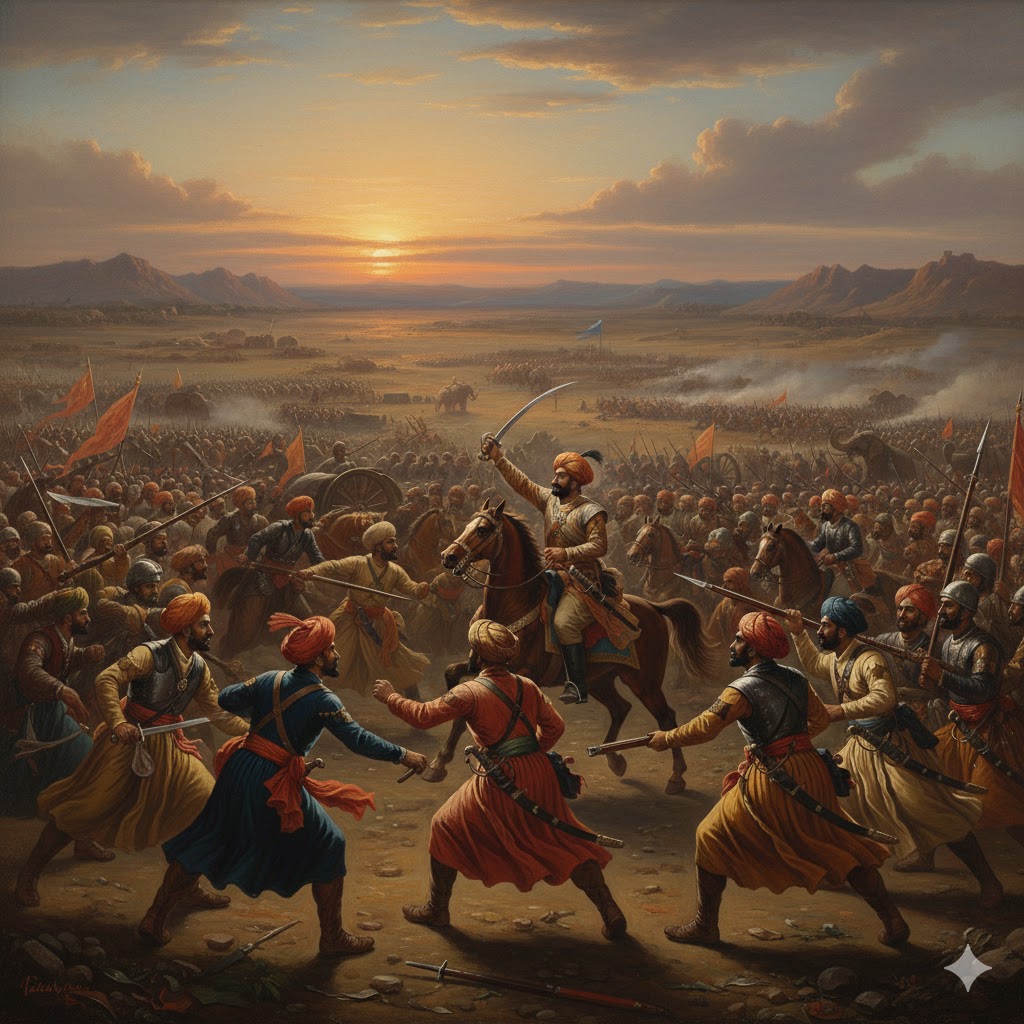
The battle commenced in the early hours of Wednesday, 14 January 1761, a day that coincided with the festival of Makar Sankranti. The Marathas emerged from their trenches before dawn, positioning their massive artillery wing in the front under the command of Ibrahim Khan Gardi.
Their tactical plan was to use the heavy cannons to pulverise the Afghan formations before launching a massive cavalry charge to sweep the field. The Afghan army, alerted to the Maratha movement, formed their own lines, with Abdali positioning himself in the rear with a strong reserve force, allowing his front lines to absorb the initial shock.
The first phase of the battle was dominated by the Maratha artillery. Ibrahim Khan Gardi’s French trained musketeers and pikemen advanced with disciplined precision, repulsing the initial Afghan and Rohilla charges.
For three hours, the Maratha cannons fired salvos at point blank range into the Afghan ranks, causing immense carnage. It is estimated that nearly 12,000 Rohilla soldiers were killed or wounded in this opening stage. The Maratha left flank was undeniably winning, and the Afghan right wing, under Najib Khan’s Rohillas, began to reel back toward their lines.
In the centre, Sadashivrao Bhau led a fierce assault against the Afghan Vizier, Shah Wali Khan. The Maratha centre, comprising the elite household troops, charged with such ferocity that they nearly broke through the Afghan lines. Afghan soldiers began to desert their positions in the confusion, and the Vizier was seen dismounting and appealing to his men to stay and fight.
At this point, around midday, it appeared that the Marathas were on the verge of a historic victory. However, the physical exhaustion of the half starved Maratha troops and their mounts began to show, preventing them from making a final, decisive breakthrough before Abdali could react.
Who was the winner of the Third Battle of Panipat?
In purely tactical and immediate terms, the victory belonged to Ahmad Shah Abdali and the Afghan coalition. The tide of the battle turned in the afternoon when Abdali deployed his fresh reserve of elite Nascibchi musketeers and his camel mounted zamburaks.
These mobile artillery pieces were used to rake the Maratha lines, while the musketeers were ordered to gun down any Afghan deserters and force the rest back into the fight. This sudden influx of fresh, disciplined troops overwhelmed the exhausted Maratha centre. The turning point of the entire engagement was the death of the young Vishwasrao, who was struck by a bullet while fighting atop his elephant.
The news of the heir’s death caused a collapse in Maratha morale. Sadashivrao Bhau, seeing his nephew fall, dismounted from his elephant and led a final, desperate charge on foot, disappearing into the thick of the fighting where he was eventually killed.
The Maratha right flank, under Malharrao Holkar, eventually withdrew from the field, a move that has been debated by historians for centuries as either a strategic retreat or a desertion. By late evening, the Maratha army was in full flight, pursued and slaughtered by the Afghan cavalry. The specific site of the victory is generally identified near modern day Kaala Aam, where a memorial now stands to commemorate the fallen.
However, the “victory” was a Pyrrhic one for Ahmad Shah Abdali. While he had destroyed the Maratha expeditionary force, his own army had suffered such heavy casualties that he was unable to consolidate his gains in India. His troops, frustrated by the lack of immediate plunder and long absence from their homes, mutinied and demanded a return to Afghanistan.
Abdali eventually left Delhi within a few months, having settled the affairs of the Mughal court to the advantage of his allies but failing to establish a lasting Durrani empire in the subcontinent. Thus, while the Marathas lost the battle, they successfully prevented the permanent foreign occupation of Northern India.
| Metric | Maratha Performance | Afghan Performance |
| Initial Phase | Dominant: artillery caused heavy Afghan losses. | Struggling: centre and right wing nearly collapsed. |
| Tactical Innovation | High: used European style infantry and heavy guns. | High: utilized mobile zamburaks and strategic reserves. |
| Command Stability | Fractured after the death of the heir. | Stable: Abdali maintained a strong grip on his reserves. |
| Long-term Result | Temporary retreat followed by rapid revival. | Immediate win followed by total withdrawal from India. |
What were the consequences of the Maratha defeat at Panipat?
The immediate consequences of the defeat were catastrophic for the Maratha state and the people of Bharat. The human cost was staggering: it is believed that not less than 1,00,000 Marathas, including soldiers and non-combatants, perished during the battle and the subsequent massacres.
The day after the battle, approximately 40,000 prisoners were slaughtered in cold blood by the Afghan and Rohilla forces. Thousands of women were taken as slaves, and the treasury was depleted by the costs of the long, unsuccessful campaign. The Peshwa, Balaji Baji Rao, was so deeply affected by the loss of his son and his cousin that he never recovered and died six months later, on 23rd June 1761.
Politically, the defeat halted the Maratha advance into the north-west for roughly ten years. It destabilised the Maratha territories in North India and led to a resurgence of regional powers like the Sikhs in Punjab, the Jats in Bharatpur, and the Rajputs, all of whom sought to reclaim autonomy in the absence of a strong Maratha central authority. The Mughal Empire, already a shadow of its former self, became even more powerless, serving as a puppet for whoever controlled Delhi – initially the Rohillas and later the British or the revived Marathas.
However, the most significant long-term consequence was the shift in the balance of power that favoured the British East India Company. The “Great Betrayal” at Panipat, as some nationalistic historians have termed it, weakened the only indigenous power that could have effectively resisted British expansion. With the Marathas temporarily out of the picture in the North, the British were able to consolidate their hold on Bengal and Bihar after the Battle of Plassey and later the Battle of Buxar, eventually emerging as the dominant force in the subcontinent by the end of the 18th century.
How did the Third Battle of Panipat impact the British rule in India?
The Third Battle of Panipat is often described as a pivotal moment that decided not who would rule India, but who would not rule it. By 1761, the British East India Company was already a significant player in the east, but they were still far from dominating the entire subcontinent.
The Marathas were the primary rivals to British ambitions, and their defeat at Panipat removed a major obstacle to the Company’s expansionist plans. The loss of nearly the entire Maratha expeditionary force and the death of its most capable commanders created a massive power vacuum in Northern and Central India.
This vacuum allowed the British to use diplomacy and limited warfare to divide and conquer the remaining regional states. While the Marathas were preoccupied with internal succession disputes and regrouping in the Deccan following the death of Peshwa Nanasaheb, the British were able to strengthen their administrative and military infrastructure in Bengal.
Historians have noted that if the Marathas had won at Panipat, they would have likely consolidated their hold over the Mughal Emperor and established a unified Indian state that could have confined the British to their coastal trading posts.
Furthermore, the exhaustion of the Afghan Durrani Empire meant that they too were no longer a threat to British interests. Abdali’s subsequent invasions were largely focused on the Punjab and were repeatedly challenged by the rising power of the Sikh Misls.
This ensured that the British did not have to worry about a formidable foreign invader from the north-west while they were expanding their territories in the south and east. Thus, the Third Battle of Panipat served as the catalyst that transitioned India from a period of indigenous Maratha dominance to one of foreign colonial rule.
How did the Marathas regain their power after the 1761 defeat?
Contrary to the “leftist” narrative that Panipat marked the end of the Maratha Empire, the period between 1761 and 1772 witnessed one of the most remarkable military and political resurrections in history.
This era was defined by the leadership of Peshwa Madhavrao I, the young son of Balaji Baji Rao, who took the throne at the age of sixteen. Madhavrao proved to be an exceptionally capable and virtuous leader, credited with restoring the empire’s prestige, replenishing the treasury, and reunifying the Maratha Confederacy.
In 1771, exactly ten years after the defeat at Panipat, Madhavrao sent a massive Maratha army into Northern India. This expedition, led by Visaji Krushna Biniwale, Mahadji Shinde, and Nana Fadnavis, had two primary objectives: to re-establish Maratha domination in Delhi and to punish the powers that had aided the Afghans in 1761.
The campaign was a resounding success. The Marathas captured Delhi in 1771, and in 1772, they escorted the Mughal Emperor Shah Alam II from British protection back to his capital, where he reigned as a Maratha vassal.
The Marathas also took severe retribution against the Rohillas. They ravaged the Rohilla territories, capturing their forts and effectively ending the power of the family that had conspired with Abdali. This campaign, known as the Maratha Resurrection, proved that the spirit of Hindavi Swarajya was far from dead.
Under Madhavrao, the Marathas also defeated the Nizam of Hyderabad and the rising power of Hyder Ali in the south, ensuring that by 1772, the Maratha Empire was once again the most powerful entity in India. It was only the untimely death of Madhavrao in 1772 that halted this momentum and eventually allowed the British to challenge the Marathas in the First Anglo-Maratha War.
| Aspect of Revival | Details of Action | Impact on Bharat |
| Leadership | Accession of Peshwa Madhavrao I (1761) | Restored discipline, integrity, and central authority. |
| Retribution | 1771 North India Expedition | Crushed the Rohillas and avenged the betrayal of 1761. |
| Sovereignty | Re-capture of Delhi (1771) | Re-established the Marathas as the supreme power in Northern India. |
| Imperial Reach | Reinstating Shah Alam II (1772) | Neutralised British influence over the Mughal throne. |
Role of Maharaja Suraj Mal and the Jat-Maratha Alliance
A significant point of debate and often misrepresented information concerns the relationship between the Marathas and the Jat ruler, Maharaja Suraj Mal of Bharatpur. Suraj Mal was a visionary leader known as the “Plato of the Jats” for his political sagacity and steady intellect.
Initially, Suraj Mal had formed an alliance with Sadashivrao Bhau and joined the northern expedition with 10,000 soldiers. However, a discord occurred between the two leaders regarding the conduct of the war. Suraj Mal, being a master of the local terrain, suggested that the Marathas should leave their heavy baggage, artillery, and non-combatant family members at the Bharatpur or Jhansi forts to increase their mobility and reduce the logistical burden.
Unfortunately, Sadashivrao Bhau, confident in his modern artillery and disciplined infantry, rejected this advice. This, combined with disagreements over the administration of captured territories, led to Suraj Mal’s withdrawal from the camp before the siege of Panipat began.
While some historical narratives have unfairly portrayed this as a betrayal, it is crucial to note that Suraj Mal’s strategic assessment was ultimately proven correct. Despite the estrangement, Suraj Mal displayed remarkable humanity and nationalistic spirit after the battle. He provided medical aid, shelter, and food to nearly 50,000 retreating and injured Maratha soldiers and non-combatants, often at the risk of inviting Abdali’s wrath on his own kingdom. His generosity saved thousands of lives and remains a shining example of Indian solidarity in the face of a foreign invader.
Who was Ibrahim Khan Gardi and why is he important?
The story of Ibrahim Khan Gardi is one of the most poignant and inspiring aspects of the Third Battle of Panipat, representing the inclusive and meritocratic nature of the Maratha Empire. Ibrahim Khan was a South Indian Muslim general who had been trained in French military discipline under the celebrated General Bussy.
He was an expert in artillery and had previously served the Nizam of Hyderabad before being won over by Peshwa Balaji Baji Rao and Sadashivrao Bhau. As the commander of the 10,000 strong Gardi infantry, he held the rank of deputy commander in chief, a testament to the trust placed in him by the Maratha leadership.
During the battle, Ibrahim Khan’s battalion was the most effective unit on the field. His artillery and disciplined musketeers repulsed every Afghan and Rohilla charge, killing thousands of enemy troops and nearly winning the day for the Marathas. Even as the Maratha centre collapsed and other generals began to leave the field, Ibrahim Khan and his men fought with incredible tenacity until they were surrounded and captured.
Because he was a Muslim fighting for a Hindu empire against an “Islamic” coalition, the Afghan captors viewed him as a traitor. Ibrahim Khan was subjected to horrific torture, including the use of hot iron rods and disembowelment, but he refused to bow before Abdali or renounce his loyalty to the Maratha state.
His martyrdom serves as a definitive rebuttal to the communal narratives often pushed by later historians, highlighting that the struggle at Panipat was a nationalistic defence of Bharat by all its people.
Military Technology: Why were the Afghans more effective?
While the Marathas possessed superior heavy artillery of French origin, the Afghans and Rohillas had a qualitative advantage in mobility and small arms technology that proved decisive in the fluid, fast-paced environment of the battle.
The Afghan army’s use of the zamburak, a light swivel gun mounted on the back of a camel, allowed them to bring artillery fire to any part of the battlefield quickly. These camel mounted guns could be fired and reloaded while moving, making them far more versatile than the heavy Maratha cannons that were fixed in position and difficult to reposition once the lines shifted.
Additionally, the Afghan troops were equipped with the jezail, a long barrelled, rifled musket that had a significantly longer range and better accuracy than the standard smooth bore muskets used by the Maratha infantry. This allowed the Afghan snipers and skirmishers to pick off Maratha officers and artillerymen from a distance, contributing to the eventual disarray in the Maratha ranks.
The Afghan cavalry was also better equipped for the cold northern winter, with heavy quilted coats and robust horses from Central Asia, whereas the Maratha horses were often small Deccan ponies that were already weakened by the two month long starvation during the siege.
What was the ultimate purpose of the Marathas fighting the Afghans at Panipat?
The Third Battle of Panipat must be viewed not just as a military event, but as a civilisational stand. The Maratha movement was explicitly aimed at securing the sacred places of Hinduism from cow slaughter and the outbursts of religious fanaticism that had characterised previous invasions.
Their presence in the north was a bulwark against the forces that sought to perpetuate a state of perpetual instability and foreign dominance in the heart of Bharat. The battle was fought to preserve an indigenous Indian authority in the Land of the Sapt Sindhu, which had come under Indian control in 1758 after nearly 750 years of foreign overreach.
The Maratha leaders and soldiers who fell at Panipat are regarded as martyrs whose blood served as the seed for future Indian resurgence. Even in defeat, they dealt such a heavy blow to the Afghan invader that no foreign force from the north-west would ever again dare to launch a full scale invasion of the Indian heartland.
The exhaustion of the Durrani Empire following Panipat ensured that the north-western frontier would eventually be secured by the Sikhs, another indigenous power, thus closing the gateway of invasions for good. The sacrifice at Panipat was, therefore, the ultimate defensive action that protected the cultural and political integrity of India at one of its most vulnerable moments.
Conclusion
The Third Battle of Panipat remains one of the most poignant and misunderstood chapters in the long history of Bharat. It was a day of unimaginable tragedy, marked by the loss of the finest military minds and the most courageous warriors of the 18th century. However, to view it solely as a “Maratha defeat” is to fall prey to a narrow and incomplete historical narrative.
In reality, the battle was a supreme act of nationalistic defence where the Maratha Confederacy, standing single-handed, checked the advance of a massive foreign coalition and preserved the possibility of an indigenous future for the subcontinent. The Marathas at Panipat did not fight for mere territorial gain; they fought for the dignity of the land and the protection of its sacred heritage.
The tactical victory of Ahmad Shah Abdali was hollow and short-lived, as he was forced to abandon his Indian ambitions and return to a crumbling empire in Afghanistan. The subsequent Maratha Resurrection under Peshwa Madhavrao I proved that the empire’s foundations were built on the unbreakable spirit of the people of Bharat.
Within a decade, the Marathas had reclaimed Delhi, punished their betrayers, and restored the honour of their fallen martyrs. While the temporary vacuum allowed for the rise of British colonialism, the legacy of Panipat remains a reminder of the valour and the vulnerabilities of India.
It teaches the eternal lesson that the security of the nation lies in its unity and its willingness to stand against foreign invaders at any cost. The heroes of Panipat – from Sadashivrao Bhau and Vishwasrao to the loyal Ibrahim Khan Gardi, continue to live in the folk songs and the collective memory of India as the ultimate guardians of Hindavi Swarajya.
Sources:
- The Third Battle of Panipat: A defining moment in Indian history – The Tribune, accessed January 13, 2026, https://www.tribuneindia.com/news/anniversary/the-third-battle-of-panipat-a-defining-moment-in-indian-history/
- Untitled – IGNCA, accessed January 13, 2026, https://ignca.gov.in/Asi_data/38167.pdf
- Third Battle of Panipat (1761) | Panipat, Haryana | India, accessed January 13, 2026, https://panipat.gov.in/third-battle/
- 265 years ago, The Third Battle of Panipat (1761) resulted in an Islamic Coalition victory led by Ahmad Shah Durrani, the Afghan Emperor resulting in a great liberation, restored power balance and safety of the Muslims of Southern Asia. It was the deadliest classic formation battle in history. : r/islamichistory – Reddit, accessed January 13, 2026, https://www.reddit.com/r/islamichistory/comments/1jmpn47/265_years_ago_the_third_battle_of_panipat_1761/
- The Third Battle of Panipat: A Defining War in Medieval Indian History – SuperKalam, accessed January 13, 2026, https://superkalam.com/upsc-mains/notes/third-battle-panipat
- Panipat battle a symbol of Maratha bravery, not defeat: CM Fadnavis – The Hindu, accessed January 13, 2026, https://www.thehindu.com/news/national/maharashtra/panipat-battle-a-symbol-of-maratha-bravery-not-defeat-cm-fadnavis/article69373625.ece
- Third Battle of Panipat, History, Causes, Impact, Result – Physics Wallah, accessed January 13, 2026, https://www.pw.live/ssc/exams/third-battle-of-panipat
- Third Battle of Panipat | History, Events & Significance – Study.com, accessed January 13, 2026, https://study.com/academy/lesson/third-battle-panipat-history-facts.html
- The third battle of Panipat was fought in 1761. Why were so many empire-shaking battles fought at Panipat? | UPSC Mains 2014 GS1 Model Answer – SuperKalam, accessed January 13, 2026, https://superkalam.com/upsc-mains/previous-year-question-paper/2014/the-third-battle-of-panipat-was-fought-in-why-were-so-many-empireshaking-battles-fought-at-panipat-b3df028e-01ca-46aa-8139-6fdd52a1ebf1
- Battles of Panipat – Drishti IAS, accessed January 13, 2026, https://www.drishtiias.com/to-the-points/paper1/battles-of-panipat
- The last battle of panipat an event that paved way to the servitude – IJCRT.org, accessed January 13, 2026, https://ijcrt.org/papers/IJCRT1133160.pdf
- Third Battle of Panipat 1761, Background, Causes, Results – Vajiram & Ravi, accessed January 13, 2026, https://vajiramandravi.com/upsc-exam/third-battle-of-panipat/
- Why didn’t Rajputs, Sikhs and Jats help Marathas during 3rd Panipat. – Reddit, accessed January 13, 2026, https://www.reddit.com/r/IndianHistory/comments/1glz7fl/why_didnt_rajputs_sikhs_and_jats_help_marathas/
- 14 JAN 1761 THIRD BATTLE OF PANIPAT – Wix.com, accessed January 13, 2026, https://bcpat02.wixsite.com/heve/single-post/2016-1-14-14-jan-1761-third-battle-of-panipat
- Mughal Empire in the Seventeenth Century-II – UPSC PDF Download – EduRev, accessed January 13, 2026, https://edurev.in/t/245014/Mughal-Empire-in-the-Seventeenth-Century-II
- Maratha Empire: History, Rulers, War & Administration [UPSC Notes] – 99Notes, accessed January 13, 2026, https://www.99notes.in/upsc-notes/general-studies-1/history/medieval-india/maratha-empire/
- Third Battle of Panipat (January 14, 1761) – GeeksforGeeks, accessed January 13, 2026, https://www.geeksforgeeks.org/social-science/third-battle-of-panipat-january-14-1761/
- Ibrahim Khan Gardi – Wikipedia, accessed January 13, 2026, https://en.wikipedia.org/wiki/Ibrahim_Khan_Gardi
- maratha – bharatuntoldstory, accessed January 13, 2026, https://bharatuntoldstory.wordpress.com/tag/maratha/
- Third Battle of Panipat 1761, Causes, Consequences & Significance – Testbook, accessed January 13, 2026, https://testbook.com/ias-preparation/third-battle-of-panipat-ncert-notes
- Maratha Empire- Third Battle of Panipat – Unacademy, accessed January 13, 2026, https://unacademy.com/content/upsc/study-material/medieval-india/maratha-empire-third-battlle-of-panipat/
- Maharaja Surajmal and the third battle of panipat – INSIGHTS IAS, accessed January 13, 2026, https://www.insightsonindia.com/2019/12/11/maharaja-surajmal-and-the-third-battle-of-panipat/
- Indian History – The Third Battle of Panipat (Featured) | PDF | Armed …, accessed January 13, 2026, https://www.scribd.com/document/138889502/Indian-History-the-Third-Battle-of-Panipat-Featured
- Map of The Eve of the Third Battle of Panipat in 1761 – Mughal Library, accessed January 13, 2026, https://www.mughallibrary.com/maps-1/map-of-the-eve-of-the-third-battle-of-panipat-in-1761
- The Muslim general who died while fighting for the Marathas in the third battle of Panipat was: – Prepp, accessed January 13, 2026, https://prepp.in/question/the-muslim-general-who-died-while-fighting-for-the-645df85057f116d7a23fe659
- Ibrahim Khan Gardi – The unsung hero of Panipat battle – Mind of a writer, heart of a soldier, accessed January 13, 2026, https://prashant25.rssing.com/chan-6141237/all_p14.html
- Third Battle of Panipat – Wikipedia, accessed January 13, 2026, https://en.wikipedia.org/wiki/Third_Battle_of_Panipat
- Third Battle of Panipat – Military History – Oxford Bibliographies, accessed January 13, 2026, https://www.oxfordbibliographies.com/abstract/document/obo-9780199791279/obo-9780199791279-0248.xml
- Explain the significance and details of the Battle of Panipat. – Filo, accessed January 13, 2026, https://askfilo.com/user-question-answers-smart-solutions/battle-of-panipat-explain-the-significance-and-details-of-3335323537353433
- 250 Years of ” The Third Battle of Panipat “ | VIDUR’s Blog – WordPress.com, accessed January 13, 2026, https://mevidur.wordpress.com/2011/01/16/250-years-of-the-third-battle-of-panipat/
- Bollywood’s ‘Great Betrayal’ of Afghanistan: “Panipat” and the cost of vilifying Ahmad Shah Durrani, accessed January 13, 2026, https://www.afghanistan-analysts.org/en/reports/context-culture/bollywoods-great-betrayal-of-afghanistan-panipat-and-the-cost-of-vilifying-ahmad-shah-durrani/
- [Solved] Third battle of Panipat was fought between – Testbook, accessed January 13, 2026, https://testbook.com/question-answer/third-battle-of-panipat-was-fought-between–6347abfb005598dcdbd94187
- Tag: Ibrahim Khan Gardi – NDHistories – WordPress.com, accessed January 13, 2026, https://ndhistories.wordpress.com/tag/ibrahim-khan-gardi/
- Battle of Panipat (1761) | Military Wiki – Fandom, accessed January 13, 2026, https://military-history.fandom.com/wiki/Battle_of_Panipat_(1761)
- Maharaja Surajmal – Jat Chiefs, accessed January 13, 2026, https://jatchiefs.com/maharaja-surajmal/