Table of Contents
The seventeenth century in the Indian subcontinent was a period of profound geopolitical transition, marked by the gradual erosion of traditional land-based powers and the insidious rise of maritime commercial entities from Europe.
While the contemporary political landscape was dominated by the continental focus of the Mughal Empire and the crumbling Deccan Sultanates, Chhatrapati Shivaji Maharaj emerged as a revolutionary figure who possessed a rare and sophisticated spatial consciousness. He was perhaps the first indigenous ruler to accurately identify that the European powers, primarily the British and the Portuguese, were not merely transient traders but a permanent and existential threat to the sovereignty of Bharat.
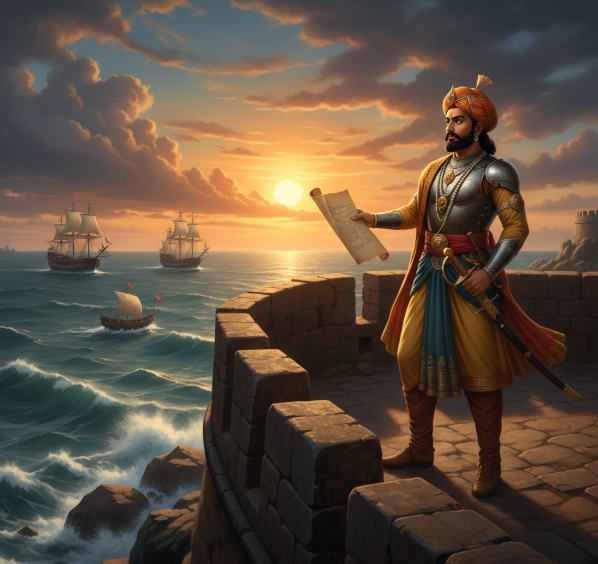
His establishment of the Maratha Navy was not an act of peripheral military expansion but a central pillar of statecraft designed to protect the “Hindavi Swarajya” from a new form of oceanic colonialism that his peers failed to perceive.
The strategic foresight of Shivaji Maharaj remains unparalleled in the medieval history of Bharat. At a time when the Mughal authorities were granting trade concessions to the English East India Company and the Portuguese were establishing a regime of religious intolerance in Goa, Shivaji Maharaj was meticulously documenting the “stubborn” and “obstinate” nature of these “Topikars” or hat-wearers.
He understood that the European “factories” were trojan horses designed to secure a foothold on the coast, from which they would eventually hollow out the political and economic core of the subcontinent. This report provides an exhaustive analysis of how Shivaji Maharaj utilised geographical vision, administrative directives, and naval innovation to mount the first organised Bharatiya resistance against European maritime hegemony.
Who was the first Indian ruler to recognise the European naval threat?
The historical record identifies Chhatrapati Shivaji Maharaj as the pioneer of indigenous naval resistance in the early modern era. While earlier dynasties like the Cholas had possessed powerful expeditionary navies for overseas trade and conquest, by the seventeenth century, the art of maritime warfare among Bharatiya rulers had largely atrophied.
The Mughal Empire, despite its vast resources, remained a land-locked entity in its strategic thinking, viewing the sea primarily as a route for the Hajj pilgrimage or a conduit for luxury goods. Consequently, the Mughals and the Bijapur Sultanate were often forced to rely on European naval protection, effectively outsourcing their maritime security to the very powers that would later colonise them.
Shivaji Maharaj broke this cycle of dependency as early as 1654 when he commissioned the construction of the first Maratha naval vessels in the creeks of Kalyan and Bhiwandi. His recognition of the threat was rooted in “Applied Geography,” where he viewed the coastline not as a boundary but as a “maritime frontier” that required active defence.
He observed the Portuguese naval might along the Konkan coast and the English attempts to fortify Mumbai, concluding that “the one with an armada rules the oceans”. This led to a paradigm shift in Indian military doctrine, moving from purely land-based defences to a comprehensive “Sea Denial” strategy designed to keep European vessels away from the mainland.
The ability of Shivaji Maharaj to predict the colonial intentions of the British and Portuguese was exceptional. He noted that once these foreigners acquired a small space, they would never let go of it, preferring to die rather than retreat.
This insight into the tenacity of European mercantilism allowed him to design an administrative and military framework that restricted their influence to the shoreline. By building a fleet of over 500 ships and constructing a network of sea forts, he established a sovereign Bharatiya presence in the Arabian Sea that challenged the established “Cartaz” or sea-pass system of the Portuguese.
What does the ‘Adnyapatra’ say about European traders and their threat?
The ‘Adnyapatra’ (आज्ञापत्र), a political treatise reflecting the administrative wisdom of the Shivaji era, serves as the most authentic source for understanding his anti-colonial philosophy. Authored by Ramchandra Pant Amatya, the document provides explicit directives on how to manage relations with European traders, referred to as “Topikars”.
The text characterises these traders as a unique and dangerous class of foreigners who were “stubborn” and possessed a long-term plan for territorial acquisition. The Adnyapatra warns that European interference must be strictly restricted to the extent of their “coming and going” for trade, and they should never be given space to settle permanently.
The directives in the Adnyapatra regarding the placement of foreign factories were designed to prevent the creation of fortified enclaves. Shivaji Maharaj’s policy was to ensure that these foreigners were always under the control of the local administration. For instance, he forbade the allotment of land near sea forts or the mouths of rivers, as such locations would allow the Europeans to use their superior naval artillery to blockade Maratha movements.
The following table outlines the strategic restrictions placed on European traders as per the Maratha administrative code:
| Directive Subject | Specific Ordinance in Adnyapatra | Strategic Rationale |
| Land Allotment | Never allot space near the entrance of a creek or the sea coast. | To prevent Europeans from establishing a naval blockade or escape route. |
| Factory Location | Allotted plots must be far from the coast and near a village. | To ensure Europeans were surrounded by local populations and easily monitored. |
| Construction | Do not permit the erection of permanent or fortified buildings.. | To avoid the creation of independent “mini-forts” within the kingdom. |
| Naval Access | Foreigners must never be allowed to visit or inspect sea forts. | To protect the technological and tactical secrets of Maratha coastal defence. |
| Expedition Fines | Fine foreign traders found in enemy territory during expeditions. | To penalize Europeans for assisting rival powers or engaging in illicit trade. |
These ordinances demonstrate a level of sophistication in managing foreign influence that was far superior to the contemporary Mughal policy of granting open trade privileges. Shivaji Maharaj understood that European economic penetration was the precursor to political subjugation. By treating them as “mercantile subjects” rather than privileged guests, he asserted the primacy of Bharatiya law over foreign commercial interests.
Why is Chhatrapati Shivaji Maharaj called the Father of the Indian Navy?
Chhatrapati Shivaji Maharaj is revered as the “Father of the Indian Navy” because he was the first modern ruler to conceive of a naval force as a permanent, state-controlled, and professional branch of the military. Prior to his reign, maritime activities in Bharat were often handled by private merchant guilds or local chieftains using temporary levies. Shivaji Maharaj established a “State Monopoly on Violence” at sea, ensuring that the navy was 100 per cent government-funded, government-built, and government-commanded. This structural innovation mirrors the professional military hierarchies of modern nation-states.
He recognized that the traditional Bharatiya focus on land battles was insufficient to protect a nation with a vast coastline. In 1654, he laid the foundation for the Maratha naval force near Kalyan, eventually expanding it to include various types of warships, merchant vessels, and dedicated dockyards.
His naval doctrine focused on “Sea Denial,” where the primary goal was not overseas conquest but the protection of the sovereign territory from European and Siddi incursions. By recruiting from local seafaring communities such as the Bhandaris, Kolis, and Konkani Muslims, he integrated indigenous expertise into a disciplined national force.
The institutional framework he created included standardized ranks, such as the Darya Sarang (Admiral) and Mai Nayak, which allowed for a merit-based promotion system rather than hereditary privilege. This professionalization was crucial for challenging the European navies, which operated on similar disciplined lines. His establishment of naval bases at Sindhudurg, Vijaydurg, and Khanderi provided the infrastructure necessary for a sustained maritime presence, allowing the Maratha Navy to hold off the British and Portuguese for over forty years.
How did Shivaji Maharaj’s naval strategy differ from the Mughal Empire?
The fundamental difference between the naval strategies of the Maratha Empire and the Mughal Empire lay in the recognition of the sea as a domain of sovereignty. The Mughals, originating from the land-locked regions of Central Asia, viewed the Indian Ocean as a secondary concern and were largely “negligent towards the sea” as a part of the state.
Even the great Mughal Emperors had to rely on the mercy of European navies for safe passage of their ships to Mecca. In contrast, Shivaji Maharaj possessed a “Geographical Vision” that treated the sea coast as a vital “maritime frontier”.
While the Mughal administration often granted trade concessions and reduced customs duties for the English and Portuguese to ensure smooth luxury trade, Shivaji Maharaj implemented protectionist policies to strengthen the local economy. He was the first to realize that European mercantile companies were draining the resources of Bharat and challenged them militarily to wrest control over regional revenue.
The following table compares the naval outlook of the Maratha state with that of the contemporary Mughal administration:
| Feature | Maratha Naval Policy (Chhatrapati Shivaji Maharaj) | Mughal Naval Policy (Aurangzeb) |
| Sovereignty Concept | The sea is a sovereign territory; “He who has a navy, rules the sea.” | The sea is a commercial highway; outsourced security to foreigners/Siddis. |
| Infrastructure | Built indigenous shipyards and sea forts like Sindhudurg. | Relied on land cities and allowed Europeans to build coastal factories. |
| Technological Stance | Actively “Reverse Engineered” European shipbuilding techniques. | Preferred to buy European ships or hire European gunners as mercenaries. |
| Trade Regulation | Imposed duties on foreign salt to protect local artisans. | Granted remissions in customs duties to the English at Surat. |
| Foreign Diplomacy | Pragmatic distrust; restricted Europeans to coastal trade only. | Conciliatory; granted territorial firmans for commercial expansion. |
The Maratha strategy was characterized by “Ganimi Kava” or maritime guerrilla warfare, utilizing the geography of the Konkan coast to ambush larger European vessels. While the Mughals were focusing on massive land armies that were slow and vulnerable, Shivaji Maharaj built a “deliberately small, agile, and locally sourced” fleet that could disappear into shallow creeks and inlets where European ships of the line could not follow.
What were the technical specifications of Maratha warships against European ships?
The technical design of the Maratha Navy was a testament to the tactical brilliance of Shivaji Maharaj. He recognized that he could not immediately match the sheer size and broadside firepower of European “Men-of-War” or “Ships of the Line”. Instead, he focused on building ships that were “ideally suited for Konkan’s waters,” characterized by a lower profile, shallow draft, and high maneuverability. These ships were designed for “Asymmetric Warfare,” allowing Maratha sailors to engage in boarding tactics where their skills in hand-to-hand combat neutralized the European advantage in long-range artillery.
The Maratha fleet primarily consisted of Gurabs and Gallivats, which formed the core of their “Green-Water” force. Unlike European vessels that relied heavily on wind for their deep-draft hulls, Maratha ships were often propelled by both oars and sails, giving them a significant advantage in the unpredictable winds and narrow channels of the western coast.
| Vessel Type | Technical Specifications and Armament | Tactical Application |
| Gurab (Grab) | Three-masted, up to 400 tons; carried two 9 or 12-pounder guns pointing forward through bulkheads. | Heavy warships designed to attack enemy masts from the leeward side to immobilize them. |
| Gallivat | Swift vessels under 120 tons; propelled by 40-50 oars; armed with light swivel guns and light cannons. | Used for rapid coastal raids, luring heavy ships into shallows, and boarding maneuvers. |
| Pal | Large three-masted vessel, the Maratha equivalent of a Man-of-War; heavily armed with cannons. | Used for sustained battles and protecting the merchant marine in deeper coastal waters. |
| Sangmeshwari | A specialized fleet of 20 ships armed with 32 guns each; noted for the victory at Khanderi. | Represented the peak of indigenous “Reverse Engineering” and technical adaptation. |
The tactical approach of the Maratha Navy involved staying “astern” of European ships to avoid the devastating broadside fire of their guns. By firing upon and destroying the masts of European ships, the Marathas would render them immobile, after which the agile Gallivats would swarm the vessel and board it. This combination of fortified coastal chokepoints and nimble squadrons allowed the Marathas to dominate local waters despite having smaller and lighter ships than the British or Portuguese.
How did sea forts like Sindhudurg and Khanderi act as barriers to colonialism?
The strategic use of “Jaladurgas” or sea forts was the cornerstone of Shivaji Maharaj’s coastal defense system. He viewed forts as the “essence of the whole kingdom” and recognized that without secure naval bases, the coastline would be “supportless” against foreign invasions.
Unlike the inland forts of contemporary powers, Maratha sea forts were operational bases, logistics hubs, and symbols of sovereignty that “entirely interrupted maritime intercourse” for hostile powers.
Sindhudurg Fort, constructed between 1664 and 1667 on the Kurte island near Malvan, is perhaps the most significant example of his maritime engineering genius. To make the fort “invincible” and resistant to the corrosive power of the sea, its foundation was laid using 4,000 mounds of iron and molten lead. The fort featured 42 bastions and was designed to control the maritime traffic of the southern Konkan coast, directly challenging Portuguese dominance from Goa.
Similarly, the island fort of Khanderi, fortified in 1679, was strategically located at the mouth of the Mumbai harbor. For the British, Khanderi was a “dagger pointed to Bombay,” as it allowed the Marathas to monitor and regulate all shipping entering the British settlement.
The British and the Siddis repeatedly attempted to capture the island but were unable to oust the Maratha defenders, marking a major strategic victory for Shivaji Maharaj. These forts were integrated into a “disciplined naval infrastructure” that was unprecedented in Bharat at the time, providing a second line of defense that protected the hinterland from colonial raids.
What was the significance of the Battle of Khanderi 1679 against the British?
The Battle of Khanderi in 1679 was a watershed moment in Bharat’s naval history, representing a direct military confrontation between the Maratha Navy and the British Royal Navy. The conflict arose when Shivaji Maharaj decided to fortify the island of Khanderi to counter the British-Siddi alliance that threatened Maratha sovereignty in the central Konkan. The British, recognizing the threat this fort posed to their trade in Mumbai, launched a series of naval assaults to prevent its construction.
Under the command of Admiral Maynak Bhandari, a small force of 150 Maratha soldiers successfully held the island against the superior numbers and firepower of the British fleet. The Maratha “Sangmeshwari” fleet, which was a product of “Reverse Engineering,” proved its technical superiority in coastal warfare.
British commander William Minwin admitted that the defeat was a result of Shivaji’s foresight in building ships that were specifically designed to match and counter European assaults.
The victory at Khanderi was significant for several reasons. Firstly, it proved that the Maratha “Sea Denial” doctrine was effective against the most powerful navy in Europe. Secondly, it showcased the resilience of indigenous technology; when Portuguese specialists hired by Shivaji initially dismantled the fleet and fled during the British attack, the Maratha crew, who had learned the techniques through observation, built a new fleet that was “far better” than the foreign original. Finally, it established Maratha supremacy over the waters around Mumbai, surrounding the British settlement with Maratha-controlled territories and sea forts.
How did Chhatrapati Shivaji Maharaj protect Bharat from Portuguese religious persecution in Bardez?
The threat from the Portuguese was not limited to trade and naval dominance; it extended to a systematic campaign of religious persecution and forced conversions in their Indian territories. In districts like Goa and Bardez, the Portuguese had established a regime of religious intolerance, destroying Hindu temples and subjecting native populations to atrocities.
Shivaji Maharaj, motivated by the ideal of “Hindavi Swarajya” and the protection of “Swadharma” (self-respect/religion), viewed these actions as a direct affront to the cultural integrity of Bharat.
In 1667, Shivaji Maharaj launched a major campaign in the region of Bardez to halt Portuguese expansion and protect the native Hindu subjects from persecution. The campaign was a resounding success; the people of Bardez welcomed the Maratha forces wholeheartedly, viewing them as liberators from the Portuguese yoke.
Historical accounts note that his raids on Portuguese territories were part of a broader policy to protect Hindu subjects and places of worship from destruction.
This campaign forced the Portuguese Governor of Goa to acknowledge Maratha power and sign a treaty of friendship in 1674. Shivaji Maharaj insisted on treaties that guaranteed religious freedom and prohibited forced conversions in regions near his domain.
By establishing forts like Betul in 1679, he created a permanent military presence to check Portuguese influence and rejuvenate the local culture that had been suppressed for over a century. His commitment to religious tolerance and the welfare of his subjects, regardless of their faith, distinguished him as a progressive ruler who fought against foreign “orthodoxies”.
What were Chhatrapati Shivaji Maharaj’s economic policies to counter European dominance?
Shivaji Maharaj’s analysis of the European threat extended to the economic sphere, where he recognized that “Trade was important as a source of revenue” but must be regulated to prevent foreign monopolies. He was the first Bharatiya ruler to implement a comprehensive system of “Economic Nationalism,” using taxes and trade regulations to protect local industry from European predatory pricing. His understanding of “Resource Geography” led him to conclude that European traders were draining the wealth of the land for their own empires.
One of his most effective measures was the imposition of a heavy duty on salt imported from Portuguese and British territories. Salt was a primary industry in the Konkan, and European companies were attempting to ruin local salt makers by flooding the market with cheap imports.
By imposing this duty, Shivaji Maharaj brought the price of imported salt on par with the local variety, ensuring the survival of Bharatiya salt pans. The following table highlights the protectionist economic measures taken by the Maratha state:
| Economic Measure | Description and Mechanism | Objective |
| Import Duty on Salt | Imposed a temporary tariff on salt coming from Goa and Mumbai. | To protect the local salt-producing industry from foreign predatory pricing. |
| Dastak (Sea Pass) | Required foreign merchant ships to buy Maratha sea-passes for trade. | To challenge the Portuguese “Cartaz” monopoly and assert maritime revenue. |
| Visa/Travel Permit | Foreigners required a “visa” from the Kamvisdar to travel to the interior. | To restrict European influence to coastal ports and prevent hinterland espionage. |
| State Monopolies | Salt, alcohol, and gemstone mining were state monopolies. | To ensure that high-value resources remained under the control of the Maratha state. |
| Price Monitoring | Monitored provincial prices of grains and released stockpiles during droughts. | To prevent European traders or colluding merchants from creating artificial shortages. |
These measures integrated economic and defensive objectives seamlessly. By implementing his own pass system, such as the Dastak (voyage permit) and Kaul (long-distance pass), he undermined the Portuguese naval monopoly and ensured that maritime commerce contributed directly to the funding of the Maratha Navy. His trade policies were rooted in the vision of a “Self-Reliant” (Atmanirbhar) state where the Maratha people could maintain their cultural and economic identity while striving for freedom from foreign domination.
How did Chhatrapati Shivaji Maharaj use “Reverse Engineering” to build his Navy?
A fascinating aspect of Shivaji Maharaj’s naval vision was his willingness to adopt and improve upon European technology while maintaining absolute sovereign control. He recognized that the Marathas lacked the initial technical knowledge for building large warships and casting heavy cannons.
To bridge this gap, he initially hired European craftsmen, including 400 Portuguese naval specialists and French experts, to work in his dockyards at Kalyan and Bhiwandi.
However, Shivaji Maharaj possessed a deep pragmatic distrust of these foreign specialists. He realized that the Portuguese, being foreigners, could not be relied upon in times of war against their own kin or the British.
Therefore, he implemented a strategy of “Knowledge Transfer” by deputing an equal number of Maratha crew members of “sharp intellect” to work alongside the Europeans. Their task was to learn the intricacies of warship building through constant observation and participation.
This strategy proved its worth during the conflict over the Khanderi fleet. When the Portuguese dismantled the fleet and slunk away just as the British were about to attack, the Maratha crew was able to step in and build a new fleet, the Sangmeshwari, on their own. This process of “Reverse Engineering” ensured that the Maratha Navy was not just a collection of imported ships but a technologically independent force.
The ships built by the Maratha men were often “far better” suited to the local conditions than those built using purely foreign techniques, illustrating the concept of adapting technology to the specific environmental and tactical needs of Bharat.
Conclusion
Chhatrapati Shivaji Maharaj was undoubtedly a visionary leader whose accurate prediction of the European colonial threat laid the foundation for the first organized maritime resistance in the history of Bharat.
At a time when the contemporary Mughal rulers were focused on land-based expansion and were granting concessions to European merchant companies, Shivaji Maharaj recognized that the real danger lay in the “Topikars” who controlled the seas.
His establishment of the Maratha Navy, the construction of strategic sea forts like Sindhudurg and Khanderi, and the implementation of protectionist economic policies were all part of a comprehensive strategy to secure “Hindavi Swarajya” from external subjugation.
His administrative code in the Adnyapatra stands as a testament to his tactical brilliance, restricting the Europeans to a status of “mercantile subjects” and preventing the creation of fortified colonial enclaves.
By professionalizing the navy and utilizing innovative “Green-Water” tactics, he proved that a technologically resilient and locally sourced force could defeat the combined naval might of the British and Portuguese.
The legacy of Shivaji Maharaj as the “Father of the Indian Navy” continues to inspire modern Bharat, serving as a reminder that sovereignty over the land is inseparable from control over the oceans. His life remains a “Lighthouse of Swaraj,” reflecting the complex interaction of geography, identity, and power that defines the spirit of a truly independent nation.
Sources:
- CHP-4 Colonialism and The Marathas | PDF – Scribd, accessed February 18, 2026, https://www.scribd.com/document/947145234/CHP-4-Colonialism-and-the-Marathas
- Bharatiya Naval and Shivaji: Lighthouse of swaraj, security and …, accessed February 18, 2026, https://organiser.org/2025/10/01/318788/bharat/bharatiya-naval-and-shivaji-lighthouse-of-swaraj-security-and-sovereignty/
- Understanding the geographical vision of Chhatrapati Shivaji Maharaj – HISTORY MARG, accessed February 18, 2026, https://www.historymarg.com/2023/12/ashivaji-mahrajs-geographical-vision-building-maratha-empire.html
- Chhatrapati Shivaji Maharaj: Architect of Hindavi Swarajya and …, accessed February 18, 2026, https://www.allsubjectjournal.com/assets/archives/2025/vol12issue11/12334.pdf
- CHHATRAPATI SHIVAJI – THE KING WHO CARED FOR HIS PEOPLE PART 2, accessed February 18, 2026, https://www.esamskriti.com/e/History/Indian-History/Chhatrapati-Shivaji-~-The-King-Who-Cared-For-His-People-Part-2-1.aspx
- CHHATRAPATI SHIVAJI – THE KING WHO CARED FOR HIS PEOPLE PART 2, accessed February 18, 2026, https://esamskriti.com/e/History/Indian-History/CHHATRAPATI-SHIVAJI-~-THE-KING-WHO-CARED-FOR-HIS-PEOPLE-PART-2-1.aspx
- CHHATRAPATI SHIVAJI – THE KING WHO CARED FOR HIS …, accessed February 18, 2026, https://esamskriti.com/e/History/Indian-History/Chhatrapati-Shivaji-~-The-King-Who-Cared-For-His-People-Part-2-1.aspx
- Chhatrapati Shivaji Maharaj’s unconquerable and impenetrable Sea-Forts ! – Hindu Janajagruti Samiti, accessed February 18, 2026, https://www.hindujagruti.org/hinduism-history/valiant-hindu-kings/chhatrapati-shivaji-maharaj/unconquerable-and-impenetrable-sea-forts
- Father of Indian Navy – Know Shivaji Maharaj’s Naval Strategies, accessed February 18, 2026, https://testbook.com/defence/father-of-indian-navy
- Chhatrapati Shivaji Maharaj’s Navy a versatile and multifaceted Fighting Force: Part 1 – NewsBharati, accessed February 18, 2026, https://www.newsbharati.com/Encyc/2024/2/16/Navy-Shivaji-Maharaj.html
- Maratha Navy – Wikipedia, accessed February 18, 2026, https://en.wikipedia.org/wiki/Maratha_Navy
- (PDF) Understanding the Geographical Vision of Chatrapati Shivaji Maharaj – ResearchGate, accessed February 18, 2026, https://www.researchgate.net/publication/303594245_Understanding_the_Geographical_Vision_of_Chatrapati_Shivaji_Maharaj
- Shivaji Jayanti: Why Chhatrapati Shivaji Maharaj, the architect of Hindavi Swaraj, is hailed as the “Father of the Indian Navy” – OpIndia, accessed February 18, 2026, https://www.opindia.com/2025/02/shivaji-jayanti-chhatrapati-shivaji-maharaj-hailed-as-the-father-of-the-indian-navy/
- Is calling shivaji maharaj the ‘Father of the Indian Navy’ right way to frame our naval history? : r/pune – Reddit, accessed February 18, 2026, https://www.reddit.com/r/pune/comments/1pm7xel/is_calling_shivaji_maharaj_the_father_of_the/
- The Arabian Sea in the 17th Century, Vol. II: The Maratha Navy and the European Powers, accessed February 18, 2026, https://easy-history.com/the-arabian-sea-in-the-17th-century-vol-ii-the-maratha-navy-and-the-european-powers/
- Kanhoji Angre and Maratha Navy- Jewel in India’s Maritime History, accessed February 18, 2026, https://ejsss.net.in/uploads/172/16041_pdf.pdf
- The Dutch-Maratha Naval Battle of 1754 – INHCRF, accessed February 18, 2026, https://inhcrf.org/blogs/the-dutch-maratha-naval-battle-of-1754-a-saga-less-known/
- INNOVATIVE MILITARY STRATEGIES AND TECHNOLOGICAL ADVANCEMENTS IN THE WARFARE OF CHHATRAPATI SHIVAJI MAHARAJ.pdf, accessed February 18, 2026, https://www.irjweb.com/INNOVATIVE%20MILITARY%20STRATEGIES%20AND%20TECHNOLOGICAL%20ADVANCEMENTS%20IN%20THE%20WARFARE%20OF%20CHHATRAPATI%20SHIVAJI%20MAHARAJ.pdf
- How Shivaji Maharaj expanded into South, defeated the Portuguese, and built a navy, accessed February 18, 2026, https://www.indiatoday.in/education-today/gk-current-affairs/story/how-shivaji-maharaj-expanded-into-south-defeated-the-portuguese-and-built-a-navy-2703403-2025-04-03
- Shivaji won against British Royal Navy in the Battle of Khanderi …, accessed February 18, 2026, https://statetimes.in/shivaji-won-against-british-royal-navy-in-the-battle-of-khanderi/
- Here are some questions based on the provided text: Very Short Answer – Filo, accessed February 18, 2026, https://askfilo.com/user-question-answers-smart-solutions/here-are-some-questions-based-on-the-provided-text-very-3434333532343039
- Exploration of ancient board games at Khanderi Fort, Alibag, Maharashtra, accessed February 18, 2026, https://rlgjaar.com/wp-content/uploads/020716.pdf
- RELATIONS WITH THE BRITISH – NDHistories, accessed February 18, 2026, https://ndhistories.wordpress.com/2026/01/13/relations-with-the-british/
- Full article: ‘Wipe away the remaining signs’: Hindu nationalist assemblage politics and the Christian other in Goa – Taylor & Francis, accessed February 18, 2026, https://www.tandfonline.com/doi/full/10.1080/14662043.2025.2500794
- Shivaji – Wikipedia, accessed February 18, 2026, https://en.wikipedia.org/wiki/Shivaji
- Maratha Nationalism | PDF – Scribd, accessed February 18, 2026, https://www.scribd.com/document/857898524/maratha-nationalism
- 18th century India was extremely volatile : r/IndianHistory – Reddit, accessed February 18, 2026, https://www.reddit.com/r/IndianHistory/comments/1envor0/18th_century_india_was_extremely_volatile/
- (PDF) Chhatrapati Shivaji Maharaj: Architect of Hindavi Swarajya and early Indian Sovereignty – ResearchGate, accessed February 18, 2026, https://www.researchgate.net/publication/397838962_Chhatrapati_Shivaji_Maharaj_Architect_of_Hindavi_Swarajya_and_early_Indian_Sovereignty
- Shivaji Maharaj’s Amatya Ramchandra Pant writes on the protection of private property in his Adnyapatra : r/IndianHistory – Reddit, accessed February 18, 2026, https://www.reddit.com/r/IndianHistory/comments/1h843t0/shivaji_maharajs_amatya_ramchandra_pant_writes_on/
- Shivaji Maharaj: The Monistic Vision of Unity and Resistance Focusing on History, Culture, and Swarajya, accessed February 18, 2026, https://www.epitomejournals.com/VolumeArticles/FullTextPDF/831_Research_Paper_(68).pdf
- (DOC) A Critical Evaluation of Maratha Navy of ChatrapatiShivaji – Academia.edu, accessed February 18, 2026, https://www.academia.edu/33152520/A_Critical_Evaluation_of_Maratha_Navy_of_ChatrapatiShivaji
- Chhatrapati Shivaji Maharaj: Impact, History, and Rise of the Maratha Empire – Vedantu, accessed February 18, 2026, https://www.vedantu.com/blog/impact-of-chhatrapati-shivaji-maharaj-on-the-maratha-empire
- Beyond Warrior Kings: Shivaji Maharaj and His Enduring Impact on Indian History – Zenodo, accessed February 18, 2026, https://zenodo.org/records/15075962/files/22.pdf?download=1