Table of Contents
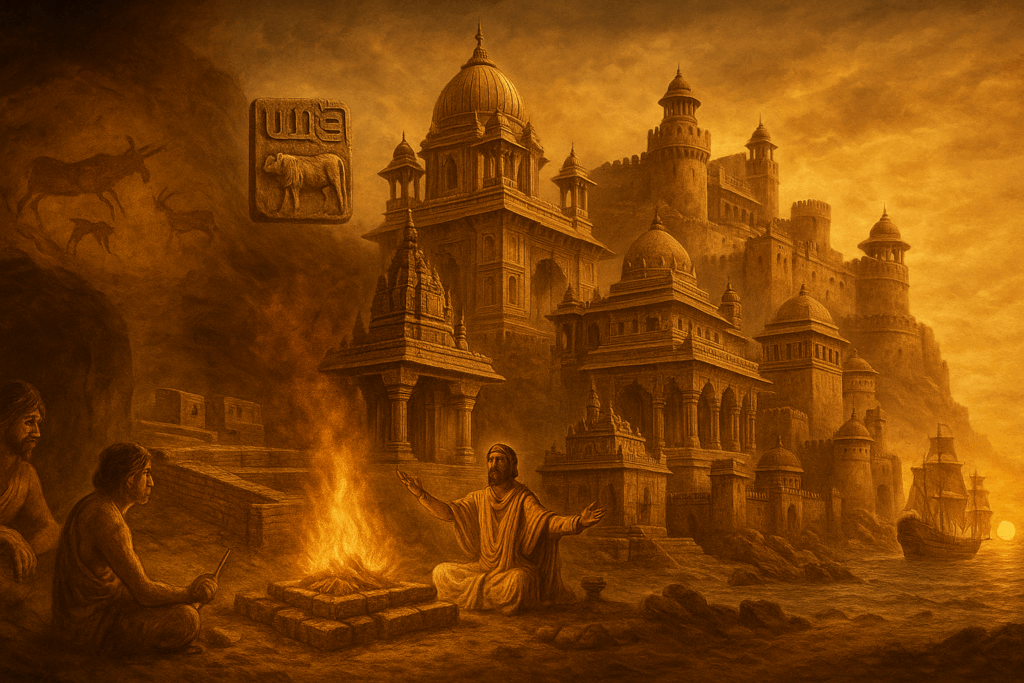
The history of India is a sprawling and intricate tapestry, woven over millennia with threads of continuity and radical change. This report presents an exhaustive analysis of the timeline of Indian history, moving beyond a simple chronology to deconstruct the profound transformations in its political, social, administrative, and economic structures from the earliest times to the present day. The research indicates that India’s historical trajectory is not a linear progression but a cyclical process marked by periods of immense centralisation and consolidation, followed by phases of fragmentation and the re-emergence of regional powers.
Each epoch, from the unified Mauryan Empire to the decentralised Gupta era, and from the sophisticated Mughal administration to the exploitative British Raj, has left an indelible legacy. The core finding is that these structures were deeply interconnected: political stability often underpinned economic prosperity, which in turn influenced social hierarchies and administrative efficiency.
The article highlights pivotal moments of change, such as the Mauryan administrative revolution, the social synthesis of the medieval Bhakti and Sufi movements, the economic exploitation engineered by British colonial policies, and the complex trade-offs of post-independence economic liberalisation. Ultimately, the report demonstrates that the India of today, a sovereign, democratic, and liberalised republic, is a product of these layered historical experiences, inheriting both the innovative legacies of its ancient past and the profound challenges of its colonial and post-colonial eras.
The study of Indian history necessitates an approach that is both chronological and thematic in nature. Simply listing dates and events fails to capture the intricate dynamics of a civilisation that has continuously evolved over tens of thousands of years. This report, therefore, adopts a multi-dimensional analytical framework, examining the interdependencies of political, social, administrative, and economic structures across four major epochs: Ancient, Medieval, Colonial, and Post-Independence India.
By analysing these four pillars in each period, a more nuanced understanding of the forces that shaped the subcontinent can be achieved. This approach also acknowledges the various schools of historical thought, such as the Nationalist and Marxist schools, which have offered different interpretations of key events and developments over time.
Part I: Ancient India (c. 65,000 BCE – c. 600 CE)
Timeline and Key Civilisations
The earliest evidence of human habitation in India dates back to approximately 60000 BCE. The historical narrative begins to formalise with the Mesolithic Period (10,000 BCE – 8,000 BCE) and the Neolithic Period (8,000 BCE – 4,000 BCE), during which early hunter-gatherer societies transitioned to settled communities with the domestication of animals and the advent of agriculture.
This proto-historical phase led to the emergence of the Indus Valley (or Harappan) Civilisation, which flourished from c. 3000 BCE to 1500 BCE. Known for its remarkable urbanisation, this civilisation saw the rise of great cities like Mohenjo-Daro and Harappa by c. 2800 BCE. The economy was significantly dependent on trade, with its people exporting goods like terracotta pots, beads, and precious metals to Mesopotamia.
Following the decline of the Harappan culture around 1900 BCE, the subcontinent entered the Vedic Period (c. 1500 BCE – c. 500 BCE) with the migration of Indo-Aryans from Central Asia. This era is foundational to Indian civilisation, as it saw the composition of the Vedas and the establishment of the basic tenets of Hinduism. The small tribal
Janas of the Vedic period gradually evolved into more organised Janapadas and eventually the powerful Mahajanapadas by c. 600 BCE, which represented the second major urban civilisation after the Indus Valley. This era of consolidation culminated in the rise of the Mauryan Empire (c. 321-185 BCE), founded by Chandragupta Maurya after he overthrew the Nanda dynasty. The Mauryas were the first to unify most of the Indian subcontinent, ruling over an immense territory that stretched over 5 million square kilometres under Emperor Ashoka.
After the Mauryan decline around 184 BCE, a period of fragmentation and foreign invasions ensued. A second pan-Indian empire was established by the Gupta dynasty (c. 320-550 CE), which presided over a period of immense cultural, artistic, and scientific advancement often referred to as a “golden age”. The empire’s end was marked by the Hunas’ invasion around 450 CE.
Political and Administrative Evolution
The political landscape of ancient India was far from monolithic, witnessing a dynamic evolution from smaller, participatory units to large, highly structured empires. Pre-Mauryan polities included various forms of government, such as tribal assemblies, republics (like that of Vaishali), and monarchies. Institutions like the Vidatha (folk assembly), Sabha (council of elders), and Samiti (popular assembly) in the Vedic period demonstrate an early spirit of consultation and communal decision-making. This foundational layer of local governance, including the vital role of Panchayats in resolving disputes and managing village affairs, persisted even as larger empires emerged.
The Mauryan Empire, however, represents a radical departure from these earlier systems. It was a model of highly centralised administration, with the king (Swamin) holding supreme power and governing through a vast bureaucracy of trusted ministers (Amatyas). This centralised structure, supported by a large standing army, allowed the state to exert strict control over its vast territories and economic activities. The state invested heavily in building and maintaining roads and other infrastructure, which was a strategic move to enhance trade and commerce across the empire.
In stark contrast, the Gupta administration was characterised by a more decentralised, feudal system. While the empire maintained a strong central government and was divided into provinces (bhuktis) and districts (vishayas), a key feature was its reliance on a network of feudal lords or vassals (Samantas) who governed their territories with considerable autonomy in return for tribute and military support.
This meant the Gupta rulers required fewer officials than the Mauryas, as local and professional bodies (Guilds) took on greater administrative roles. The judicial system also became more developed, with a clear demarcation between civil and criminal law for the first time.
The administrative evolution from the Mauryas to the Guptas reveals a fundamental tension in Indian history: the struggle between maintaining a powerful, centralised state and the practical necessity of delegating authority to local and regional powers. The Mauryan model, while effective for unifying the subcontinent, proved difficult to sustain. The subsequent rise of the Gupta Empire saw a different approach, a decentralised, feudal system that was more adaptive to the challenges of governing a vast, diverse territory. This cyclical pattern of centralisation, followed by fragmentation and a new form of recentralization, is a recurring theme that would re-emerge in later historical periods.
The administrative differences between the two empires are significant and can be best understood through a direct comparison.
Table 1: Comparative Analysis of Mauryan and Gupta Administration
| Feature | Mauryan Empire (c. 322–185 BCE) | Gupta Empire (c. 320–550 CE) |
| Centralisation of Power | Highly Centralized | More Decentralised and Feudal |
| Bureaucratic Structure | Vast, highly structured bureaucracy with numerous officials (Amatyas). | Smaller central bureaucracy, relied on appointed officers (Kumaramatyas) and local bodies. |
| Feudal System | Absent, the state maintained a large standing army directly controlled by the emperor. | Present; relied on a network of feudal lords (Samantas) and subordinate kings for military and revenue. |
| Economic Control | Strict state control over economic activities, trade, and infrastructure. | Allowed for greater local control over land and resources; Guilds played a significant role. |
| Judicial System | Less detailed, though the king upheld dharma and was the final authority. | More developed with a clear demarcation between civil and criminal law. |
Social Fabric: Caste, Varna, and Gender Roles
The social structure of ancient India was defined by the varna system, which evolved over time. In the earliest Vedic period, society was divided into two main groups: the Indo-Aryan (arya varna) and the dasa varna (rival tribes). However, by the end of the Atharvaveda period, a new four-tiered hierarchy emerged: Brahmins (priests), Kshatriyas (rulers and warriors), Vaishyas (merchants and traders), and Shudras (labourers).
The Dalits or “Untouchables” were considered outside this system. The system became increasingly rigid over time, with the introduction of thousands of sub-castes (jatis) often based on specific occupations. While some historians attribute the origin of the caste system to the Aryans, others suggest that it evolved from the ritual kingship systems of pre-Vedic Dravidian cultures and the occupational groups of the Indus Valley Civilisation.
The status and roles of women also underwent a significant transformation over the course of the ancient period. During the early Vedic period, women were afforded a respectable status and enjoyed considerable freedom and equality. They had access to education, were permitted to participate in religious ceremonies, and had the freedom to choose their partners. The Rigveda even mentions female scholars and sages such as Maitreyi, Gargi, and Lopamudra.
However, in the later Vedic and post-Vedic periods, the status of women progressively declined. Their participation in public and political gatherings ceased, and they were gradually barred from formal education. Texts like the Arthashastra and Smritishastras imposed significant restrictions, and the birth of a daughter began to be viewed as a cause for regret. By the Gupta period, while society was flourishing in arts and sciences, women’s social standing had deteriorated, with laws emphasising their lifelong dependence on their fathers, husbands, and sons.
Economic Systems: Agriculture, Trade, and Revenue
Agriculture formed the bedrock of the ancient Indian economy. The Indus Valley Civilisation relied on farming and animal domestication, while the large empires that followed depended on stable agricultural productivity to sustain their vast populations. Economic activity became more complex with the rise of trade. The Indus Valley civilisation engaged in maritime trade with Mesopotamia, and by the period of the
Mahajanapadas, punch-marked silver coins were being minted, signalling the formalisation of commerce. The political unity and military security provided by the Mauryan Empire, combined with enhanced infrastructure and the increased use of coins as currency, significantly boosted trade and commerce. India’s economy was estimated to be the largest in the world for most of the period between the 1st and 17th centuries CE.
The primary source of state income was land revenue, which was typically collected as a one-sixth share of agricultural produce (Bhaga). In the early Vedic period, this was often a voluntary offering or tribute (Bali), but it became a more formalised tax as states grew. The Mauryan administration, with its structured bureaucracy, imposed taxes on a wide range of activities, including trade, mining, and irrigation.
The Gupta period saw the introduction of cash payments for land revenue for specific purposes, demonstrating an evolving fiscal system. Southern kingdoms like the Cholas also developed a sophisticated revenue system with detailed land surveys and systematic records.
Part II: Medieval India (c. 600 CE – 1757 CE)
Timeline and Key Dynasties
The early medieval period (6th to 13th centuries) began with the fragmentation of power after the decline of the Gupta Empire, giving rise to numerous regional states. Major dynasties of this era included the Chalukyas, Rashtrakutas, and Palas. In the south, the Chola Empire established a powerful overseas presence, controlling parts of modern-day Sri Lanka, Malaysia, and Indonesia.
The late medieval period began with a series of Islamic invasions, which led to the founding of the Delhi Sultanate in 1206 CE by Qutbuddin Aibak after the Turkish conquests. The Sultanate ruled for over 300 years, extending its control as far as Madurai, and was governed by five successive dynasties. The medieval period reached its zenith with the establishment of the Mughal Empire by Babur in 1526 CE after the First Battle of Panipat. The Mughals presided over an era of unprecedented prosperity, and their empire became one of the world’s largest economies and manufacturing powers.
Political and Administrative Systems
The administrative framework of medieval India saw a transition from the fragmented polities of the early period to the more centralised imperial structures of the Sultanate and Mughal eras. The Delhi Sultanate established an Islamic state where the Sultan was the supreme head. Its central administration was organised into several key departments, including the Diwan-i-Wizarat (finance) headed by the Wazir, and the Diwan-i-Ariz (military) commanded by the Ariz-i-Mumalik.
For provincial administration, the Sultanate relied on the Iqta system, in which the empire was divided into provinces (Iqtas) and assigned to nobles (Muqtis or Walis) who were responsible for collecting revenue and maintaining law and order. This system, while effective for expansion, had an inherent weakness: as nobles became more powerful, they often asserted their independence, contributing to the Sultanate’s eventual fragmentation.
The Mughals, having witnessed the administrative instability of the Sultanate, introduced a highly centralised system. At the heart of this administration were the Mansabdari and Jagirdari systems, which served to centralise power and ensure the loyalty of the nobility. The Mansabdari system, introduced by Emperor Akbar, established a hierarchical rank (Mansab) for every official, which designated both their military rank and their administrative position.
This system integrated military and administrative functions, creating a disciplined bureaucracy directly accountable to the emperor. The Jagirdari system complemented this by assigning revenue-yielding land grants (Jagirs) to officials in exchange for their service. Crucially, these Jagirs were often transferable, which prevented officials from establishing permanent power bases in a single region, thus mitigating the risk of fragmentation seen under the Sultanate.
The evolution from the Delhi Sultanate’s Iqta system to the Mughal’s Mansabdari and Jagirdari systems reflects a significant administrative adaptation. While both systems involved the delegation of power and land, the Mughal model was a more sophisticated and centralised form of control. By tying an official’s rank and income directly to the emperor and the state’s military needs, the Mughals were able to ensure a greater degree of loyalty and prevent the emergence of independent regional power centres that had plagued the Sultanate.
This transition demonstrates a learned response to the perennial challenge of governing a vast, diverse subcontinent. The success of this model was a key factor in the stability and longevity of the Mughal Empire at its peak.
A detailed comparison of these administrative frameworks highlights their distinct approaches to governance.
Table 2: Key Administrative Differences: Delhi Sultanate vs. Mughal Empire
| Feature | Delhi Sultanate (1206–1526 CE) | Mughal Empire (1526–1857 CE) |
| Nature of Power | More fragmented and feudal; power delegated to nobles. | Strong central authority, with significant control over provincial and local governance. |
| Provincial System | Iqta system: provinces were granted to nobles (Muqtis), who managed law, order, and revenue. | Highly structured Mansabdari and Jagirdari systems. |
| Bureaucratic Structure | Central departments (Diwan-i-Wizarat, Diwan-i-Ariz) assist the Sultan. | A graded hierarchical bureaucracy of Mansabdars integrating military and administrative roles. |
| Revenue Collection | Based on the Iqta system, nobles collected revenue and remitted a share to the centre. | Based on Jagirs, which were revenue assignments granted to officials for their service. |
| Military Organization | The Sultan was Commander-in-Chief, with a large army of about 3 lakh soldiers under Ariz-i-Mumalik. | The Mansabdari system itself was a military ranking structure, ensuring a disciplined and loyal military force. |
Socio-Cultural Dynamics
The medieval period was marked by profound socio-cultural developments, largely influenced by the interaction between the indigenous Hindu traditions and the newly introduced Islamic culture. This interaction led to a significant “cultural syncretism” and the emergence of a composite “Hindustani culture”. The rise of the Bhakti and Sufi movements was a pivotal aspect of this synthesis.
Sufism, a mystical form of Islam, found resonance with indigenous philosophies and practices. Many Sufis in India preached a message of divine unity that was seen as similar to the Vedantic philosophy of Hinduism, thus acting as a powerful mediating force between the two cultures. Similarly, the Bhakti movement, which swept through northern India from the 14th to the 17th century, was a powerful force for social change.
As a cultural renaissance and a revolt against the caste system, it preached a central doctrine of social equality and personal devotion to God, attracting a wide following from all sections of society. The Bhakti saints, who themselves came from various social strata, proclaimed that caste had no meaning in devotion. The movements introduced new forms of religious expression, such as group singing (Kirtan) and emotional love songs to the Lord, and gave new impetus to the growth of regional languages and literature.
These spiritual movements were not merely religious phenomena; they were powerful catalysts for social change. While the political structures were defined by rulers and their administrative innovations, the Bhakti and Sufi movements demonstrate that societal evolution was also driven by powerful, grassroots cultural and spiritual forces that transcended political and communal divides. Their teachings provided an outlet for a form of social resistance and a means of cultural synthesis that was essential for reconciliation and coexistence.
Economic Landscape
The medieval Indian economy was one of the largest and most prosperous in the world. Agriculture remained the primary economic activity, with land revenue serving as the major source of income for rulers. Alauddin Khalji, for instance, raised the land revenue to half the share of the produce. Sher Shah and later Akbar modernised this system, implementing a uniform land measurement system to ensure a more rational and effective collection process.
Beyond its agrarian base, the Indian economy thrived on a vast network of inland and international trade. The Mughals presided over an era where the country was a major global manufacturing power, producing about a quarter of the world’s GDP and leading in the production and export of high-quality textiles and other handicrafts. Key industries also included a technologically advanced shipbuilding sector, which produced vessels that were on par with European counterparts.
The Mughals welcomed European trading companies, integrating India into the global trade network that brought silver and other goods into the subcontinent. Major trade routes, both sea and land, connected India with regions as far as Southeast Asia, the Middle East, and Europe. Inland trade was also vibrant, with major commercial hubs like Delhi, Agra, and Lahore facilitating the movement of goods across the empire.
Part III: Colonial India (1757 – 1947)
Timeline and Major Events
The period of British rule began with the decline of the Mughal Empire in the early 18th century and the rise of powerful regional states like the Marathas and Sikhs. The British East India Company, which had been present as a trading entity, gradually asserted political dominance after key victories, most notably the Battle of Plassey in 1757. This era of Company rule culminated in the transfer of power to the British Crown following the Indian Rebellion of 1857, marking the beginning of the British Raj. This period, which concluded with India’s independence in 1947, was defined by a profound and lasting transformation of the subcontinent’s political, economic, and social structures.
Administrative Overhaul
The British Raj fundamentally restructured India’s administrative system. It established a highly centralised bureaucracy, a uniform civil service, a police force, and a judicial system based on English common law. This shift from the more fragmented and decentralised indigenous systems to a top-down, centralised state was a hallmark of colonial governance. A key feature of this administrative machinery was its use as a tool for economic exploitation. The most significant example of this was the British land revenue policies, which were designed to secure a steady income for the colonial power by transforming traditional land relationships.
The British introduced three major land revenue systems, each with unique features and devastating consequences.
- Permanent Settlement (1793): Implemented in Bengal, Bihar, and Orissa, this system recognised Zamindars as hereditary landowners who were responsible for collecting a fixed revenue from peasants and remitting it to the British. This created a new class of wealthy, loyal landlords, but it led to the impoverishment of farmers who were subjected to high, arbitrary tax demands. The policy made land a transferable commodity, which could be sold if a Zamindar defaulted on payments, a practice formalised by the “Sunset Law”.
- Ryotwari System: Introduced in the Madras and Bombay Presidencies, this system eliminated the Zamindar intermediary and settled revenue directly with the individual cultivators (ryots). While it theoretically provided peasants with ownership rights, the revenue demands were excessively high (50-60% of the produce) and were rigidly enforced, regardless of crop failure. This forced farmers into a cycle of debt and often led to land alienation to moneylenders.
- Mahalwari System: This system, prevalent in the North-Western Provinces and Punjab, made revenue settlements with entire villages (mahals) or landholding communities. A village headman was tasked with collecting revenue, which was often fixed at a very high rate (50-75% of the produce). Like the other systems, it resulted in peasant suffering, indebtedness, and land passing into the hands of moneylenders and merchants.
These administrative systems were not merely legal or organisational reforms; they were powerful economic tools that engineered the “drain of wealth” from India. By replacing traditional revenue collection, which was often a share of the produce, with a fixed, commercial obligation, the British made the rural economy and the fate of the peasant directly dependent on a punitive, foreign-controlled market system. The introduction of concepts like land transferability and mortgage fundamentally altered the agrarian structure and created the conditions for widespread rural poverty and indebtedness.
A comparative table highlights the key features of these systems and their far-reaching consequences.
Table 3: British Land Revenue Systems: Features and Impacts
| System Name | Permanent Settlement (1793) | Ryotwari System (1820) | Mahalwari System (1819) |
| Proponents | Lord Cornwallis | Thomas Munro and Alexander Read | Holt Mackenzie and James Thomson |
| Regions | Bengal, Bihar, Orissa, and parts of Madras and Varanasi | Madras, Bombay, and parts of Assam | North-Western Provinces, Punjab, Gangetic Valley |
| Unit of Assessment | The Zamindar (landlord) | The individual cultivator (ryot) | The village (mahal) or community |
| Revenue Nature | Fixed in perpetuity; not to be increased | Periodically revised every 20-30 years | Periodically revised |
| Impact on Peasants | Subjected to high demands from Zamindars, Led to impoverishment and land loss | Direct payment to the government, but high rates led to debt and land alienation | High revenue demands led to debt, forcing land to pass to moneylenders |
Economic Transformation
The colonial era marked a period of profound economic subjugation. India, once a global economic powerhouse, underwent a process of de-industrialisation and was transformed into a supplier of raw materials and a captive market for British-manufactured goods. This was driven by a deliberate “preferential trade policy”. British machine-made textiles and other goods were imported into India duty-free, while Indian exports faced high tariffs in Britain, making them uncompetitive. The once-thriving textile, shipbuilding, and steel industries declined precipitously as a result.
The colonial administrative infrastructure, including the railways and telegraphs, was primarily established to serve British commercial and strategic interests, facilitating the swift exploitation and export of India’s resources. This extensive economic drainage resulted in a drastic decline in India’s share of the global economy, from 24.4% in 1700 to a mere 4.2% by 1950. This period of exploitation left India with a fragile, impoverished economy burdened by high illiteracy and low per capita income at the time of independence.
Social Stratification and Reform Movements
While British policies led to economic impoverishment, they also had a lasting impact on India’s social fabric. The British formalised the caste system through censuses and administrative policies, which in some cases exacerbated existing social divisions and rigidities. However, the same period also saw the rise of significant social reform movements. Figures like Raja Ram Mohan Roy and Ishwar Chandra Vidyasagar campaigned against oppressive practices like Sati and child marriage and advocated for widow remarriage and women’s education. The introduction of Western education by the British, while initially serving their own administrative needs, inadvertently created a new class of educated Indians who would later lead the nationalist and independence movements.
Part IV: Post-Independence India (1947 – Present)
Timeline and Major Milestones
India gained independence on August 15, 1947, a moment marred by the Partition that led to the creation of India and Pakistan. The new Government of India, led by Prime Minister Jawaharlal Nehru and with Sardar Vallabhbhai Patel overseeing the integration of princely states, embarked on the monumental task of nation-building. In 1950, India adopted its Constitution, which established it as a Sovereign Socialist Secular Democratic Republic with a parliamentary system of government. The country held its first national elections in 1952, solidifying its commitment to a multi-party democracy.
Political and Administrative Integration
The first major challenge for the newly independent nation was the political integration of more than 565 princely states into the Indian Union. Under the leadership of Sardar Vallabhbhai Patel, the new government successfully merged these territories through a combination of political negotiations and, when necessary, military action. This process created a unified nation and transformed the administrative structures of these states to align with the central government’s authority and the new Constitution.
The Indian Constitution became the supreme legal authority, establishing a federal structure with a clear division of legislative powers between the Union and the States. It guaranteed fundamental rights to all citizens, established an independent judiciary, and ensured free and fair elections, laying the foundation for modern governance. This system has been sustained, making India’s democracy unique among the world’s newly independent states.
Economic Trajectory: Central Planning to Liberalisation
Independent India inherited a fragile, predominantly agrarian economy. Under Jawaharlal Nehru, the nation adopted a state-directed model of “import substitution industrialisation” and a “mixed economy”. Public investment was channeled into heavy industries and infrastructure, a strategy that, despite criticism of the restrictive “License Raj,” resulted in an annual GDP growth of about 4% between 1950 and 1964, a significant improvement over the colonial era.
However, the mid-1960s brought a severe food crisis, prompting the launch of the Green Revolution. This initiative introduced high-yielding varieties of seeds, modern irrigation, and improved agricultural technology, successfully making India self-sufficient in food grains. Yet, this economic success came with significant social costs. The high cost of inputs and a lack of government support meant that many small farmers could not participate, which widened the gap between wealthy and poor farmers and led to increased indebtedness and a rise in farmer suicides in some regions.
Faced with a severe balance of payments crisis in 1991, India initiated a series of transformative economic reforms, moving from a closed, centrally planned model to a more liberalised and market-oriented one. The LPG model – Liberalisation, Privatisation, Globalisation – dismantled the “License Raj,” reduced public sector dominance, and opened the economy to foreign investment. These reforms accelerated India’s GDP growth to an average of 6-7% annually, significantly increased foreign investment, and led to the expansion of the private sector.
However, a closer look at the post-1991 period reveals that these economic successes have been accompanied by significant social consequences. The economic growth has been criticised as “jobless growth,” a phenomenon where high GDP growth does not translate into a sufficient increase in employment, particularly in the manufacturing and agriculture sectors. The reforms have also led to increased social and spatial inequality, and India’s integration into the global economy has made it more vulnerable to fluctuations in global commodity prices and foreign monetary policies, such as those of the U.S. Federal Reserve.
The economic journey of modern India is a complex narrative of trade-offs. The pursuit of growth and stability, while necessary, has often come at the expense of social equity and environmental sustainability. It demonstrates that economic policy is not an isolated function but a powerful driver of social stratification and inequality.
A comparative table illustrates the key economic shifts and their social consequences.
Table 4: Economic Shifts and Social Consequences: Pre- vs. Post-1991 Reforms
| Feature | Pre-1991 Economic Era (c. 1950-1990) | Post-1991 Economic Reforms (LPG) |
| Economic Model | State-led Industrialisation, Mixed Economy (License Raj) | Liberalization, Privatization, Globalization (LPG) |
| Key Features | Public sector dominance, import substitution, extensive government controls and licensing | Abolition of industrial licensing, reduced public sector role, promotion of foreign investment and trade |
| GDP Growth Rate | Averaged 3.5% annually; “Hindu rate of growth” | Accelerated to 6-7% annually; became one of the fastest-growing major economies |
| Social Consequences | High poverty, low per capita income, and an agrarian-dominated economy | “Jobless growth,” increased social inequality, and heightened vulnerability to global economic shocks |
Conclusion: Synthesis and Legacy
The historical journey of India is a testament to its remarkable resilience and capacity for change. The analysis reveals a recurring pattern: periods of centralised political authority, from the Mauryas to the Mughals, often coincided with economic prosperity and administrative innovation. However, the models of governance and societal organisation were never static. The shift from the Mauryans’ rigid centralisation to the Guptas’ pragmatic feudalism, and from the Delhi Sultanate’s delegated Iqta system to the Mughals’ more controlled Mansabdari framework, demonstrates a continuous effort to adapt to the challenge of ruling a subcontinent of immense diversity.
The colonial era introduced a radical discontinuity, not merely replacing one set of rulers with another, but fundamentally re-engineering administrative and economic structures for exploitation. The British land revenue systems stand as a stark example of how administrative policy can be used as a tool for economic subjugation, transforming social relationships and creating widespread poverty.
In the post-independence era, India has grappled with the legacies of both its ancient past and its colonial history. The political integration of princely states and the adoption of a federal constitution were responses to the fragmented polities of earlier times. Similarly, the economic journey from state-led planning to market liberalisation reflects a continuous search for a model that can deliver growth and address historical vulnerabilities. However, the experience of the Green Revolution and the post-1991 reforms demonstrates that economic triumphs can come at a social cost, highlighting the complex and often paradoxical trade-offs inherent in national development.
In summary, the political, social, administrative, and economic structures of India have not evolved in isolation. They have co-existed in a dynamic, causal relationship, with changes in one domain inevitably influencing the others. The India of today is a complex product of these intertwined historical layers, and its future will be shaped by how it continues to reconcile the innovative spirit of its past with the enduring challenges of its present.
Detailed Chronological Table
| Date (Approximate) | Event or Period |
| c. 60000 BCE | Human habitation of India |
| c. 7000 BCE | Evidence of religious practices in the Indus Valley |
| c. 7000 BCE – c. 600 BCE | The Indus Valley (or Harappan) Civilisation Period |
| 5500 BCE | Cotton cultivation begins in India |
| c. 4000 BCE | Farming settlements are established in the Indus Valley |
| c. 3300 BCE | Early Harappan Civilisation practised the burial of the dead |
| c. 3000 BCE | First signs of urbanisation in the Indus Valley |
| c. 2800 BCE – c. 1900 BCE | The rise of Mohenjo-Daro and Harappa |
| 2000 BCE | Pepper is widely used in Indian cooking |
| c. 1900 BCE – c. 1500 BCE | Decline of the Harappan Culture |
| c. 1500 BCE – c. 500 BCE | The Vedic Period in India |
| c. 600 BCE | Emergence of 16 Mahajanapadas |
| 563 BCE – c. 483 BCE | The life of Siddhartha Gautama (Buddha) |
| 540 BCE | Birth of Vardhamana Mahavira (Founder of Jainism) |
| 530 BCE | Persia conquers the Indus Valley |
| 327 BCE – 326 BCE | Alexander’s campaign in northern India |
| 322 BCE | Establishment of the Mauryan dynasty |
| 268 BCE – 232 BCE | Reign of Ashoka the Great |
| 261 BCE | End of the Kalinga War |
| 184 BCE | The decline of the Mauryan Empire |
| 100 BCE | Establishment of the Satavahana Dynasty in the Deccan |
| 78 CE | The Shaka era was started by the Kushan ruler Kanishka |
| 240 CE | Establishment of the Gupta Empire by Sri Gupta |
| 319 CE | Beginning of the Gupta era by Chandragupta I |
| 335 to 380 CE | Reign of Samudragupta |
| 450 CE | Hunas invasion and the end of the Gupta Empire |
| 606 to 647 CE | Period of King Harshavardhana |
| 712 CE | Attack of Muhammad bin Kassim |
| 753 CE | Establishment of the Rashtrakuta dynasty |
| 1000 to 1027 CE | Invasion of India by Mahmud of Ghazni |
| 1192 CE | Second Battle of Tarain: Prithviraj III defeated |
| 1206 CE | Establishment of the Delhi Sultanate by Qutbuddin Aibak |
| 1290 CE | Establishment of the Khalji dynasty |
| 1320 CE | Establishment of the Tughlaq dynasty |
| 1336 CE | Establishment of the Vijayanagara Empire by Harihara and Bukka |
| 1398 CE | Invasion of Delhi by Timur |
| 1498 CE | Arrival of Vasco da Gama at Calicut |
| 1526 CE | First Battle of Panipat; Establishment of the Mughal Empire |
| 1565 CE | Battle of Talikota; decline of the Vijayanagara empire |
| 1600 CE | The charter of the British East India Company |
| 1739 CE | Battle of Karnal; Nadir Shah occupies Delhi |
| 1757 CE | Battle of Plassey; British troops occupied Calcutta |
| 1793 CE | Permanent Settlement Regulation of 1793 |
| 1853 CE | First passenger rail opened in India (Bombay to Thane) |
| 1857 CE | Indian Rebellion; end of Company rule and start of the British Raj |
| 1905 CE | The partition of Bengal took place |
| 1947 CE | Independence of India and Partition |
| 1950 CE | The Constitution of India was adopted |
| 1965 CE | The Green Farming Revolution begins |
| 1991 CE | The New Economic Policy (LPG reforms) is introduced |
Sources:
- Indian History Chronology: Ancient India to Modern India – Learn faster! – Clear IAS, accessed September 16, 2025, https://www.clearias.com/indian-history-chronology/
- Timeline: India – World History Encyclopedia, accessed September 16, 2025, https://www.worldhistory.org/timeline/india/
- India’s Ancient History Timeline – Education Province, accessed September 16, 2025, https://educationprovince.com/india-ancient-history-timeline/
- History of India: Ancient, Medieval & Modern History Timeline – Testbook, accessed September 16, 2025, https://testbook.com/ias-preparation/chronology-of-ancient-to-modern-history-of-india
- HISTORY OF INDIAN ECONOMY, accessed September 16, 2025, https://cgijeddah.gov.in/web_files/267622636-History-of-Indian-Economy.pdf
- Maurya and Gupta Empires – Expansion of Maurya, Chandragupta …, accessed September 16, 2025, https://www.vedantu.com/history/the-maurya-and-gupta-empires
- archive.stmarys-ca.edu, accessed September 16, 2025, https://archive.stmarys-ca.edu/archive-library-602/political-structure-of-ancient-india.pdf
- Ancient India Polity: Brief History, Characteristics Here! – Testbook, accessed September 16, 2025, https://testbook.com/static-gk/ancient-india-polity
- Economic history of India – Wikipedia, accessed September 16, 2025, https://en.wikipedia.org/wiki/Economic_history_of_India
- Governance And Administration Of The Gupta Empire: Structure And …, accessed September 16, 2025, https://pwonlyias.com/udaan/gupta-empire-administration/
- Caste system in India – Wikipedia, accessed September 16, 2025, https://en.wikipedia.org/wiki/Caste_system_in_India
- Analyzing Religious & Social Structures in Ancient India Practice – Study.com, accessed September 16, 2025, https://study.com/skill/practice/analyzing-religious-social-structures-in-ancient-india-questions.html
- STATUS AND CONDITION OF WOMEN IN ANCIENT INDIAN SOCIETY – International Journal of Education and Science Research Review, accessed September 16, 2025, https://ijesrr.org/publication/51/79%20ijesrr%20jan%202018%20ugc%20apporoved.pdf
- Women in Ancient India – lwtcpl.com, accessed September 16, 2025, https://www.lwtcpl.com/post/women-in-ancient-india
- Status of women during different period | PPT – SlideShare, accessed September 16, 2025, https://www.slideshare.net/slideshow/status-of-women-52039418/52039418
- Women in the Rig Vedic Period – Unacademy, accessed September 16, 2025, https://unacademy.com/content/railway-exam/study-material/history/women-in-the-rig-vedic-period/
- 2347-7075 Impact Factor – 8.141 Revenue System in Ancient India – Zenodo, accessed September 16, 2025, https://zenodo.org/records/15240014/files/34.pdf?download=1
- History of Land Tenure System in India (upto Permanent Settlement in Bengal), accessed September 16, 2025, https://www.wbja.nic.in/wbja_adm/files/scan0047_1.pdf
- Medieval India – Wikipedia, accessed September 16, 2025, https://en.wikipedia.org/wiki/Medieval_India
- Chronology of Historical Events in Indian History, accessed September 16, 2025, https://www.jagranjosh.com/general-knowledge/historical-events-in-indian-history-1393410497-1
- Administration under Delhi Sultanate (UPSC Notes) – BYJU’S, accessed September 16, 2025, https://byjus.com/free-ias-prep/administration-under-delhi-sultanate/
- De-industrialisation of India – Wikipedia, accessed September 16, 2025, https://en.wikipedia.org/wiki/De-industrialisation_of_India
- Socio-Cultural and Economic History of Medieval India (1700A.D. – Assignment Help, accessed September 16, 2025, https://www.indiaassignmenthelp.com/socio-cultural-and-economic-history-of-medieval-india-1700a-d-1900-a-d-assignment-help
- polsci.institute, accessed September 16, 2025, https://polsci.institute/indian-political-thought-l/key-differences-mughal-delhi-sultanate-administration/#:~:text=Unlike%20the%20Delhi%20Sultanate%2C%20which,over%20provincial%20and%20local%20governance.
- Mansabdari and Jagirdari System | PDF – Scribd, accessed September 16, 2025, https://www.scribd.com/document/735937083/Mansabdari-and-jagirdari-system
- A Comparative Analysis of the Mughal Kaleen Mansabdari System …, accessed September 16, 2025, http://proceeding.conferenceworld.in/SAH-2K22/19.pdf
- Impact of Islam on Indian Culture: Bhakti and Sufi Movements, accessed September 16, 2025, https://www.historydiscussion.net/history-of-india/impact-of-islam-on-indian-culture-bhakti-and-sufi-movements/2022
- The Impact of Islam and Sufism On The Monotheistic Bhakti Movement | PDF – Scribd, accessed September 16, 2025, https://www.scribd.com/document/597404541/The-impact-of-Islam-and-sufism-on-the-monotheistic-bhakti-movement
- Economic and Social Life of Delhi Sultanate – Medieval India History, accessed September 16, 2025, https://prepp.in/news/e-492-economic-and-social-life-of-delhi-sultanate-medieval-india-history-notes
- www.insightsonindia.com, accessed September 16, 2025, https://www.insightsonindia.com/medieval-indian-history/delhi-sultanate/economy-during-delhi-sultanate-period/#:~:text=Land%20revenue%20was%20major%20source,the%20bulk%20of%20the%20people.
- Trade And Commerce In Medieval India: Detailed Notes For UPSC! – Testbook, accessed September 16, 2025, https://testbook.com/ias-preparation/trade-and-commerce-in-medieval-india
- Mughal Empire History, Technology & Economy – Lesson | Study.com, accessed September 16, 2025, https://study.com/academy/lesson/the-mughal-empire-economy-technology-trade.html
- the trade routes & trade centres in the 16th & 17th century – BSSS Publication, accessed September 16, 2025, https://bssspublications.com/Home/IssueDetailPage?IsNo=473
- British Policies in India from 1765 to 1857, UPSC Notes – Vajiram & Ravi, accessed September 16, 2025, https://vajiramandravi.com/upsc-exam/british-policies-in-india/
- Impact of British Rule In India, Political, Cultural, Social Impact – Physics Wallah, accessed September 16, 2025, https://www.pw.live/ssc/exams/impact-of-british-rule-in-india
- The British Rule and its effect upon Social, Cultural and Economic Status of Rural India, accessed September 16, 2025, https://www.rjhssonline.com/AbstractView.aspx?PID=2020-11-4-13
- Land Revenue Policy: Permanent, Mahalwari & Ryotwari System – NEXT IAS, accessed September 16, 2025, https://www.nextias.com/blog/land-revenue-policy/
- British Land Revenue Systems: Permanent, Ryotwari, Mahalwari – BYOL Academy, accessed September 16, 2025, https://byolacademy.com/indian-freedom-struggle/british-land-revenue-systems/4080/
- Permanent Settlement of Bengal (UPSC Notes) – BYJU’S, accessed September 16, 2025, https://byjus.com/free-ias-prep/ncert-notes-permanent-settlement-of-bengal/
- Permanent Settlement 1793, History, Features, Impact, Merits, Demerits, accessed September 16, 2025, https://www.pw.live/ssc/exams/permanent-settlement-1793
- Permanent Settlement – Wikipedia, accessed September 16, 2025, https://en.wikipedia.org/wiki/Permanent_Settlement
- Ryotwari System and Mahalwari System – For UPSC – Testbook, accessed September 16, 2025, https://blogmedia.testbook.com/blog/wp-content/uploads/2021/04/ryotwari-system-and-mahalwari-system-for-upsc-00bb5430.pdf
- Ryotwari system | Meaning, India, & Tamil Nadu | Britannica, accessed September 16, 2025, https://www.britannica.com/topic/ryotwari-system
- Economy of India under the British Raj – Wikipedia, accessed September 16, 2025, https://en.wikipedia.org/wiki/Economy_of_India_under_the_British_Raj
- Economy of India | Post-Independence Growth, Agriculture, Manufacturing, & Trade | Britannica Money, accessed September 16, 2025, https://www.britannica.com/money/economy-of-India
- History of India (1947–present) – Wikipedia, accessed September 16, 2025, https://en.wikipedia.org/wiki/History_of_India_(1947%E2%80%93present)
- Political integration of India – Wikipedia, accessed September 16, 2025, https://en.wikipedia.org/wiki/Political_integration_of_India
- Constitution | Supreme Court of India, accessed September 16, 2025, https://www.sci.gov.in/constitution/
- www.india.gov.in, accessed September 16, 2025, https://www.india.gov.in/topics/governance-administration#:~:text=India%20is%20a%20Sovereign%20Socialist,constitutional%20head%20of%20the%20country.
- Evolution of Indian Economy Since Independence : 7 Major Highlights – Grip Invest, accessed September 16, 2025, https://www.gripinvest.in/blog/evolution-indian-economy
- Green Revolution in India – Wikipedia, accessed September 16, 2025, https://en.wikipedia.org/wiki/Green_Revolution_in_India
- Lessons From the Aftermaths of Green Revolution on Food System and Health – PMC, accessed September 16, 2025, https://pmc.ncbi.nlm.nih.gov/articles/PMC7611098/
- The Green Revolution of the 1960’s and Its Impact on Small Farmers in India – UNL Digital Commons, accessed September 16, 2025, https://digitalcommons.unl.edu/cgi/viewcontent.cgi?article=1027&context=envstudtheses
- New Economic Policy 1991, Objectives, Features, Impacts – Vajiram & Ravi, accessed September 16, 2025, https://vajiramandravi.com/upsc-exam/new-economic-policy-1991/
- The Effects of India’s 1991 Balance of Payments Crisis, accessed September 16, 2025, https://ojs.stanford.edu/ojs/index.php/intersect/article/download/3023/1782/11621
- Economic liberalisation in India – Wikipedia, accessed September 16, 2025, https://en.wikipedia.org/wiki/Economic_liberalisation_in_India
- Major economic reforms were introduced in India in 1991–93. – Brookings Institution, accessed September 16, 2025, https://www.brookings.edu/wp-content/uploads/2016/07/2005_bhalla_das.pdf
- Inequality in India: A survey of recent trends – the United Nations, accessed September 16, 2025, https://www.un.org/esa/desa/papers/2007/wp45_2007.pdf
- Chronological of Important Events in Indian History | PDF | South Asia | British India – Scribd, accessed September 16, 2025, https://www.scribd.com/document/657879304/chronological-of-important-events-in-indian-history