Table of Contents
What is Hinduism and what does Sanatana Dharma mean?
Hinduism is a diverse family of traditions and philosophies that originated in the Indian subcontinent, characterized by a belief in the authority of the Vedas, the cycle of reincarnation, and the pursuit of liberation.
Adherents often refer to their tradition as Sanatana Dharma, a Sanskrit phrase translating to “the eternal law” or “eternal way,” emphasizing that the principles governing existence are timeless and universal. Unlike many global religions, Hinduism is not a monolithic system with a single founder or creed; rather, it is a “basket of multiple faiths” that shares core metaphysical concerns while allowing for vast regional and philosophical variation.
The history of the name itself reveals the geographical origins of the term. “Hindu” is an exonym derived from the Sanskrit word Sindhu, the ancient name for the Indus River. Ancient Persians, unable to easily pronounce the initial “S,” referred to the people living beyond the river as “Hindus”.
This geographical label was later adopted by the Greeks as Indos and by the British as Hinduism in the 19th century to categorize the indigenous religious practices of India that were not Islamic, Christian, or Jain. Consequently, the term Sanatana Dharma is preferred by many scholars and practitioners to highlight the tradition’s perceived eternal and non-sectarian nature, transcending historical and political labels.
Who founded Hinduism?
Hinduism has no single human founder or specific date of origin, making it unique among the world’s major religions. It is considered a “revealed” tradition (Shruti), meaning its core truths were perceived by ancient sages known as Rishis through deep meditation and spiritual insight. These insights were later compiled into the Vedas, which serve as the foundational authority for most Hindu traditions.
The absence of a founder facilitates a decentralized structure where authority is distributed among various lineages (Sampradayas), spiritual teachers (Gurus), and sacred texts.
This lack of a central historical figure has allowed Hinduism to evolve organically over millennia, integrating diverse tribal, local, and philosophical traditions into its expansive landscape. This evolution has produced a rich tapestry of thought ranging from the ritualistic focus of the early Vedic period to the profound non-dualist philosophy of the Upanishads and the emotionally resonant devotion of the Bhakti movement.
How old is Hinduism compared to other religions?
Hinduism is widely regarded as the world’s oldest living religion, with roots extending back at least 4,000 years. While its formal textual history begins with the composition of the Vedas (c. 1500-1200 BCE), archaeological evidence from the Indus Valley Civilization (c. 3300-1700 BCE) suggests that many characteristic elements of Hindu practice, such as the worship of a mother goddess and proto-Shiva figures, were present long before the Vedic era.
In a comparative context, Hinduism’s antiquity predates the formal establishment of most other major global faiths. The following table contextualizes its historical timeline relative to other significant traditions and milestones:
| Historical Era | Key Religious and Cultural Milestones | Significance in Hindu History |
| 3300–1700 BCE | Indus Valley Civilization (Mature Phase) | Early iconography of lingams, goddess figures, and yogic postures found in cities like Mohenjo-Daro. |
| 1500–1000 BCE | Composition of the Rigveda | The oldest layered text of the Vedas, establishing the foundations of Vedic ritual and mantra. |
| 800–400 BCE | Upanishadic Era & Axial Age | Shift toward philosophical introspection; central concepts of Brahman and Atman are codified. |
| 500 BCE | Rise of Buddhism and Jainism | Heterodox (Nastika) traditions emerge as critiques of Vedic ritualism. |
| 200 BCE–200 CE | Composition of major Epics & Dharma Shastras | The Ramayana and Mahabharata take shape, along with the Manusmriti. |
| 19th Century | Modern Hindu Renaissance | Leaders like Swami Vivekananda introduce Hindu philosophy (Vedanta) to the global stage. |
Is Hinduism a monotheistic or polytheistic religion?
Hinduism is most accurately described as monistic or panentheistic – believing in a single, ultimate Divine Reality that manifests in a multitude of forms. While the tradition recognizes millions of deities, they are understood as different aspects or functions of one Supreme Being, often referred to as Brahman. This view is often termed henotheism: the worship of one Supreme God without denying the existence of other gods.
The philosophical nuance lies in the distinction between Brahman (the impersonal, infinite consciousness) and Ishvara (the personal God with form). Brahman is Nirguna (without attributes and unknowable), while the various gods and goddesses are Saguna (with attributes), allowing human beings to relate to the Divine through personal qualities like compassion, wisdom, or strength.
What is the meaning of Brahman in Hindu philosophy?
In Hindu metaphysics, Brahman is the Ultimate Reality, the infinite and all-pervasive consciousness that is the source and essence of the entire universe. Brahman is not a “god” in the sense of a celestial being but is the ground of all existence, transcending time, space, and causality. According to the Advaita (non-dualist) school of philosophy, the true nature of every individual soul (Atman) is identical to Brahman, but this realization is obscured by spiritual ignorance (Avidya) and the illusion of the material world (Maya).
| School of Vedanta | Interpretation of God (Brahman) | Relationship with the Soul (Atman) |
| Advaita | Brahman is the only truth; all form is an illusion. | Identical: Jivo Brahmaiva Naparah (The soul is none other than Brahman). |
| Vishishtadvaita | Brahman is a personal God (Vishnu) with infinite qualities. | Qualified Oneness: The soul is a part of God, like a leaf is part of a tree. |
| Dvaita | Brahman (Vishnu) is a distinct, supreme, and independent reality. | Absolute Duality: God and the soul are eternally separate and distinct. |
Why do Hindus worship many different deities?
The multiplicity of deities in Hinduism allows practitioners to approach the Divine through forms that resonate with their specific needs, temperaments, and life situations. These deities act as “executives in a large corporation,” each responsible for different cosmic functions. For example, a student may worship Saraswati for wisdom, a business owner may worship Lakshmi for prosperity, and those facing obstacles may pray to Ganesha.
This pluralism is summarized in the Rigvedic dictum: “Truth is one, the wise call it by many names”. By offering various forms, Hinduism provides a “multiplicity of paths” rather than demanding conformity to a single manifestation of the Divine. This encourages a highly personalized spiritual life where an individual chooses an Ishta Devata (preferred deity) while respecting the validity of others’ choices.
Why are Hindu gods often depicted with blue skin or animal features?
The iconography of Hindu deities is a symbolic language used to convey complex spiritual concepts through visual art. Blue skin, as seen in Vishnu or Krishna, represents the infinite and all-pervasive nature of the Divine, mirroring the vastness of the sky or the depth of the ocean. It signifies that the deity is beyond the physical limitations of mortal skin and exists as an eternal force.
Animal features are equally symbolic, illustrating that the Divine is present in all of nature and that every form of life is sacred. Ganesha’s elephant head represents supreme intelligence and the capacity to “think big,” while Hanuman’s monkey (vaanara) form symbolizes the power of the mind when controlled by devotion and discipline. These depictions serve as meditative tools, helping the devotee focus on specific divine qualities like strength, protection, or compassion.
Are Hindus idol worshipers?
What people often misunderstand: Hindus do not believe that a physical statue is God. Instead, they use icons, known as Murtis, as focal points for prayer and meditation. This practice, called Murti Puja, is a deeply symbolic act of connecting with the Divine through form. To a Hindu, the Murti is a “conduit” or a spiritual tool that helps the finite human mind concentrate on the infinite Divine.
In the same way that a person might cherish a photograph of a loved one – not because they believe the paper is the person, but because it evokes their presence – the Murti helps the devotee invoke the presence of the Divine. Most Hindu rituals involve a process called Prana Pratishtha, where the deity’s essence is ritually invited into the icon for the duration of the worship, acknowledging that the Divine is ultimately formless but can be accessed through form.
What is the law of Karma in Hinduism?
Karma is the universal law of cause and effect, stating that every action, word, and thought produces a corresponding consequence that will eventually return to the individual. It is not a system of divine reward or punishment administered by an external judge, but a self-regulating psychological and cosmic mechanism. Positive, selfless actions (Punya) generate good karma, leading to favorable future outcomes, while harmful or selfish actions (Papa) lead to suffering and spiritual obstacles.
One common misunderstanding is that karma implies fatalism or a “fixed destiny”. In reality, karma emphasizes personal responsibility and free will. While past actions determine one’s current circumstances (the “hand of cards” one is dealt), the individual has the absolute freedom to choose how they act in the present, thereby shaping their future karma and spiritual evolution.
What is the meaning of Dharma?
Dharma is the ethical and moral foundation of Hinduism, often translated as “duty,” “righteousness,” or “universal order”. It refers to the principles that maintain the harmony of the universe and the specific obligations an individual must fulfill based on their nature and role in society. Living according to dharma is considered essential for achieving both worldly success and spiritual peace.
Dharma is layered and contextual:
- Sanatana Dharma: Universal ethics applying to all, such as truthfulness, compassion, and non-violence (Ahimsa).
- Varnashrama Dharma: Duties associated with one’s stage of life and social position.
- Sva-dharma: One’s unique personal path and responsibility, which may vary from person to person.
How does reincarnation work?
Reincarnation, or Samsara, is the process by which the soul (Atman) is born into a new physical body after the death of the previous one. Hindus believe that the soul is eternal and immortal, undergoing a series of births to learn lessons, exhaust past karma, and gradually evolve toward spiritual perfection.
The soul’s next destination is determined by the cumulative weight of its karma. Just as a person discards old clothes to wear new ones, the soul discards an aged or damaged body to inhabit a new form – whether human, animal, or celestial. This cycle of birth and death continues until the soul achieves complete self-realization and detaches from material desires.
What is the ultimate goal of Moksha?
Moksha is the ultimate spiritual goal in Hinduism, representing liberation from the cycle of reincarnation (Samsara) and the attainment of eternal peace or union with the Divine. It is achieved through “Self-realization” (Atma-jnana), the profound experiential understanding that one’s true nature is divine and one with the Ultimate Reality.
Reaching moksha requires the overcoming of spiritual ignorance (Avidya) and the elimination of ego-driven desires and attachments. While some schools believe moksha can only be attained after death, others, like Advaita Vedanta, teach the concept of Jivanmukti – liberation while still alive in the physical body through the attainment of perfect knowledge and equanimity.
What are the four Vedas and why are they important?
The Vedas are the most ancient and authoritative scriptures of Hinduism, considered Apaurusheya (not of human origin) and eternal in nature. They were “heard” by ancient sages during deep meditation and transmitted orally for generations before being committed to writing. The four Vedas are:
| Veda | Focus and Content | Significance |
| Rigveda | Hymns and prayers dedicated to Vedic deities like Agni, Indra, and Surya. | The oldest and most foundational Veda, establishing the basics of Vedic thought. |
| Samaveda | Musical chants and melodies derived from Rigvedic verses. | Emphasizes the spiritual power of sound and liturgical performance. |
| Yajurveda | Instructions for the performance of sacrificial rituals and ceremonies (Yajnas). | Focuses on the practical and ritualistic application of sacred knowledge. |
| Atharvaveda | Mantras for daily life, including charms, healing, and protection. | Bridges the gap between high ritual and the everyday needs of the people. |
Is the Bhagavad Gita considered the “Hindu Bible”?
What people often misunderstand: While the Bhagavad Gita is one of the most beloved and widely read Hindu scriptures, it is not a “Bible” in the sense of being the exclusive or singular source of authority. Hinduism possesses a vast library of sacred texts, and while the Gita is highly influential, different sects may prioritize other works like the Puranas or regional devotional songs.
The Bhagavad Gita is a 700-verse dialogue between Prince Arjuna and Bhagwan Krishna, taking place on the battlefield of Kurukshetra. It is essentially a guide to ethical living, teaching how to fulfill one’s duties (Dharma) with a sense of detachment and devotion to God. It is often described as the “essence of the Upanishads” because it synthesizes the diverse paths of yoga – action, knowledge, and devotion – into a practical framework for all people.
What are the Upanishads and their central message?
The Upanishads are the concluding philosophical portions of the Vedas, often referred to as Vedanta (the end or culmination of the Vedas). Composed between 800 and 200 BCE, they represent a shift from external rituals to internal meditation and philosophical inquiry. The term Upanishad means “to sit down near,” referring to the student sitting near a guru to receive secret or profound spiritual instructions.
The central message of the Upanishads is the underlying unity of all existence. They explore the nature of the Atman (the individual soul) and its ultimate identity with Brahman (the universal soul). Through famous dialogues like those between Nachiketa and Yama, the Upanishads teach that liberation is achieved only through the knowledge of this non-dual reality.
What is the difference between the Ramayana and the Mahabharata?
The Ramayana and the Mahabharata are the two great Indian epics (Itihasas), serving as the socio-cultural bedrock of Hindu life. While the Vedas are often seen as specialized knowledge, the epics communicate dharma through engaging stories and complex human characters.
- The Ramayana: Written by the sage Valmiki, it tells the story of Rama, an avatar of Vishnu, and his journey to rescue his wife Sita from the demon-king Ravana. It idealizes the roles of the perfect son, husband, and king, emphasizing the triumph of dharma over adharma.
- The Mahabharata: Attributed to the sage Vyasa, it is the world’s longest epic, depicting a massive family feud between the Pandavas and the Kauravas. It is an exhaustive study of human nature, ethics, and politics, famously containing the Bhagavad Gita.
Why do Hindus wear a red dot (bindi) on their forehead?
The red dot, or bindi, is a significant spiritual symbol traditionally placed on the “sixth chakra” (Ajna), located between the eyebrows. This area is often called the “Third Eye of Wisdom,” representing the inner vision and spiritual insight necessary to perceive the Divine. Traditionally made of red turmeric or vermilion (kumkum), it symbolizes the goal of keeping the mind focused on spiritual liberation (Moksha).
What people often misunderstand: While a red bindi was historically a symbol of marriage, in modern times it has largely become a fashionable accessory worn by women of all ages, regardless of marital status. Similarly, men wear a Tilak, which can consist of dots, lines, or U-shapes made of sandalwood paste, sacred ash, or kumkum, often signifying their specific deity tradition or lineage.
What is the spiritual significance of the “Om” symbol?
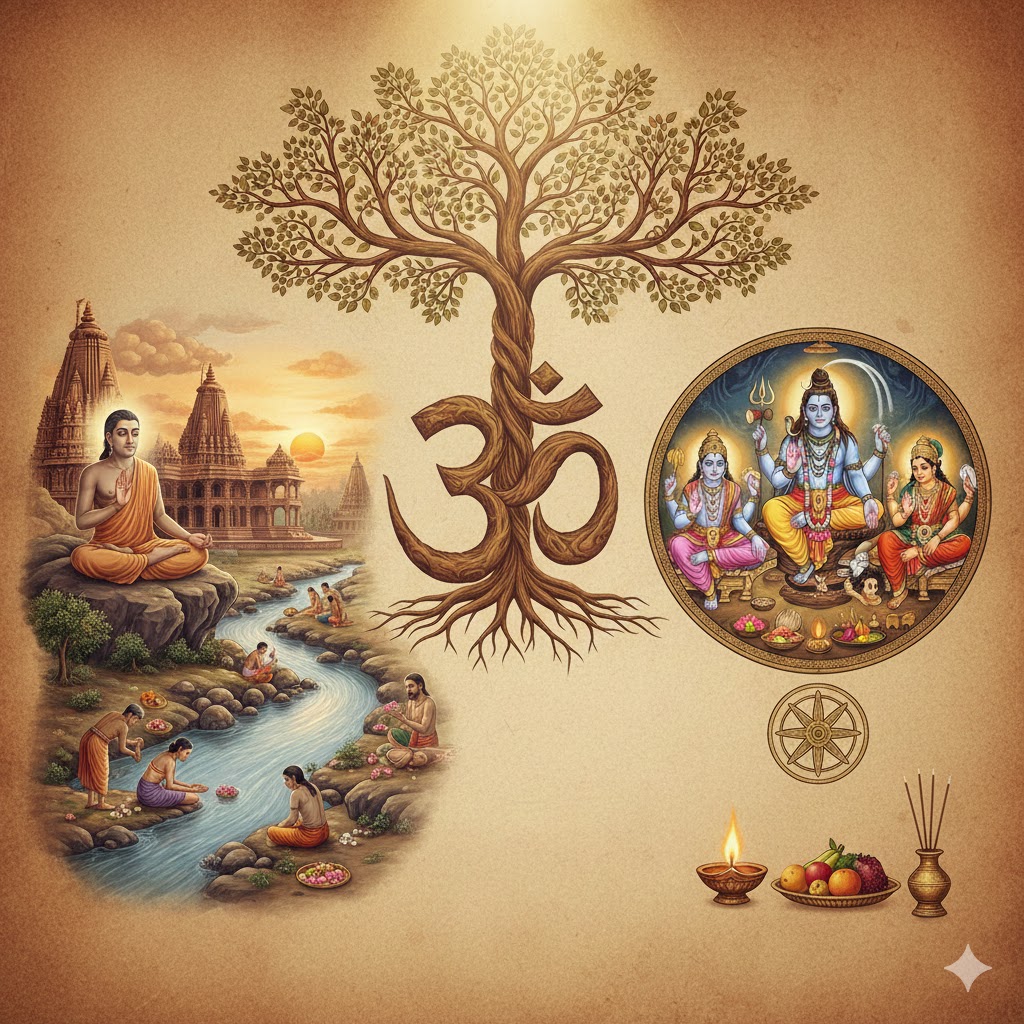
ॐ (Om or Aum) is the most sacred syllable in Hinduism, believed to be the primordial sound that resonated at the creation of the universe. It represents Brahman, the Ultimate Reality, and is considered the root mantra from which all other sounds and languages emerged.
The symbol is composed of three phonetic elements representing various significant triads in Hindu thought:
- A (अ): The waking state and the creator, Brahma
- U (उ): The dream state and the preserver, Vishnu.
- M (म): The deep sleep state and the transformer, Shiva.
The silence following the chant represents the Fourth State (Turiya), or pure consciousness beyond time and space.
What is the meaning of the Swastika in Hinduism? Is it really a Nazi Symbol?
In Hinduism, the swastika is an ancient, holy symbol of auspiciousness, good fortune, and prosperity. The word is derived from the Sanskrit Su (good) and Asti (to exist), roughly meaning “let good prevail”. Its four limbs symbolize the four directions, the four Vedas, the four goals of life (Dharma, Artha, Kama, Moksha), and the four stages of life.
What people often misunderstand: The Hindu swastika is distinct from the Nazi hakenkreuz. The Hindu symbol is typically oriented flat (not at a 45-degree angle), often decorated with four dots, and used on temple entrances, invitations for weddings, and at the start of new business ventures to invoke divine blessings. For Hindus, it is a “Peace Symbol” that represents the seat of God and the movement of the sun.
What are the 16 Sanskaras (Rites of Passage)?
Hinduism marks the journey of life through sixteen major sacraments, known as Sanskaras, which serve to purify the soul and provide social and moral discipline at each stage of development.
| Stage of Life | Major Sanskara | Significance |
| Pre-Birth | Garbhadhana | Ritual to invoke a virtuous soul before conception. |
| Childhood | Jatakarma | Welcoming the newborn; whispering mantras into the ear. |
| Childhood | Namakarana | Naming ceremony, typically held on the 11th or 12th day. |
| Education | Upanayana | Sacred thread ceremony; initiation into formal Vedic study. |
| Adulthood | Vivaha | Marriage; seen as the most important social sacrament. |
| Final Rite | Antyesti | Funeral rites; facilitating the soul’s transition from the body. |
Why is the cow considered sacred in Hindu tradition?
What people often misunderstand: Hindus do not “worship” cows as gods. Instead, they revere the cow as a sacred symbol of life, non-violence (Ahimsa), and the earth’s generosity. The cow is viewed as a “maternal caretaker” because it provides essential nourishment (milk, butter, yogurt) while taking very little in return (consuming only grass and water).
This reverence reflects a broader Hindu value for all living beings, but the cow is singled out because of its vital role in the traditional agrarian economy and its gentle nature. To a Hindu, the cow represents the “sustenance of life” and is often called Gau Mata (Mother Cow) to honor its role in human survival and well-being.
What are the major Hindu holidays?
Hindu festivals are vibrant celebrations that mark seasonal changes, historical legends, and spiritual victories of good over evil.
- Diwali (Festival of Lights): Commemorates the return of Bhagwan Rama to Ayodhya. Homes are decorated with oil lamps (diyas) to symbolize the inner light protecting against spiritual darkness.
- Holi (Festival of Colors): Welcomes spring and celebrates the triumph of Prahlada’s devotion over the demoness Holika. It is famous for participants throwing colored powders to symbolize unity and the breaking of social barriers.
- Navaratri (Nine Nights): Dedicated to the Mother Goddess Durga and her nine forms. It involves fasting, prayer, and dance (Garba), celebrating the victory of the feminine divine over evil forces.
- Ganesh Chaturthi: A ten-day festival marking the birth of Ganesha, the god of wisdom and the remover of obstacles.
What is the difference between Varna and Jati?
The Indian social structure is composed of two distinct concepts that are often mistakenly used interchangeably: Varna and Jati.
- Varna: A theoretical framework mentioned in the Rigveda describing four broad social classes based on human temperament and occupation. In its original form, it was a flexible classification of roles (priest, warrior, merchant, laborer) intended to ensure social harmony.
- Jati: The thousands of specific, birth-based endogamous groups (occupational communities) that evolved over centuries. Jati is a localized manifestation of social identity, often influenced by regional, linguistic, and political factors.
While Varna was a spiritual and functional model, Jati became the rigid hereditary system often criticized today. Modern scholarship suggests that the British colonial administration further solidified the Jati system by using it as a primary category for censuses and legal classifications, often distorting more fluid social realities.
Is the caste system a religious requirement of Hinduism?
What people often misunderstand: Many scholars and Hindu reformers argue that the rigid caste hierarchy and the practice of “untouchability” are social distortions rather than religious mandates. While ancient texts like the Manusmriti describe social hierarchies, the foundational Shruti texts (the Vedas and Upanishads) emphasize the spiritual equality of all souls (Atman).
Historically, many of Hinduism’s greatest saints and reformers came from the “lower” castes, demonstrating that spiritual realization is independent of social birth. Today, many modern Hindus actively resist caste-based discrimination, citing that the soul has no caste and that a person’s worth should be determined by their Karma (actions) and Guna (qualities) rather than their Janma (birth).
What was the debate between Gandhi and Ambedkar on caste?
In the early 20th century, the struggle for social reform in India was led by two contrasting figures: Mahatma Gandhi and Dr. B.R. Ambedkar.
- Mahatma Gandhi: A “critical traditionalist” who believed the original Varna system was a beneficial division of labour. He sought to reform Hinduism from within, advocating for the abolition of untouchability and renaming the marginalized groups Harijans (children of God).
- Dr. B.R. Ambedkar: A legal scholar and Dalit leader who saw the caste system as inherently oppressive and inseparable from Hindu scripture. He advocated for the “annihilation of caste” through constitutional rights and political representation. Ambedkar famously burned the Manusmriti in protest and eventually converted to Buddhism, leading a mass movement of Dalits seeking spiritual and social freedom.
| Perspective | Mahatma Gandhi | Dr. B.R. Ambedkar |
| View on Varna | Naturally good; needs purification of distortions. | Inherently oppressive; foundational to inequality. |
| Method of Reform | Moral persuasion and “change of heart” among upper castes. | Legal, institutional, and constitutional intervention. |
| Religious Stance | Sought to reform Hinduism from within tradition. | Rejected Hinduism; advocated for conversion to Buddhism. |
Is Yoga a Hindu practice?
Deeply rooted in Hindu scripture and belief, Yoga is an ancient spiritual discipline designed to unite the individual soul with the Divine. While it is widely embraced in the West for its physical and mental health benefits, in its full context, Yoga is a “spiritual technology” found in the Vedas and the Yoga Sutras of Patanjali.
What people often misunderstand: The fact that Yoga is practiced by non-Hindus for health reasons does not change its Hindu roots. To a Hindu, the physical postures (Asanas) are only one limb of an eight-fold path meant to lead to Samadhi, or complete absorption in the Divine. However, Hinduism is an “open-source” tradition, and teachers generally welcome anyone to practice Yoga, regardless of their religious background.
What are the four paths of Yoga in Hinduism?
In the Bhagavad Gita, Bhagwan Krishna describes four primary paths of Yoga, catering to the different temperaments of human beings:
- Bhakti Yoga (The Path of Devotion): Focusing on love and surrendered devotion to a personal God.
- Jnana Yoga (The Path of Knowledge): Using intellectual inquiry and study to realize the identity of the Atman and Brahman.
- Karma Yoga (The Path of Selfless Action): Performing one’s duties without attachment to the results, as an offering to the Divine.
- Raja Yoga (The Path of Meditation): The “royal path” focusing on controlling the mind and senses through disciplined meditation.
What happens to the soul after death in Hinduism?
Death in Hinduism is not an end but a “sacred transition” where the soul (Atman) leaves the temporary physical body to continue its evolutionary journey. According to the Garuda Purana, the soul may spend time in intermediate realms or be immediately reborn, depending on its accumulated karma.
The soul’s journey is guided by its desires and actions. Those who have lived dharmic lives and achieved self-realization may attain Moksha (liberation), merging with the Divine and ending the cycle of birth and death. Those with remaining karma take on a new physical form to continue their spiritual growth.
Do Hindus believe in heaven and hell?
What people often misunderstand: Hinduism recognizes realms of pleasure (Svarga) and pain (Naraka), but unlike Abrahamic traditions, these are not eternal destinations. They are temporary “waiting rooms” where the soul experiences the results of its past actions before being reborn into the cycle of Samsara.
- Svarga (Heaven): A celestial realm where virtuous souls enjoy rewards for their good deeds. Once their “merit” is exhausted, they must return to earth for another birth.
- Naraka (Hell): A place of purification where sinners are tormented to “burn off” their negative karma. The Bhagavata Purana lists various hells like Tamisra (darkness) for those who grab others’ wealth and Andhatamisra for those who deceive others.
Why do Hindus cremate their dead?
Cremation, or Antyesti (the last sacrifice), is the traditional method for disposing of the body in Hinduism. It is believed that the sacred fire (Agni) helps the soul detach from the physical body and its earthly ties, facilitating its transition to the next realm. By reducing the body to its basic elements (earth, water, fire, air, ether), cremation symbolizes the return of the individual to the cosmos.
Following the cremation, the ashes are typically immersed in a sacred river, such as the Ganges, which is believed to purify the soul and aid its journey toward Moksha. This final act represents the merging of the individual with the infinite Divine.
Glossary of 25 Key Sanskrit Terms
- Ahimsa: The principle of non-violence toward all living beings.
- Atman: The individual soul or eternal self.
- Avatar: A divine incarnation of a deity on earth.
- Bhakti: Loving devotion to a personal God.
- Brahman: The impersonal, ultimate Reality or universal consciousness.
- Dharma: Duty, righteousness, and the moral order of the universe.
- Guna: The three qualities of nature: Sattva (purity), Rajas (passion), and Tamas (inertia).
- Guru: A spiritual teacher or guide who reveals the truth to a disciple.
- Ishvara: The personal God with form and attributes.
- Jati: Localized, birth-based community or occupational group.
- Karma: The law of cause and effect governing all actions.
- Maya: The illusion that masks the true nature of reality.
- Moksha: Liberation from the cycle of birth and death.
- Murti: A consecrated icon used in Hindu worship.
- Nirvana: Ultimate liberation or extinction of desire.
- Puja: The ritual act of worship or honoring the Divine.
- Puranas: Ancient texts containing legends and folklore of the deities.
- Rishi: An ancient sage who “saw” the eternal truths of the Vedas.
- Samsara: The continuous cycle of birth, death, and rebirth.
- Sanskara: A sacramental rite of passage marking a life stage.
- Shakti: Divine feminine energy or power.
- Shruti: That which is “heard” – the revealed scriptures (the Vedas).
- Smriti: That which is “remembered” – tradition-based scriptures (the Epics).
- Upanishads: Philosophical texts concluding the Vedas.
- Varna: The theoretical four-fold division of society based on temperament.
FAQs
Q: Is Hinduism the oldest religion?
A: Yes, Hinduism is widely regarded as the world’s oldest living religion, with foundational elements dating back over 4,000 years.
Q: Do Hindus have commandments?
A: Unlike Abrahamic religions, Hinduism offers guidelines rather than absolute commandments. Actions are guided by Dharma and ethical principles like Yamas and Niyamas.
Q: Why do Hindus cremate their dead?
A: Cremation is believed to help the soul detach from its physical form and earthly ties, aiding its journey toward reincarnation or liberation.
Q: Can non-Hindus practice yoga?
A: Yes. While yoga has Hindu roots, it is a universal discipline. Many non-Hindus practice it for physical and mental health.
Q: What is the goal of a Hindu’s life?
A: The ultimate goal is Moksha, or liberation from the cycle of birth and death, achieved through self-realization and union with the Divine.
Conclusion
Hinduism, or Sanatana Dharma, represents a profound and resilient spiritual heritage that has guided millions for over four millennia. By balancing the intellectual rigor of non-dualist philosophy with the emotional resonance of personal devotion, it provides an inclusive framework for every individual to seek their own truth. Whether one is drawn to its ancient rituals, its complex deities, or its universal ethical codes, Hinduism invites a life of deep meaning and purposeful action.
Read More about Hinduism here:
- What is Dharma?
- What are the Schools of Thought in Hinduism?
- How is Hinduism linked to Science?
- What is the relationship between Hinduism and EQ?
- More Articles…
Sources:
- Short answers to real questions about Hinduism – Hindu American Foundation, accessed December 30, 2025, https://www.hinduamerican.org/hinduism-short-answers-real-questions
- Hinduism: Sanatana Dharma or Brahmanical Religion – Scholars Middle East Publishers, accessed December 30, 2025, https://saudijournals.com/media/articles/SJHSS_56_294-297.pdf
- Hinduism or Sanatana Dharma? – Hindu Website, accessed December 30, 2025, https://www.hinduwebsite.com/hinduism/sanatana.asp
- Hinduism – Wikipedia, accessed December 30, 2025, https://en.wikipedia.org/wiki/Hinduism
- Unraveling Misconceptions: Clarifying Hinduism’s Rich and Misunderstood Traditions – HD Asian Art, accessed December 30, 2025, https://www.hdasianart.com/blogs/news/unraveling-misconceptions-clarifying-hinduism-s-rich-and-misunderstood-traditions
- Sanatana Dharma and Hinduism – Boloji, accessed December 30, 2025, https://www.boloji.com/articles/1581/sanatana-dharma-and-hinduism
- Hinduism | Origin, History, Beliefs, Gods, & Facts | Britannica, accessed December 30, 2025, https://www.britannica.com/topic/Hinduism
- 5 Hindu Religious Book Recommendations for Bloggers – Exotic India Art, accessed December 30, 2025, https://www.exoticindiaart.com/blog/5-book-recommendations-for-hindu-religious-book-bloggers/
- Fourteen Questions People Ask about Hinduism…and Fourteen Terrific Answers – Kauai’s Hindu Monastery, accessed December 30, 2025, https://www.himalayanacademy.com/fourteen-questions-people-ask-about-hinduism-and-fourteen-terrific-answers/
- The spiritual philosophy of Advaita: Basic concepts and relevance to …, accessed December 30, 2025, https://pmc.ncbi.nlm.nih.gov/articles/PMC10956581/
- Real Questions – Hindu American Foundation, accessed December 30, 2025, https://www.hinduamerican.org/wp-content/uploads/2020/01/more-short-answers-real-questions-about-hinduism.pdf
- 10 Big Questions About Hinduism, Answered – People | HowStuffWorks, accessed December 30, 2025, https://people.howstuffworks.com/hinduism.htm
- Hinduism – Authoritative Research Guide – Oxford Bibliographies – obo, accessed December 30, 2025, https://www.oxfordbibliographies.com/page/222
- Guide to antyesti: Hindu funeral and mourning rituals | Empathy, accessed December 30, 2025, https://www.empathy.com/funeral/funerary-and-mourning-practices-in-hindu-tradition
- Caste system in India – Wikipedia, accessed December 30, 2025, https://en.wikipedia.org/wiki/Caste_system_in_India
- The History of Hindu Funeral Practices: Ancient Roots and Modern Adaptations, accessed December 30, 2025, https://www.asianindianfuneralservice.com/blog/blog/the-history-of-hindu-funeral-practices-ancient-roots-and-modern-adaptations
- Schools of Indian Philosophy – Drishti IAS, accessed December 30, 2025, https://www.drishtiias.com/to-the-points/paper4/schools-of-indian-philosophy
- Jati | Varna System, Caste System & Social Hierarchy – Britannica, accessed December 30, 2025, https://www.britannica.com/topic/jati-Hindu-caste-system
- Varna System vs. Caste System: Origins, Differences, and Modern Relevance – SimplyUPSC, accessed December 30, 2025, https://learn.simplyupsc.com/blogdetails/varna-system-vs-caste-system
- The Best Books on Hinduism – Five Books Expert Recommendations, accessed December 30, 2025, https://fivebooks.com/best-books/hinduism-sravana-borkataky-varma/
- Hinduism 101 – Hindu American Foundation, accessed December 30, 2025, https://www.hinduamerican.org/hinduism-101
- 14 Questions People Ask About Hinduism, accessed December 30, 2025, https://www.himalayanacademy.com/media/books/insight_2022-01_fourteen-questions/insight_2022-01_fourteen-questions.pdf
- 14 Frequently Asked Questions – Hinduism Today, accessed December 30, 2025, https://www.hinduismtoday.com/hindu-basics/14-faq/
- 10 Common Myths About Hinduism – Divinesansar, accessed December 30, 2025, https://divinesansar.com/blogs/beliefs/10-common-myths-about-hinduism
- Dvaita Vedanta – Wikipedia, accessed December 30, 2025, https://en.wikipedia.org/wiki/Dvaita_Vedanta
- Schools of Vedanta – Unacademy, accessed December 30, 2025, https://unacademy.com/content/upsc/study-material/philosophy/schools-of-vedanta/
- Interpretations of the Self in Hindu Philosophy: Advaita vs. Dvaita – IJFMR, accessed December 30, 2025, https://www.ijfmr.com/papers/2024/5/28523.pdf
- Hindu festivals – Navratri, accessed December 30, 2025, https://bharathindusamaj.co.uk/hindu-festivals
- What are some major misconceptions to explore about Hinduism (for a book)? – Reddit, accessed December 30, 2025, https://www.reddit.com/r/hinduism/comments/1i2y8s3/what_are_some_major_misconceptions_to_explore/
- Not a Hindu, but I have some questions I’d like to ask : r/hinduism – Reddit, accessed December 30, 2025, https://www.reddit.com/r/hinduism/comments/nxviw2/not_a_hindu_but_i_have_some_questions_id_like_to/
- Probably basic question from a non-Hindu : r/hinduism – Reddit, accessed December 30, 2025, https://www.reddit.com/r/hinduism/comments/10ceupa/probably_basic_question_from_a_nonhindu/
- Understanding Hinduism for American Yogis – Asivana Yoga, accessed December 30, 2025, https://asivanayoga.com/blogs/yoga-blog/understanding-hinduism-for-american-yogis
- Ten Questions People Ask About Hinduism…and ten terrific answers, accessed December 30, 2025, https://www.hinduismtoday.com/magazine/april-may-june-2004/2004-04-ten-questions-people-ask-about-hinduism-and-ten-terrific-answers/
- Hinduism 101: Women and Hinduism – Hindu American Foundation, accessed December 30, 2025, https://www.hinduamerican.org/blog/hinduism-101-women-and-hinduism
- HAF’s Diwali Resources & Toolkit – Hindu American Foundation, accessed December 30, 2025, https://www.hinduamerican.org/diwali
- Demolishing Gender Roles within Hinduism – SOCIAL ETHICS SOCIETY – JOURNAL OF APPLIED PHILOSOPHY, accessed December 30, 2025, https://ses-journal.com/wp-content/uploads/2024/06/SES-Journal-Special-Issue-on-Gender-and-Culture-June-2024-Article-2-1.pdf
- Women in Buddhism and Hinduism: A feminist perspective comparative perspectives on gender roles and spirituality – International Journal of History, accessed December 30, 2025, https://www.historyjournal.net/article/343/7-1-4-224.pdf
- Symbols – Hindu symbols are an integral part of Hinduism. As Hinduism is the oldest religion on Earth, it has more numbers of symbols than other religions. Each Hindu symbol has a different meaning and is used on different occasions. – Hindu Temple Nottingham, Cultural Community Centre, accessed December 30, 2025, https://www.hindutemple.org.uk/symbols
- Hindu Symbols | List, Meaning & Significance – Study.com, accessed December 30, 2025, https://study.com/academy/lesson/hindu-symbols-history-types-significance.html
- HINDU SYMBOLS: SWASTIKAS, HAIR, OM, TILAKS – Facts and Details, accessed December 30, 2025, https://factsanddetails.com/india/Religion_Caste_Folk_Beliefs_Death/Hindu_Worship_Customs_and_Practices/entry-8679.html
- What is the significance of the swastika? – Hinduism Stack Exchange, accessed December 30, 2025, https://hinduism.stackexchange.com/questions/158/what-is-the-significance-of-the-swastika
- The 16 Sanskaras: Sacred Rituals that Shape Life in Hinduism | Bharti Sanskriti, accessed December 30, 2025, https://bhartisanskriti.com/culture/the-16-sanskaras-sacred-rituals-that-shape-life-in-hinduism/
- The significance of 16 sanskars in Hindu tradition – International Journal of Sanskrit Research, accessed December 30, 2025, https://www.anantaajournal.com/archives/2025/vol11issue5/PartC/11-4-27-389.pdf
- The 16 Sanskaras in Hinduism – Panditji on way, accessed December 30, 2025, https://panditjionway.com/16-sanskaras-in-hinduism/
- Sanskaras in Hinduism: Meaning, Types, and Spiritual Significance – SimplyUPSC, accessed December 30, 2025, https://learn.simplyupsc.com/blogdetails/hindu-sanskaras-rites-of-passage
- Hindu Festivals and Their Significance – Rudraksha Bazar, accessed December 30, 2025, https://www.rudrakshabazar.com/insight/detail/hindu-festivals
- Diwali – The Festival of Lights and History Behind It 2025 – Pernia’s Pop Up Shop, accessed December 30, 2025, https://www.perniaspopupshop.com/about-occasions/diwali
- The caste system: varna and jati | Intro to Hinduism Class Notes – Fiveable, accessed December 30, 2025, https://fiveable.me/introduction-hinduism/unit-6/caste-system-varna-jati/study-guide/tcwPAYfVpSS7x91h
- (PDF) Complexity of Varna and Jāti: A Relook at the Indian Caste System – ResearchGate, accessed December 30, 2025, https://www.researchgate.net/publication/363738961_Complexity_of_Varna_and_Jati_A_Relook_at_the_Indian_Caste_System
- The Role of Women in Hinduism: Becoming leaders of patriarchal traditions – Blogs at Illinois Wesleyan, accessed December 30, 2025, https://blogs.iwu.edu/span408-mmunoz/files/2017/12/the-role-of-women-in-hinduism.pdf
- Interpretation and Comparative Analysis of Ambedkar and Gandhi’s Definition of Social Justice – Navjyot Publications, accessed December 30, 2025, https://navjyot.net/wp-content/uploads/2025/01/61.pdf
- Gandhi vs Ambedkar, Ideological Differences & Similarities, UPSC Notes – Vajiram & Ravi, accessed December 30, 2025, https://vajiramandravi.com/upsc-exam/gandhi-vs-ambedkar/
- Accepted version (241 KB), accessed December 30, 2025, https://www.repository.cam.ac.uk/bitstreams/90a9356d-4eba-462e-864b-2ab469044f0d/download
- Ideological Convergence’s and Conflicts: A Comparative Analysis of Gandhi and Ambedkar, accessed December 30, 2025, https://www.ijssr.com/wp-content/uploads/journal/published_paper/volume-2/issue-5/IJSSR30611.pdf
- Gandhi’s and Ambedkar’s views on caste: the representation of historical figures in Arundhati Roy’s «The Doctor and the Saint» – Anglais – La clé des langues, accessed December 30, 2025, https://cle.ens-lyon.fr/anglais/litterature/litterature-postcoloniale/gandhi-s-and-ambedkar-s-views-on-caste-the-representation-of-historical-figures-in-arundhati-roy-s-the-doctor-and-the-saint
- Educational Insight: Four Questions People Ask About Hinduism, accessed December 30, 2025, https://www.hinduismtoday.com/magazine/october-november-december-2011/2011-10-educational-insight-four-questions-people-ask-about-hinduism/
- Guide to Antyesti: Hindu Funeral and Mourning Rituals – Carewell Cremations, accessed December 30, 2025, https://carewellcremations.com/guide-to-antyesti-hindu-funeral-and-mourning-rituals/
- Guide: Navigating Hindu Funerals and End of Life Traditions – Buried in Work, accessed December 30, 2025, https://buriedinwork.com/guides/hindu-funerals-and-end-of-life-traditions/
- Complete Guide to 13-Day Hindu Funeral Rites (Antyesti), accessed December 30, 2025, https://swargayatraa.com/the-13-days-of-hindu-funeral-rites/
- Hindu Afterlife Beliefs Explained | PDF | Hell | Penance – Scribd, accessed December 30, 2025, https://www.scribd.com/document/400144701/The-Garuda-Purana-Introduction-pdf
- Thread – Is there a heaven and hell in Hinduism? – Consensus, accessed December 30, 2025, https://consensus.app/search/is-there-a-heaven-and-hell-in-hinduism/iW_rwuVZRhatEfwoi47aCg/
- What does Hindu doctrine tell about hell and Heaven? : r/hinduism – Reddit, accessed December 30, 2025, https://www.reddit.com/r/hinduism/comments/mar69t/what_does_hindu_doctrine_tell_about_hell_and/
- Naraka (Hinduism) – Wikipedia, accessed December 30, 2025, https://en.wikipedia.org/wiki/Naraka_(Hinduism)
- Naraka and Svarga: Significance and symbolism, accessed December 30, 2025, https://www.wisdomlib.org/concept/naraka-and-svarga
- Diwali | A Guide to Religious Observances | Resources | Center for Spiritual Life, accessed December 30, 2025, https://www.brandeis.edu/spiritual-life/resources/guide-to-observances/diwali.html